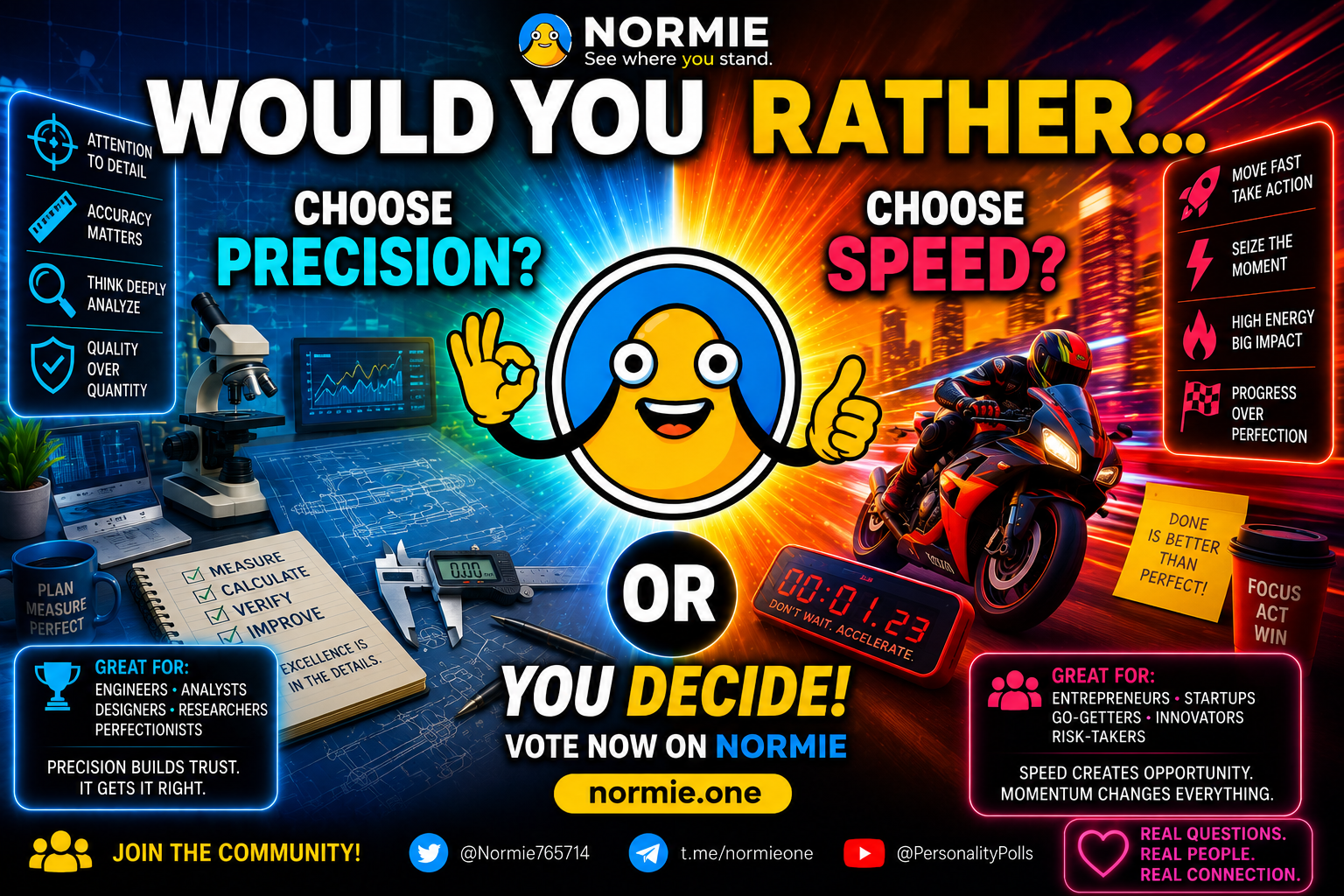
Would You Rather… Choose Precision OR Choose Speed?
At first glance, this seems like a practical question.
Would you rather be incredibly accurate or incredibly fast?
Would you rather take your time and get things right, or move quickly and adapt along the way?
But beneath the surface, this question reveals something much deeper about your personality, leadership style, decision-making process, risk tolerance, and how you approach success.
In many ways, this question reflects one of the oldest tradeoffs in human history.
Virtually every major achievement, business, innovation, military campaign, athletic performance, and personal decision exists somewhere between two competing forces:
Precision and Speed.
The answer you choose may reveal how you navigate life itself.
CLICK HERE TO TAKE POLL
If You Choose: Precision
People who choose precision often value:
Accuracy
Quality
Excellence
Preparation
Reliability
Attention to detail
Their mindset is often:
"Doing it right is more important than doing it fast."
For them, mistakes are costly.
A poorly built bridge collapses.
A bad financial decision can destroy wealth.
A rushed medical diagnosis can have life-altering consequences.
Precision-focused people understand that details matter.
The Precision Personality
Precision-oriented individuals tend to think carefully before acting.
They gather information.
They analyze possibilities.
They consider risks.
They refine their work repeatedly before releasing it.
Their goal isn't simply to finish.
Their goal is to finish correctly.
These individuals often believe:
"Slow is smooth, and smooth is fast."
In other words, taking extra time upfront often prevents bigger problems later.
Strengths of Precision Thinkers
High Quality Results
Their work tends to be dependable and well executed.
Reduced Errors
They catch mistakes others miss.
Strong Credibility
People trust them because they are thorough.
Long-Term Success
Precision often creates durable outcomes.
Potential Challenges
Precision can become perfectionism.
The pursuit of flawless execution can create:
Analysis paralysis
Delayed decisions
Missed opportunities
Fear of failure
Excessive caution
Sometimes waiting for perfect information means arriving too late.
The world often rewards action, even imperfect action.
Personality Indicators
People who choose precision often score higher in:
Conscientiousness
Analytical thinking
Risk awareness
Detail orientation
Long-term planning
They frequently excel in:
Engineering
Medicine
Accounting
Research
Law
Quality control
Strategic planning
If You Choose: Speed
People who choose speed often value:
Momentum
Adaptability
Opportunity
Action
Learning through experience
Innovation
Their mindset is often:
"Done is better than perfect."
For them, action creates information.
You don't learn by thinking forever.
You learn by moving.
They understand that many opportunities disappear if you wait too long.
The Speed Personality
Speed-oriented individuals are comfortable making decisions with incomplete information.
They trust themselves to adapt if things change.
Rather than trying to eliminate uncertainty, they embrace it.
They often believe:
"You can always adjust course later."
In rapidly changing environments, speed can be a superpower.
Strengths of Fast Movers
Momentum
They avoid getting stuck.
Adaptability
They respond quickly to changing conditions.
Innovation
Fast experimentation often produces breakthroughs.
Opportunity Capture
They act before competitors do.
Potential Challenges
Speed carries risks.
Fast movers may sometimes:
Miss important details
Make avoidable mistakes
Create rework
Overlook consequences
Sacrifice quality
A fast decision isn't always a good decision.
Moving quickly in the wrong direction simply gets you lost faster.
Personality Indicators
People who choose speed often score higher in:
Openness
Entrepreneurial thinking
Risk tolerance
Adaptability
Decisiveness
They often thrive in:
Startups
Sales
Entrepreneurship
Trading
Creative industries
Technology
The Psychology Behind the Choice
This question often reflects a deeper psychological tension:
Security vs Opportunity
Precision seeks certainty.
Speed seeks possibility.
Precision asks:
"How can I avoid mistakes?"
Speed asks:
"How can I capture opportunities?"
Both approaches solve different problems.
Neither is inherently superior.
The best approach depends on context.
Where Precision Wins
Precision dominates when mistakes are expensive.
Examples include:
Surgery
Aircraft design
Nuclear engineering
Legal contracts
Financial audits
In these environments, one small error can have enormous consequences.
Accuracy matters more than speed.
Where Speed Wins
Speed dominates when opportunities disappear quickly.
Examples include:
Entrepreneurship
Social media
Startups
Trading
Product launches
Innovation
In these environments, waiting too long can be more dangerous than making mistakes.
Execution matters more than perfection.
The Hidden Truth
The most successful people eventually discover something important:
The real goal is not choosing between precision and speed.
The real goal is knowing when to use each.
Elite performers often move through a cycle:
Move quickly.
Learn rapidly.
Improve precisely.
Repeat.
This creates both momentum and quality.
They understand that speed creates opportunities.
Precision captures value.
What Your Answer May Reveal
Choosing Precision Might Suggest:
You value quality over quantity.
You dislike avoidable mistakes.
You trust preparation.
You are thoughtful and deliberate.
You seek mastery and excellence.
Choosing Speed Might Suggest:
You value momentum.
You learn by doing.
You embrace uncertainty.
You are comfortable taking risks.
You believe opportunities favor action.
The Entrepreneur's Dilemma
This question is especially relevant today.
The AI era is accelerating everything.
Products launch faster.
Markets shift faster.
Information spreads faster.
In this environment, many people believe speed is becoming more valuable.
But precision remains critical.
A fast AI system that produces bad results is still bad.
A slow system that never ships is equally problematic.
The future likely belongs to people who can combine both.
Those who move quickly without becoming reckless.
And those who pursue quality without becoming stuck.
The Deeper Question
Perhaps the real question isn't:
"Would you rather choose precision or speed?"
Perhaps it's:
"What scares you more?"
Making a mistake?
Or missing an opportunity?
Precision-focused people often fear failure.
Speed-focused people often fear regret.
One wants certainty before acting.
The other wants action before certainty.
And somewhere between those two approaches lies the sweet spot where extraordinary results are created.
The most successful people aren't the fastest.
They aren't the most precise.
They are the ones who know when to accelerate and when to slow down.
Because life is not simply a race.
And it's not simply an exam.
It's a continuous balancing act between getting it right and getting it done.