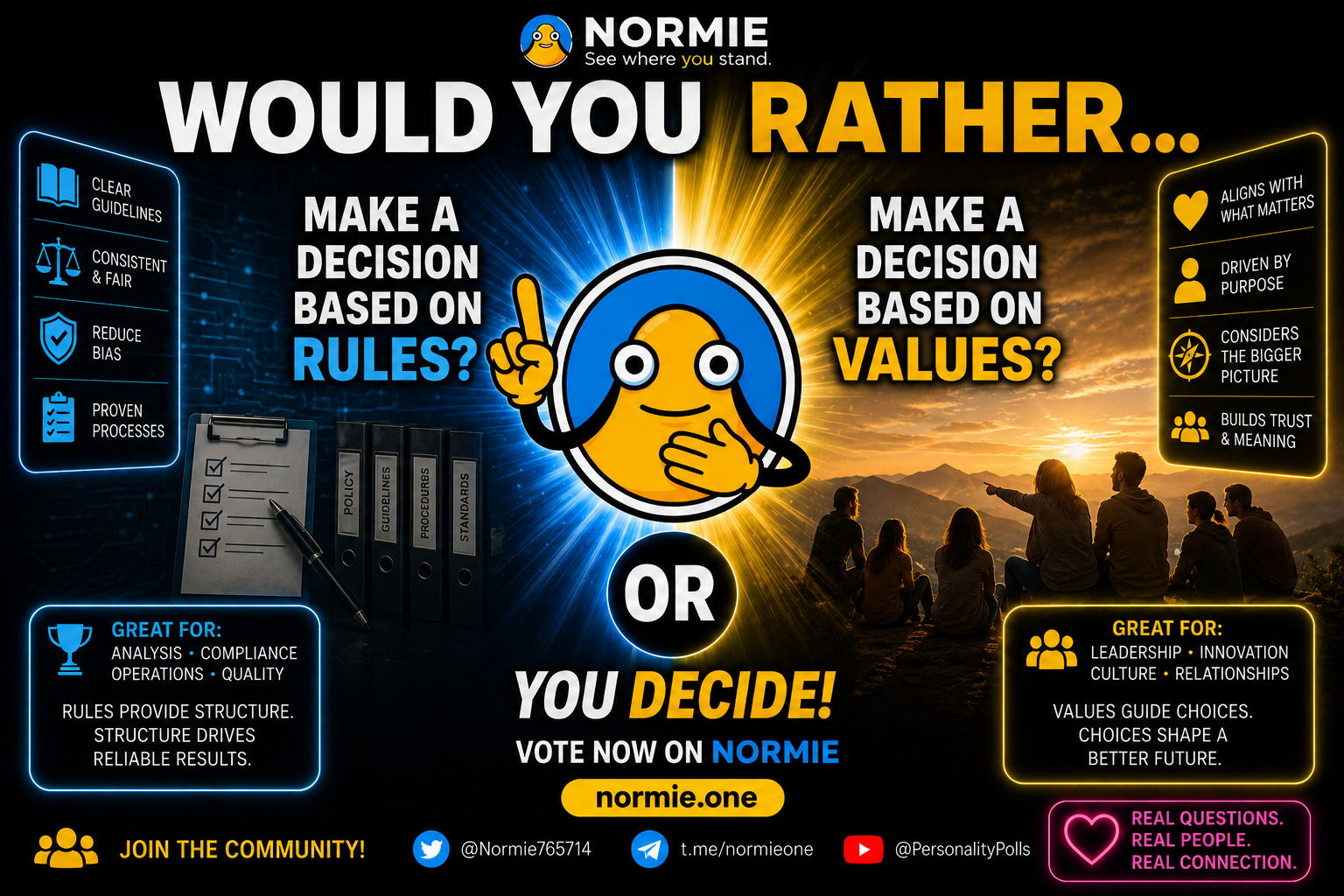
Would You Rather… Make a Decision Based on Rules OR Make a Decision Based on Values?
This question reveals something surprisingly deep about how you navigate life, relationships, leadership, ethics, and decision-making.
At first glance, both options sound similar. After all, rules and values often overlap.
But psychologically, they come from very different places.
CLICK HERE TO TAKE THE POLL
If You Choose: Make Decisions Based on Rules
People who lean toward rules often value:
Structure
Consistency
Fairness
Predictability
Order
Objectivity
Their thinking tends to be:
"If everyone follows the same rules, society works better."
Rules provide a framework that reduces uncertainty and emotional bias.
When facing difficult situations, rule-oriented people often ask:
What is the correct procedure?
What policy applies here?
What is fair for everyone?
What would happen if everyone acted this way?
Strengths of Rule-Based Thinkers
Consistency
They treat people equally rather than making exceptions based on emotions.
Reliability
Others know what to expect from them.
Strong Ethics
Many rule-oriented people have a powerful sense of justice.
Effective Leadership
Rules create systems that scale beyond individual personalities.
Potential Blind Spots
Rules don't always fit every situation.
Life is messy.
People are unique.
Sometimes strict adherence to rules can lead to outcomes that feel unfair or lacking compassion.
Rule-focused individuals may occasionally struggle with:
Flexibility
Adaptability
Emotional nuance
Exceptions to the rule
Personality Correlations
People who choose rules often score higher in:
Conscientiousness (Big Five)
Judging (MBTI)
Duty and responsibility traits
Traditional leadership styles
Risk management tendencies
They often become:
Judges
Engineers
Military leaders
Accountants
Compliance professionals
Operations managers
If You Choose: Make Decisions Based on Values
People who choose values often prioritize:
Meaning
Integrity
Compassion
Purpose
Authenticity
Human impact
Their thinking tends to be:
"The right decision depends on what matters most."
Instead of asking what rule applies, they ask:
What aligns with my principles?
What helps people most?
What feels morally right?
What outcome reflects who I want to be?
Strengths of Value-Based Thinkers
Adaptability
They can adjust when situations don't fit neatly into predefined categories.
Empathy
They often consider the human side of decisions.
Authenticity
Their choices reflect deeply held beliefs.
Visionary Leadership
They frequently inspire others through purpose rather than authority.
Potential Blind Spots
Values can be subjective.
Two people can share good intentions but reach completely opposite conclusions.
Value-driven individuals can sometimes struggle with:
Consistency
Boundaries
Scalability
Making difficult objective decisions
Personality Correlations
People who choose values often score higher in:
Openness
Empathy
Intuition
Idealism
Purpose-driven motivation
They often become:
Entrepreneurs
Visionary leaders
Coaches
Therapists
Artists
Activists
Community builders
The Real Difference
Rules ask:
"What should I do?"
Values ask:
"Who do I want to be?"
Rules focus on behavior.
Values focus on identity.
Rules create order.
Values create meaning.
Rules tell us how to act.
Values tell us why we act.
The Most Effective People Use Both
The highest-performing leaders rarely choose one exclusively.
They combine:
Values as the compass.
Rules as the map.
Values determine direction.
Rules create consistency.
Without values, rules can become rigid bureaucracy.
Without rules, values can become chaos.
The sweet spot is:
Strong principles. Flexible execution.
What Your Choice May Reveal
Choosing Rules Might Suggest:
You trust systems over emotions.
You seek stability and fairness.
You value consistency.
You believe clear standards create better outcomes.
Choosing Values Might Suggest:
You trust personal judgment.
You prioritize meaning over procedure.
You focus on people more than systems.
You believe context matters more than strict rules.
The Deeper Question
Perhaps the most revealing answer isn't choosing one side.
It's asking:
When rules and values collide, which one wins?
That moment reveals your true operating system.
Some people would break a rule to protect a person.
Others would enforce the rule because they believe fairness depends on consistency.
Neither answer is automatically right or wrong.
But your choice says a great deal about how you see responsibility, morality, leadership, and human nature.
And that's exactly why this simple "Would You Rather?" question can reveal so much about who you are.