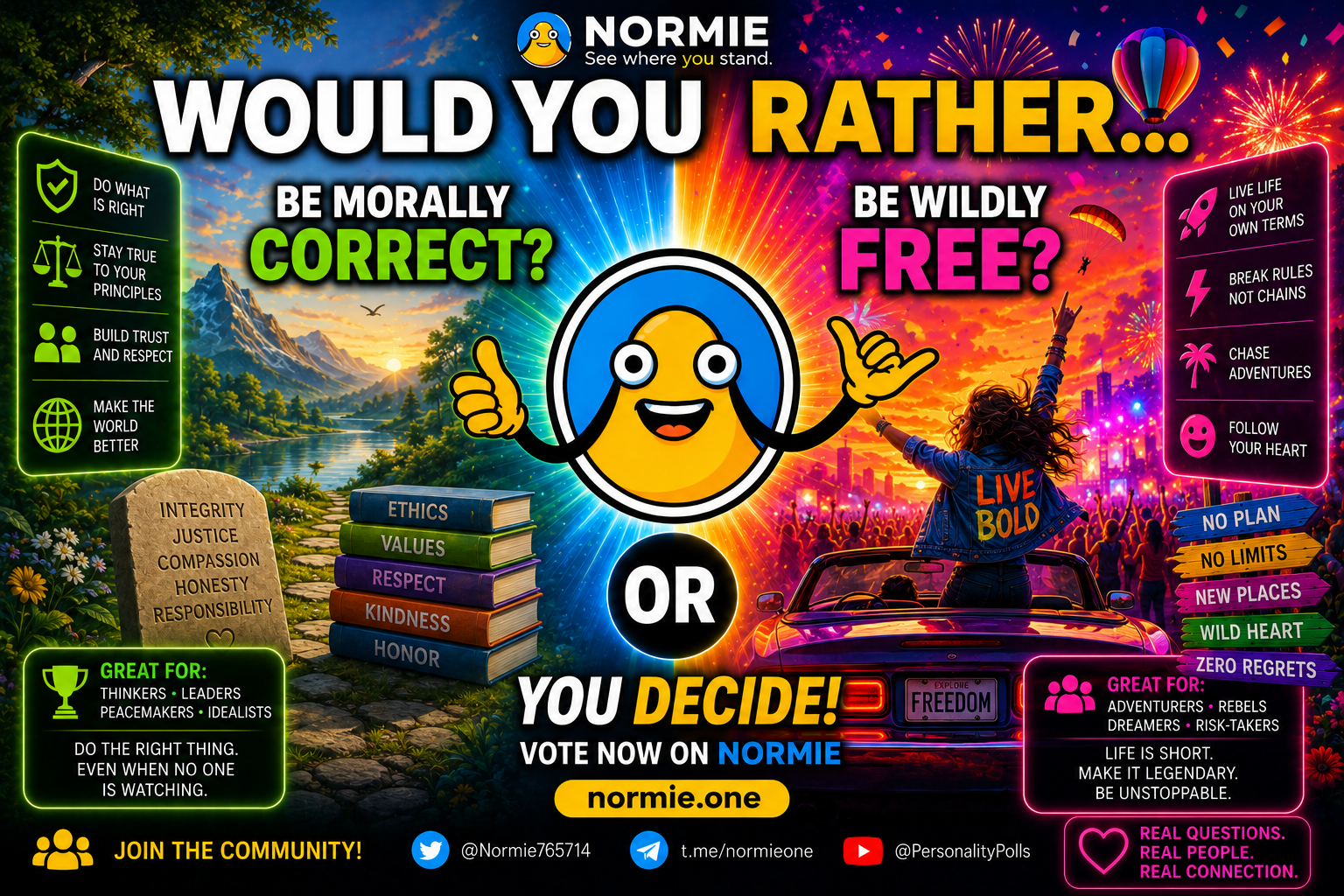
Would You Rather… Be Morally Correct OR Be Wildly Free?
This may be one of the deepest personality questions you can ask.
At first glance, it seems simple.
Would you rather do what is morally right, or would you rather live completely free from limitations, expectations, and rules?
But beneath the surface lies a tension that has shaped philosophy, religion, politics, psychology, and human civilization for thousands of years.
The question isn't really about morality versus freedom.
It's about who gets to decide how you should live.
Your conscience?
Society?
Tradition?
Or yourself?
Your answer reveals a great deal about your values, identity, worldview, and relationship with authority.
CLICK HERE TO TAKE THE POLL
If You Choose: Be Morally Correct
People who choose moral correctness often value:
Integrity
Responsibility
Fairness
Duty
Trust
Social harmony
Their mindset is often:
"Freedom means little if it comes at the expense of doing what is right."
For them, morality provides a compass.
It guides behavior.
It creates trust.
It helps people cooperate and build meaningful relationships.
They believe actions matter.
Character matters.
Principles matter.
The Importance of Moral Foundations
Every civilization depends on shared values.
Honesty.
Compassion.
Respect.
Justice.
Responsibility.
Without these principles, society becomes unstable.
People who prioritize morality often feel that personal freedom should be balanced by accountability.
After all, if everyone acted solely according to their desires, what would prevent selfishness, exploitation, or chaos?
Strengths of Morally Driven People
Trustworthiness
Others know where they stand.
Consistency
Their actions align with their principles.
Strong Relationships
People are drawn to those with integrity.
Purpose
Their lives are guided by values rather than impulses.
Potential Challenges
Morality can become rigid.
People who strongly prioritize being morally correct may sometimes:
Judge others too harshly
Feel guilty unnecessarily
Suppress personal desires
Become overly concerned with approval
Struggle when moral situations are complex
The world is rarely black and white.
Many ethical decisions involve difficult trade-offs.
Personality Indicators
People who choose morality often score higher in:
Conscientiousness
Responsibility
Duty
Reliability
Long-term thinking
They often become:
Teachers
Leaders
Judges
Coaches
Mentors
Community builders
If You Choose: Be Wildly Free
People who choose freedom often value:
Independence
Authenticity
Exploration
Self-expression
Adventure
Individual sovereignty
Their mindset is often:
"Life is too short to live according to someone else's rules."
For them, freedom is one of the highest human values.
The ability to choose.
The ability to explore.
The ability to become whoever they wish to become.
Freedom represents possibility.
It represents self-discovery.
It represents the refusal to be confined.
The Desire for Liberation
Many of history's innovators, artists, explorers, and entrepreneurs challenged accepted norms.
They questioned authority.
They rejected limitations.
They followed their own path.
Without freedom, creativity often dies.
Progress slows.
Innovation disappears.
People who prioritize freedom often believe:
"The greatest risk is living a life that isn't truly your own."
Strengths of Freedom-Oriented People
Authenticity
They tend to live according to their true nature.
Creativity
They challenge assumptions and create new possibilities.
Courage
They are willing to take unconventional paths.
Adaptability
They often thrive in uncertain environments.
Potential Challenges
Freedom without responsibility can become destructive.
Freedom-focused individuals may sometimes:
Resist necessary structure
Ignore consequences
Become impulsive
Struggle with commitments
Prioritize personal desires over collective needs
Absolute freedom can sometimes conflict with the needs of others.
Personality Indicators
People who choose freedom often score higher in:
Openness
Creativity
Independence
Risk tolerance
Entrepreneurial thinking
They are often found among:
Artists
Entrepreneurs
Explorers
Innovators
Creators
Visionaries
The Hidden Conflict
The fascinating thing about this question is that both sides are pursuing something valuable.
The morally correct person seeks:
A good life.
The wildly free person seeks:
An authentic life.
Neither goal is wrong.
The challenge is that they sometimes collide.
What happens when:
Doing the right thing limits your freedom?
Following your dreams disappoints others?
Personal authenticity conflicts with social expectations?
Freedom challenges tradition?
These are some of the hardest decisions humans face.
What History Teaches Us
Throughout history, societies have struggled to balance these two forces.
Too much emphasis on morality and rules can create oppression.
Too much emphasis on freedom can create instability.
Healthy societies require both:
Shared values that create trust
Individual freedoms that encourage innovation
The same is true for individuals.
What This Question Really Reveals
This isn't actually a question about morality or freedom.
It's a question about your deepest source of meaning.
Do you find meaning through:
Living According to Principles?
Or
Living According to Possibility?
One seeks virtue.
The other seeks self-discovery.
One asks:
"What is the right thing to do?"
The other asks:
"What is the most authentic thing to do?"
The Most Fulfilled People Find a Balance
The happiest and most fulfilled people often discover that morality and freedom are not enemies.
In fact, they may need each other.
Freedom without values can become chaos.
Values without freedom can become imprisonment.
The goal is not choosing one at the expense of the other.
The goal is becoming free enough to choose your values consciously.
And principled enough to use your freedom wisely.
What Your Answer May Reveal
Choosing Morally Correct Might Suggest:
You prioritize integrity.
You value responsibility.
You believe actions have consequences.
You seek purpose through principles.
You care deeply about trust and fairness.
Choosing Wildly Free Might Suggest:
You value authenticity.
You resist unnecessary limitations.
You seek adventure and self-expression.
You prioritize personal sovereignty.
You believe life should be lived on your own terms.
The Deeper Question
Perhaps the real question isn't:
"Would you rather be morally correct or wildly free?"
Perhaps the real question is:
"What kind of freedom do you want?"
The freedom to do whatever you want?
Or the freedom to become the person you were meant to be?
Because the most profound freedom may not come from rejecting all rules.
It may come from choosing your values so deliberately that no one can take them away.
In the end, the strongest people are often neither purely moral nor purely free.
They are individuals who possess the freedom to choose their principles—and the courage to live by them.