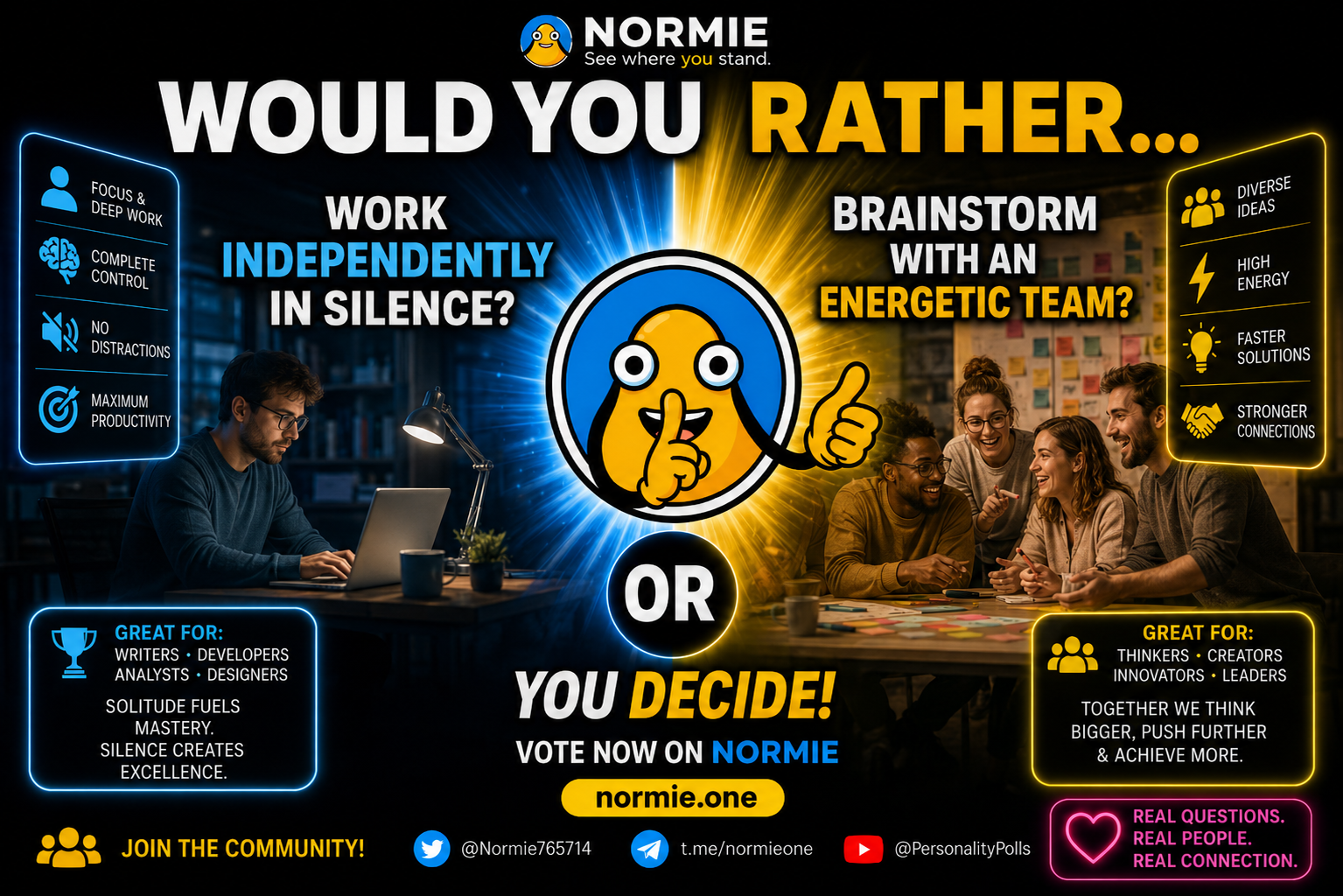
Would You Rather… Work Independently in Silence OR Brainstorm with an Energetic Team?
At first glance, this seems like a simple question about work preferences.
Do you prefer sitting quietly, focused on your own thoughts, or being surrounded by creative people bouncing ideas off one another?
But beneath the surface, this question reveals something much deeper about your personality, thinking style, energy source, and how you create your best work.
The answer often influences your career choices, leadership style, relationships, and even how you solve problems.
CLICK HERE TO TAKE THE POLL
If You Choose: Work Independently in Silence
People who choose independent work often value:
Focus
Deep thinking
Autonomy
Self-reliance
Creativity without interruption
Personal ownership
Their mindset is often:
"My best ideas emerge when I have space to think."
Rather than drawing energy from constant interaction, they gain clarity from reflection.
Silence isn't empty.
It's productive.
It's where ideas are refined, strategies are built, and complex problems are solved.
The Power of Deep Work
Many of history's greatest breakthroughs happened in moments of solitude.
Scientists.
Writers.
Inventors.
Programmers.
Artists.
Often, their most important work occurred away from crowds and distractions.
Independent thinkers tend to enjoy:
Long periods of concentration
Research and analysis
Strategic planning
Self-directed projects
Creative exploration
They often prefer quality conversations over constant collaboration.
Strengths of Independent Workers
Deep Focus
They can enter a flow state and work for hours without distraction.
Original Thinking
Without group influence, they often develop unique perspectives.
Self-Motivation
They don't require external accountability to perform.
Efficiency
Less time spent in meetings often means more time spent creating.
Potential Challenges
Working alone isn't always ideal.
Independent workers may sometimes:
Overanalyze
Become isolated
Miss outside perspectives
Struggle with collaboration
Reinvent solutions others already know
Personality Indicators
People who choose independent work often score higher in:
Introversion
Conscientiousness
Analytical thinking
Strategic reasoning
Self-sufficiency
They are often found among:
Engineers
Writers
Designers
Researchers
Investors
Programmers
Entrepreneurs
If You Choose: Brainstorm with an Energetic Team
People who choose collaboration often value:
Connection
Shared creativity
Collective intelligence
Energy
Momentum
Communication
Their mindset is often:
"Great ideas become extraordinary when people build them together."
For them, creativity is social.
Ideas improve through conversation.
Innovation emerges through interaction.
The Power of Collective Intelligence
Human beings are naturally collaborative.
Many of the world's most successful companies, inventions, and movements emerged from groups rather than individuals.
When talented people challenge and inspire each other:
Blind spots shrink
Creativity expands
Problems get solved faster
New opportunities appear
Team-oriented people often think better out loud than in silence.
Strengths of Collaborative Thinkers
Idea Generation
Discussion sparks creativity.
Adaptability
They can quickly build on feedback.
Communication Skills
They excel at sharing and refining ideas.
Community Building
They naturally bring people together.
Potential Challenges
Collaboration isn't always efficient.
Team-oriented individuals may sometimes:
Get distracted
Depend too heavily on group approval
Experience groupthink
Spend more time discussing than executing
Lose individual focus
Personality Indicators
People who choose teamwork often score higher in:
Extraversion
Social intelligence
Empathy
Communication skills
Collaborative leadership
They are often found among:
Leaders
Coaches
Sales professionals
Community builders
Project managers
Educators
Content creators
What This Question Really Measures
This isn't simply about being introverted or extroverted.
It's about where your best thinking occurs.
Some people think first and speak later.
Others speak first and think through conversation.
Neither is better.
They're simply different cognitive operating systems.
The Solitary Creator
Their formula:
Think → Refine → Share
They generate ideas internally before presenting them.
They often produce highly polished work.
The Collaborative Creator
Their formula:
Share → Discuss → Improve
Ideas emerge through interaction.
They often move faster and iterate more frequently.
The Most Effective People Master Both
The highest performers typically combine both approaches.
They use:
Solitude for Clarity
Time alone helps develop ideas.
Collaboration for Expansion
Other people help improve ideas.
The most successful innovators often alternate between:
Deep individual work
High-energy collaboration
They understand that breakthroughs rarely happen through isolation alone or meetings alone.
They emerge from the combination.
What Your Answer May Reveal
Choosing Independent Work Might Suggest:
You trust your own thinking process.
You value autonomy.
You prefer depth over constant interaction.
You recharge through solitude.
You seek mastery and focus.
Choosing Team Brainstorming Might Suggest:
You gain energy from people.
You enjoy collaborative creativity.
You believe ideas improve through discussion.
You thrive on momentum and feedback.
You value connection and community.
The Deeper Question
Perhaps the most revealing question isn't:
"Do you prefer working alone or with others?"
It's:
"Where do your best ideas come from?"
Some people discover brilliance in silence.
Others discover brilliance in conversation.
And many of the most successful people learn to move between both worlds.
Because the future belongs not only to those who can think deeply alone...
But also to those who can build powerfully together.
That's why this seemingly simple "Would You Rather?" question reveals so much about how you create, collaborate, and ultimately succeed.