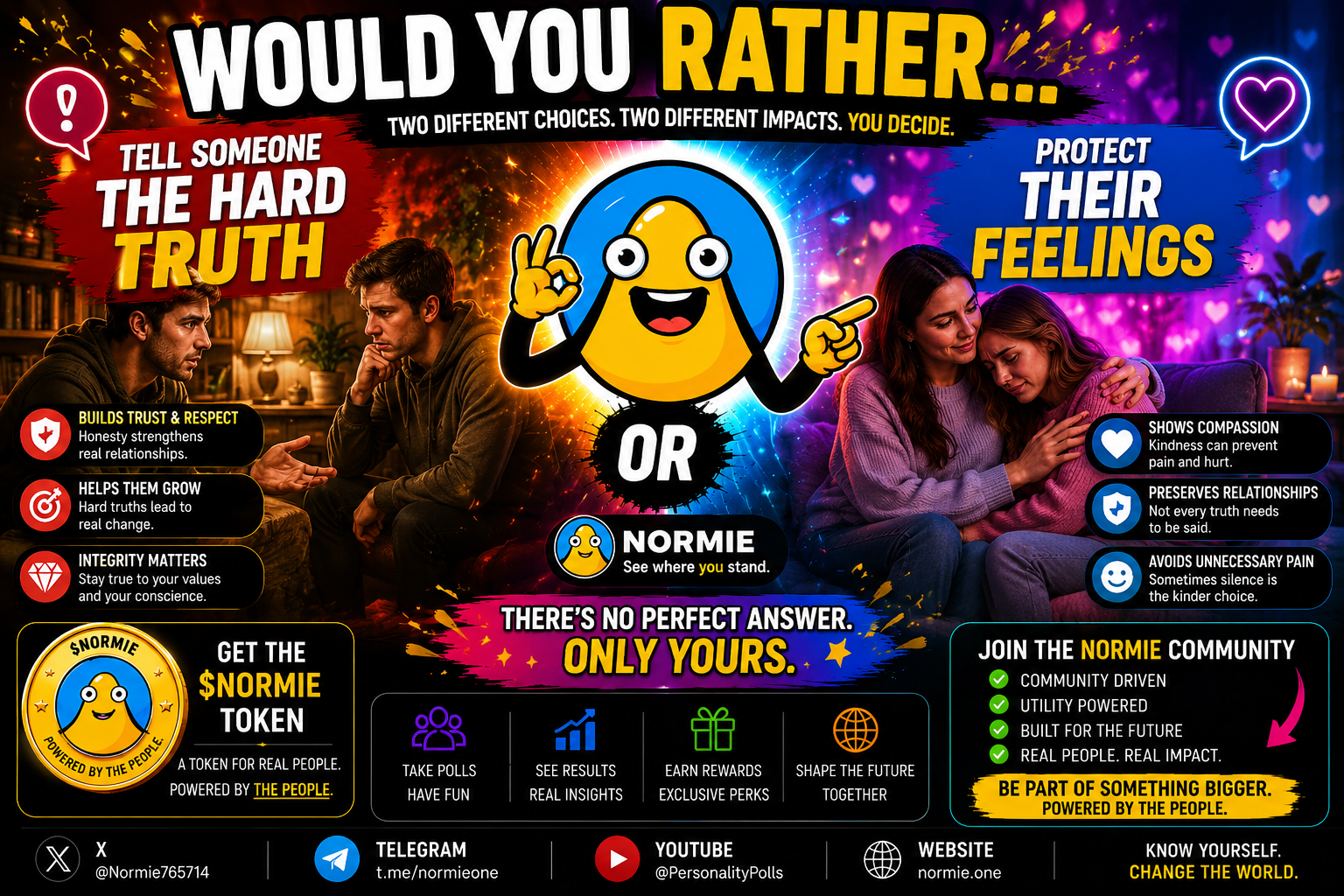
Would You Rather… Tell Someone the Hard Truth OR Protect Their Feelings?
This may be one of the most revealing personality questions you can ask.
At first glance, it seems straightforward.
Would you rather tell someone a difficult truth, even if it hurts them?
Or would you rather protect their feelings, even if it means withholding part of the truth?
Most people immediately feel tension between these two choices.
Because both are rooted in something positive.
One is rooted in honesty.
The other is rooted in compassion.
And that's what makes this question so fascinating.
It's not a choice between right and wrong.
It's a choice between two values that often collide.
Truth and kindness.
Honesty and empathy.
Integrity and harmony.
Your answer may reveal how you navigate relationships, leadership, conflict, trust, and human connection.
CLICK HERE TO TAKE THE POLL
If You Choose: Tell Someone the Hard Truth
People who choose honesty often value:
Truth
Authenticity
Integrity
Accountability
Transparency
Personal growth
Their mindset is often:
"People deserve the truth, even when it's uncomfortable."
For them, honesty is a form of respect.
Sugarcoating reality may feel kind in the moment, but it can prevent growth in the long run.
If a friend is making a serious mistake...
If an employee is underperforming...
If a relationship is struggling...
Truth-focused people believe difficult conversations are necessary.
The Power of Honesty
Many of the most important turning points in life begin with uncomfortable truths.
A coach points out a weakness.
A mentor delivers difficult feedback.
A friend says something nobody else is willing to say.
In the moment, it may hurt.
But years later, it may be exactly what changed everything.
People who choose the hard truth often believe:
"Temporary discomfort is better than living a lie."
Strengths of Truth-Tellers
Integrity
Their words align with reality.
Trustworthiness
People know they are honest.
Growth-Oriented
They encourage improvement rather than avoidance.
Courage
They are willing to have difficult conversations.
Potential Challenges
Truth without empathy can become cruelty.
People who prioritize honesty may sometimes:
Come across as harsh
Damage relationships unintentionally
Underestimate emotional impact
Focus on being right rather than being helpful
Deliver truth without compassion
Not every truth needs to be spoken immediately.
And not every truth needs to be delivered the same way.
If You Choose: Protect Their Feelings
People who choose compassion often value:
Empathy
Kindness
Harmony
Emotional safety
Relationships
Understanding
Their mindset is often:
"How you make people feel matters."
For them, truth is important.
But timing and delivery matter too.
Sometimes people are not ready to hear something.
Sometimes they need support before they need correction.
Sometimes preserving a relationship is more important than winning an argument.
The Power of Compassion
Many people remember how others made them feel far longer than what was actually said.
A gentle conversation can open a door.
A harsh truth can close it.
Compassion-focused individuals often ask:
Is this helpful?
Is this necessary?
Is this the right time?
Will this strengthen or damage the relationship?
Strengths of Compassionate Protectors
Empathy
They understand emotional impact.
Relationship Building
They create trust and safety.
Emotional Intelligence
They read situations well.
Supportiveness
People often feel understood around them.
Potential Challenges
Compassion without honesty can become avoidance.
People who prioritize protecting feelings may sometimes:
Avoid difficult conversations
Enable unhealthy behavior
Delay necessary feedback
Struggle with confrontation
Sacrifice truth for comfort
In trying to avoid pain, they may unintentionally prevent growth.
What This Question Really Measures
This question isn't simply about honesty.
And it isn't simply about kindness.
It's about which value you prioritize when the two conflict.
The Truth-Oriented Person Asks:
"What needs to be said?"
The Compassion-Oriented Person Asks:
"How will this affect them?"
One focuses on reality.
The other focuses on emotional impact.
Both perspectives are valuable.
And both can become problematic when taken to extremes.
Leadership and Relationships
This question appears everywhere.
Parents face it.
Teachers face it.
Managers face it.
Partners face it.
Friends face it.
Great leaders often struggle with balancing:
Honesty and encouragement
Accountability and support
Transparency and sensitivity
The strongest leaders don't choose one over the other.
They learn how to combine both.
The Most Effective People Use Both
The most emotionally intelligent people understand something powerful:
Truth and kindness are not opposites.
The goal is not to choose one.
The goal is to deliver truth with compassion.
The ideal formula is:
High Honesty + High Empathy
Not:
Brutal Honesty
Or
Endless Protection
The best communicators know how to tell difficult truths in ways people can actually hear.
Because truth without kindness creates resistance.
And kindness without truth creates stagnation.
What Your Answer May Reveal
Choosing the Hard Truth Might Suggest:
You value honesty above comfort.
You prioritize growth and accountability.
You believe reality should be faced directly.
You trust people to handle difficult information.
You see honesty as respect.
Choosing to Protect Feelings Might Suggest:
You value empathy and relationships.
You are highly aware of emotional impact.
You prioritize harmony and understanding.
You believe timing matters.
You see kindness as respect.
The Deeper Question
Perhaps the real question isn't:
"Would you rather tell the hard truth or protect someone's feelings?"
Perhaps the deeper question is:
"What does that person need most right now?"
The truth?
Or support?
Because life rarely presents us with perfect choices.
The hardest conversations often require both.
The courage to be honest.
And the wisdom to be compassionate.
The people who master both don't just communicate better.
They build stronger relationships, stronger communities, and stronger lives.
And that may be the real lesson hidden inside this simple "Would You Rather?" question.