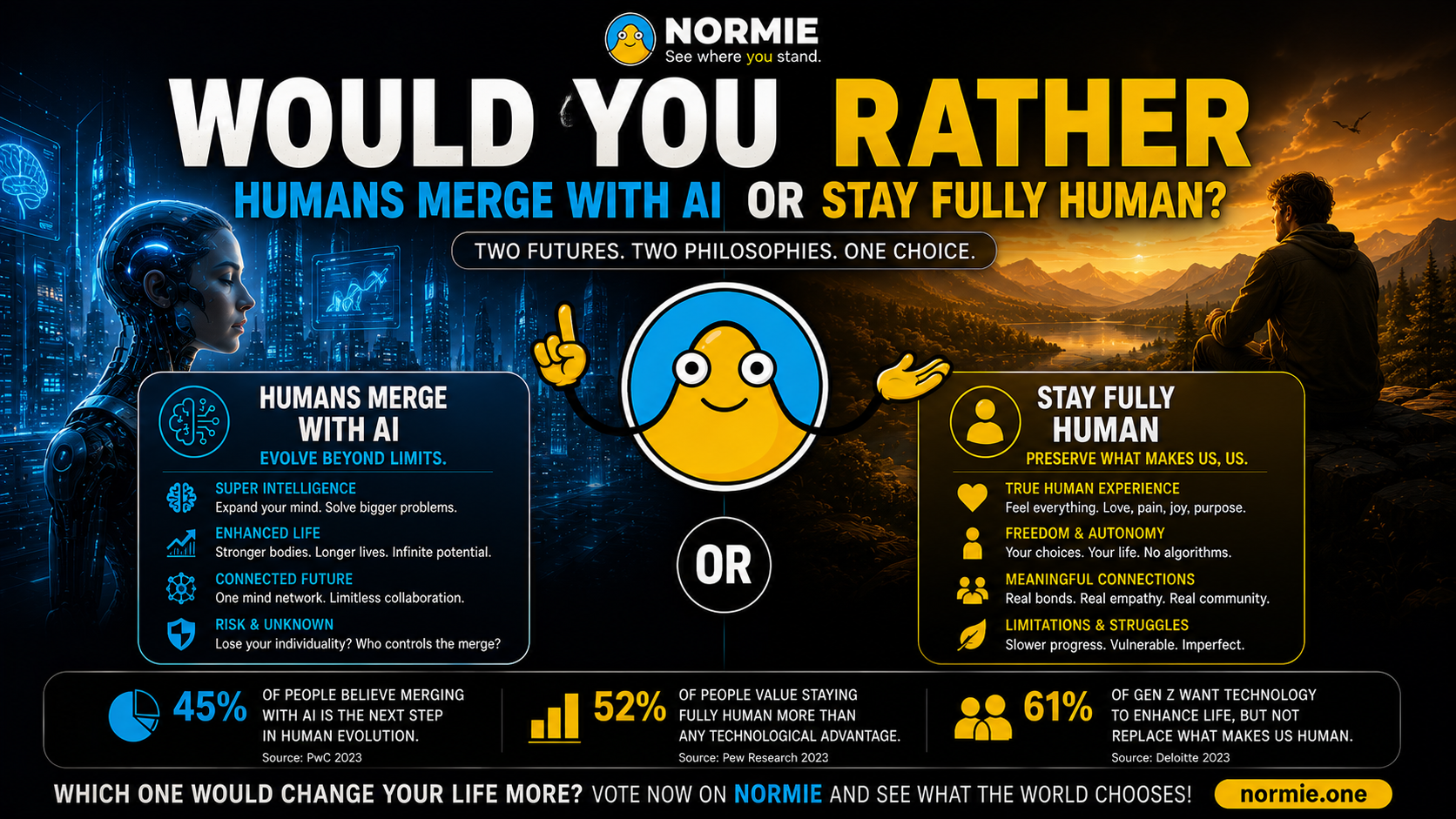
Would You Rather Humans Merge With AI… or Stay Fully Human?
The future may not arrive with explosions, robot wars, or dramatic science-fiction battles.
It may arrive quietly.
One upgrade at a time.
A neural implant that improves memory.
An AI assistant that predicts your thoughts.
A brain-computer interface that expands intelligence.
Genetic optimization.
Emotion-regulating algorithms.
Digital consciousness backups.
Human minds connected directly to artificial intelligence.
And eventually humanity may face one of the biggest philosophical decisions in history:
Would You Rather…
Humans Merge With AI…
OR
Stay Fully Human?
 https://www.normie.one/?startPoll=33f1350e-57fb-45b7-887e-f607ef5845d6
At first, this sounds like science fiction.
But increasingly, it sounds like a real future scenario.
And the answer people choose may reveal how they define:
identity
consciousness
freedom
progress
suffering
meaning
and what it truly means to be human.
The Dream of Human Enhancement
For thousands of years, humans have tried to overcome limitation.
We invented:
tools
medicine
language
writing
computers
the internet
artificial intelligence
Technology has always acted as an extension of the human mind.
AI may simply be the next stage of that evolution.
Supporters of human-AI integration believe merging with AI could unlock:
super intelligence
longer lifespans
enhanced creativity
instant learning
disease prevention
emotional regulation
collective intelligence
deeper scientific breakthroughs
To them, refusing enhancement may eventually feel like refusing electricity or the internet.
They see AI not as a threat…
but as humanity’s next evolutionary leap.
The Rise of the “Post-Human” Future
Some futurists believe humans are approaching the beginning of a “post-human” era.
In this future:
brains connect directly to machines
memory expands digitally
language barriers disappear instantly
AI becomes integrated into thought itself
biological limitations fade
consciousness may partially exist online
Instead of humans using technology externally…
technology may become internal.
The line between:
human
machine
intelligence
and identity
could slowly disappear.
Why the Idea Feels Both Exciting and Terrifying
Humans are naturally conflicted about radical technological change.
Every major advancement in history created both:
optimism
and fear
AI amplification promises incredible benefits:
solving diseases
accelerating innovation
increasing intelligence
reducing suffering
enhancing productivity
But it also raises existential questions.
If AI can influence thought itself:
who controls it?
who owns the systems?
what happens to individuality?
can consciousness be manipulated?
does free will weaken?
what becomes “authentic” emotion?
The more humans merge with technology…
the harder it becomes to define where humanity ends and machinery begins.
The Argument for Staying Fully Human
Many people instinctively reject the idea of merging with AI entirely.
Not because they hate technology.
But because they believe human imperfection is essential.
To stay fully human means preserving:
emotional depth
vulnerability
unpredictability
natural relationships
autonomy
struggle
organic consciousness
Supporters of this view argue that:
pain, uncertainty, failure, and limitation are not bugs in the human experience…
they are the very things that create meaning.
Without struggle:
growth changes.
Without mortality:
urgency changes.
Without emotional vulnerability:
love changes.
Some believe that excessive optimization could slowly erase the essence of humanity itself.
The Hidden Fear: Losing Individuality
One of the deepest fears surrounding AI integration is not physical harm.
It’s psychological absorption.
Humans value individuality deeply.
People want:
unique identities
independent thoughts
personal freedom
emotional ownership
But advanced AI systems thrive on:
prediction
optimization
data integration
behavioral modeling
If millions of humans eventually rely on the same intelligence systems for:
decisions
emotions
communication
memory
information
relationships
could society slowly become more psychologically uniform?
The fear is not just becoming weaker.
It’s becoming less uniquely human.
The Generational Divide Is Already Emerging
Interestingly, younger generations are often more open to technological integration.
Why?
Because they already live partially merged with digital systems.
Modern humans already outsource parts of themselves to technology:
memory to smartphones
navigation to GPS
communication to algorithms
social validation to platforms
entertainment to recommendation engines
identity to online profiles
In many ways, humanity has already begun merging psychologically with machines.
The difference is:
the next phase may become biological.
AI Could Become Humanity’s Greatest Tool
Or Its Greatest Dependency
The image’s central tension captures something profound:
Merge With AI:
enhanced intelligence
connected minds
expanded potential
technological evolution
Stay Fully Human:
emotional authenticity
freedom
imperfection
independent identity
This reflects one of the oldest tensions in civilization:
Efficiency vs Humanity
The future may increasingly ask:
Should humans maximize capability?
Or preserve natural experience?
And perhaps the most dangerous possibility is not AI becoming evil…
but humans becoming too dependent on it to function without it.
The Strange Irony of Progress
Throughout history, humans created technology to gain more freedom.
Yet many technologies eventually create:
dependence
distraction
surveillance
psychological conditioning
Social media connected humanity…
while increasing loneliness for many.
Smartphones increased convenience…
while fragmenting attention.
AI may amplify this paradox dramatically.
The same technology capable of expanding consciousness could also:
narrow autonomy
centralize power
manipulate perception
weaken independent thought
The future may depend less on AI itself…
and more on how humans choose to use it.
The Spiritual Question No One Talks About
At its core, this debate is not only technological.
It is spiritual and philosophical.
What makes humans valuable?
Is it:
intelligence?
efficiency?
productivity?
optimization?
Or is it:
empathy?
emotion?
consciousness?
imperfection?
love?
mortality?
If humans eliminate suffering entirely…
would meaning itself change?
If intelligence becomes limitless…
does wisdom automatically follow?
These questions may define the next century of civilization.
The Most Likely Future: Hybrid Humanity
The future probably won’t be fully human or fully machine.
It may become a spectrum.
Some people may embrace:
neural enhancements
AI-assisted cognition
genetic optimization
augmented reality integration
Others may reject deep technological dependence entirely.
Society could eventually split into:
hyper-augmented humans
minimally connected humans
privacy-first communities
AI-integrated civilizations
The definition of “human” itself may evolve.
Final Thought
Humans created AI to become more powerful.
But every powerful tool changes the people who use it.
The real question may not be:
“Will AI change humanity?”
Because it already is.
The real question is:
“How much of ourselves are we willing to change in return?”
Because the future may not belong entirely to humans…
or entirely to machines.
It may belong to whatever humanity becomes next.
Would You Rather…
Humans Merge With AI…
OR
Stay Fully Human?
Vote now on Normie — the psychology-powered SocialFi platform exploring human behavior, technology, philosophy, and the future of human consciousness.
Join the community:
X / Twitter @Normie765714
YouTube @PersonalityPolls