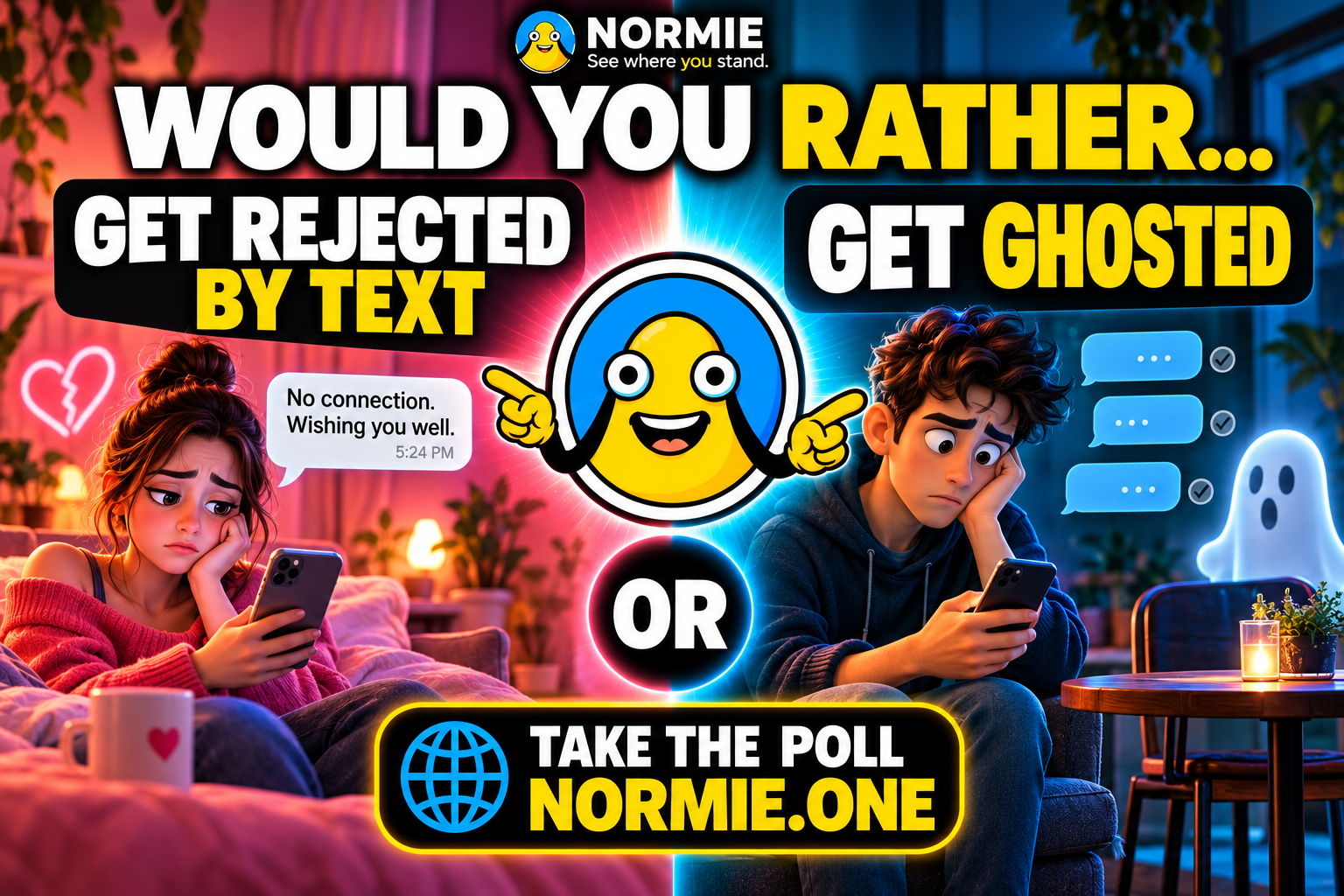
Would You Rather Get Brutally Rejected by Text—or Ghosted Without Explanation?
Your phone lights up. It’s the person you’ve been hoping to hear from.
The message is painfully clear: they’re not interested. Maybe the wording is cold. Maybe they offer an explanation you wish you hadn’t read. Either way, the possibility you were holding onto ends in a few sentences.
Now imagine the alternative.
No message. No explanation. Your last text sits unanswered while you wonder whether they’re busy, overwhelmed, or simply done with you.
Would you rather face a brutal rejection—or be left with complete silence?
Vote in the Normie poll and choose your side.

The Case for Rejection: At Least You Know
There’s something to be said for an answer, even one you hate.
A rejection text closes the door. You can stop drafting follow-ups, checking your notifications, and asking friends to interpret what “a little busy lately” might mean.
You might feel embarrassed, angry, or disappointed. But you have something concrete to respond to.
For people who choose rejection, the argument is simple: knowing it’s over gives you a place to begin moving on.
Still, the word brutally matters.
“I don’t feel a romantic connection” is one thing. A detailed critique of your personality, appearance, or awkward joke over dinner is another. A cruel text can become something you reread, searching for a verdict on yourself that one person was never qualified to give.
Would you still want the answer if you knew it would hurt more than necessary?
The Case for Ghosting: Spare Me the Speech
Ghosting has an obvious drawback: you’re left guessing.
But someone choosing silence might say, “If you don’t want me, I don’t need a paragraph explaining why.”
They would rather draw their own conclusion than receive a message that feels humiliating, patronizing, or painfully rehearsed. They may already see disappearing as a clear enough answer.
There’s also a difference between wanting closure and wanting feedback. You might want to know a connection is finished without wanting an unsolicited performance review of your date.
For these voters, silence could feel easier to leave behind than a sentence they’ll remember for years.
The catch? You don’t always recognize ghosting immediately.
At first, it can look exactly like waiting.
Which Hurts More: the Answer or the Uncertainty?
An unanswered message creates room for several stories:
Maybe their phone broke.
Maybe something happened.
Maybe I should check in one more time.
Meanwhile, a rejection can raise a different set of questions:
Did they mean that?
Was I really that bad?
Why couldn’t they have said it kindly?
Neither option guarantees peace. A direct answer can leave emotional loose ends, and silence can eventually become an answer you accept.
The poll asks you to choose which discomfort you’d rather carry: a painful certainty or an unresolved possibility.
Does Your Answer Change Depending on the Relationship?
Imagine you exchanged six messages on a dating app. Now imagine you dated for six months.
Would you make the same choice?
After a brief conversation, a disappearing match might barely register. After shared routines, personal conversations, and future plans, the same silence can feel much harder to understand.
A few details could completely change your vote:
How long were you involved? One coffee and an established relationship create different expectations.
How harsh is the rejection? Blunt honesty and deliberate humiliation are different experiences.
Would an explanation help? Sometimes it answers a real question. Sometimes it gives you more to argue with.
Do you feel safe? Someone facing threats, coercion, or harassment may reasonably choose to cut off contact without further discussion.
Your answer might depend less on whether you value honesty and more on what you believe the other person owes you in that particular situation.
There Is a Kinder Third Option
The poll makes you pick between two uncomfortable outcomes. Real life often gives us a better choice.
A short message can be honest without being cruel:
“Thanks for spending time with me. I don’t feel the connection I’m looking for, and I wanted to be clear.”
It may still sting. But it communicates a decision without turning someone’s vulnerability into a target.
And if you’re the person receiving the rejection, you don’t have to agree with it, persuade them otherwise, or treat it as a measure of your worth.
One person can decide a relationship isn’t right for them. That decision doesn’t define everything you have to offer.
Your Turn: Pick Your Uncomfortable Ending
Would you choose the text that hurts but ends the guessing?
Or would you take the silence and work out the ending yourself?
Vote now on Normie: Brutal rejection by text or complete ghosting?
Then ask someone you know. Their answer—and the story behind it—might surprise you.