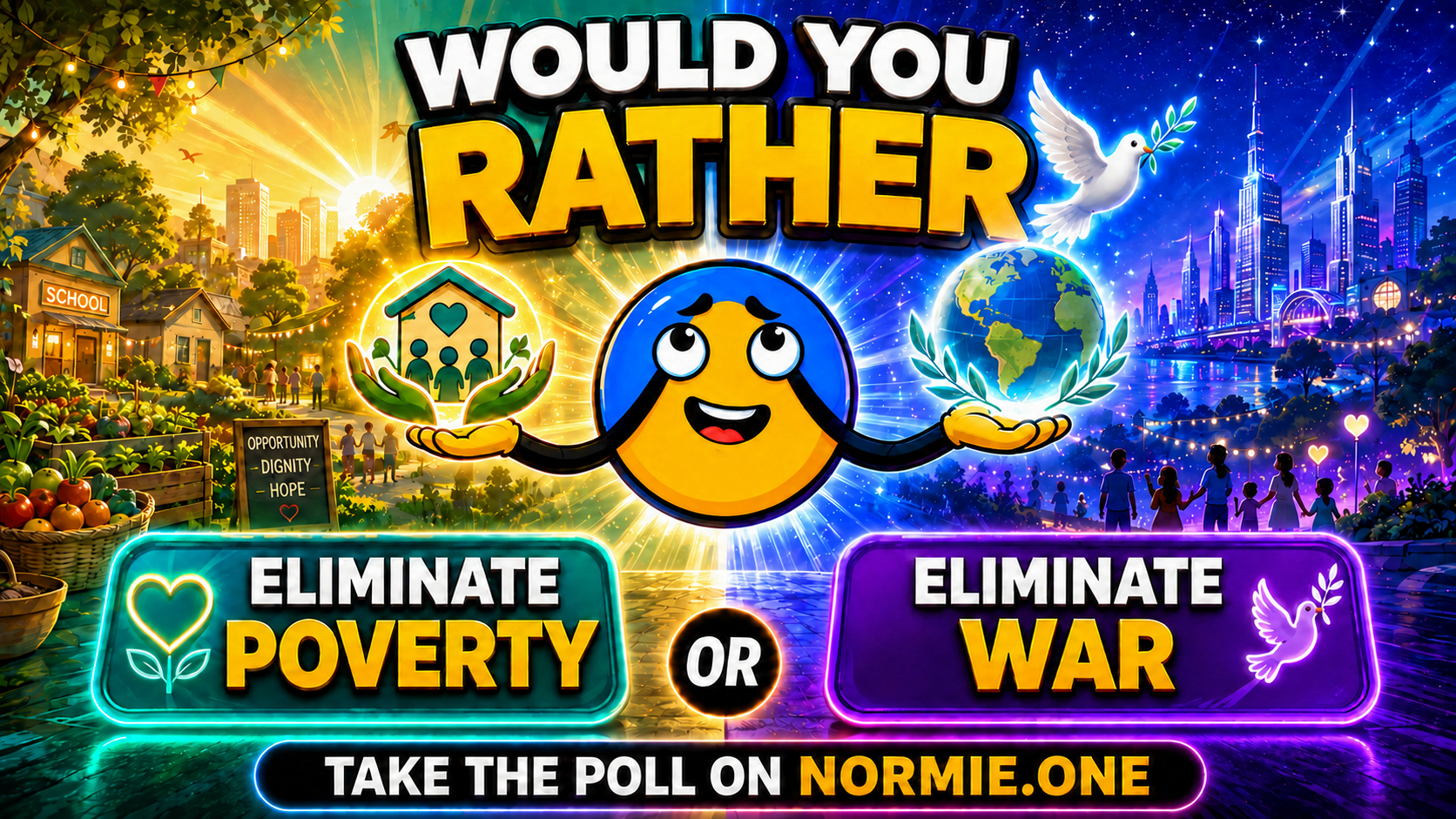
Would You Rather Eliminate Poverty… or Eliminate War?
“A better world is not built only by ending suffering—it is built by ending the conditions that keep creating it.”
Few questions expose humanity’s priorities more clearly than this one.
If you could eliminate poverty forever, billions of people could gain access to the basic foundations of a dignified life: nutritious food, safe housing, healthcare, education, clean water, and a genuine chance to build a future. Children would be less likely to begin life trapped by circumstances they did not choose. Families could spend less time surviving and more time learning, creating, and contributing.
If you could eliminate war forever, humanity could end one of its most devastating cycles. Entire communities would no longer be destroyed by violence. Families would not be forced to flee their homes. Young people would not be sent into conflicts they did not create. Resources now spent on weapons and recovery could be directed toward health, innovation, infrastructure, and opportunity.
Both choices are morally enormous. Both would reshape civilization.
The Case for Eliminating Poverty
Poverty is not simply a lack of money. It is often a lack of choices.
It can mean that an illness becomes catastrophic because medical care is inaccessible. It can mean that a talented child never receives the education needed to develop their potential. It can mean working constantly while remaining unable to build security, save for the future, or escape an environment that limits opportunity.
Eliminating poverty would not automatically eliminate every social problem, but it could transform the starting point for billions of people. It could reduce desperation, expand access to knowledge, and allow more people to participate in the economy and their communities with dignity.
Those who choose to eliminate poverty may believe that lasting peace begins when people have enough. Enough food. Enough safety. Enough opportunity. Enough hope to imagine a future worth protecting.
They may ask: How can humanity become truly peaceful if so many people are still forced to fight simply to survive?
The Case for Eliminating War
War creates suffering at a scale that is difficult to comprehend from a distance.
Its effects are not limited to battlefields. War destroys hospitals, schools, homes, cultural landmarks, supply chains, and economies. It leaves trauma that can echo through generations. Even after the fighting ends, communities may spend decades rebuilding what was lost in months or years of conflict.
Eliminating war would mean more than ending military violence. It would create space for cooperation. Countries could invest more in human progress than in destruction. Families could raise children without fear that political decisions, territorial disputes, or ideological conflicts might suddenly shatter their lives.
Those who choose to eliminate war may believe that peace is the condition that makes all other progress possible.
They may ask: What good is opportunity if a person can lose everything overnight to violence they cannot control?
The Problems Are Connected
The hardest part of this question is that poverty and war are deeply intertwined.
Poverty can contribute to instability, resentment, exploitation, and competition over scarce resources. It can leave populations more vulnerable to manipulation by those who promise power, protection, or revenge.
War, in turn, creates poverty. It destroys livelihoods, interrupts education, displaces families, and makes basic necessities harder to access. A conflict may end on paper while its economic and psychological consequences continue for decades.
This is why the question has no easy answer. Eliminating either problem could create a ripple effect that reduces the other. But the direction of that ripple depends on what you believe lies closest to the root of human suffering.
Do we need to create greater abundance first? Or do we need to create lasting peace first?
What Your Choice May Reveal
Choosing eliminate poverty may suggest that you prioritize human dignity, opportunity, economic fairness, and the belief that people flourish when their basic needs are met.
Choosing eliminate war may suggest that you prioritize safety, peace, stability, and the belief that human potential cannot thrive under the threat of violence.
Both answers come from compassion. Both represent a desire to make the world less cruel and more livable.
Perhaps the deeper lesson is that humanity cannot afford to treat either challenge as someone else’s problem. A future worth building will require systems that create more opportunity, more cooperation, and fewer incentives for desperation and conflict.
Would You Rather Eliminate Poverty… or Eliminate War?
Take the poll on Normie, choose the future you would prioritize, and join the conversation about what humanity should solve first.