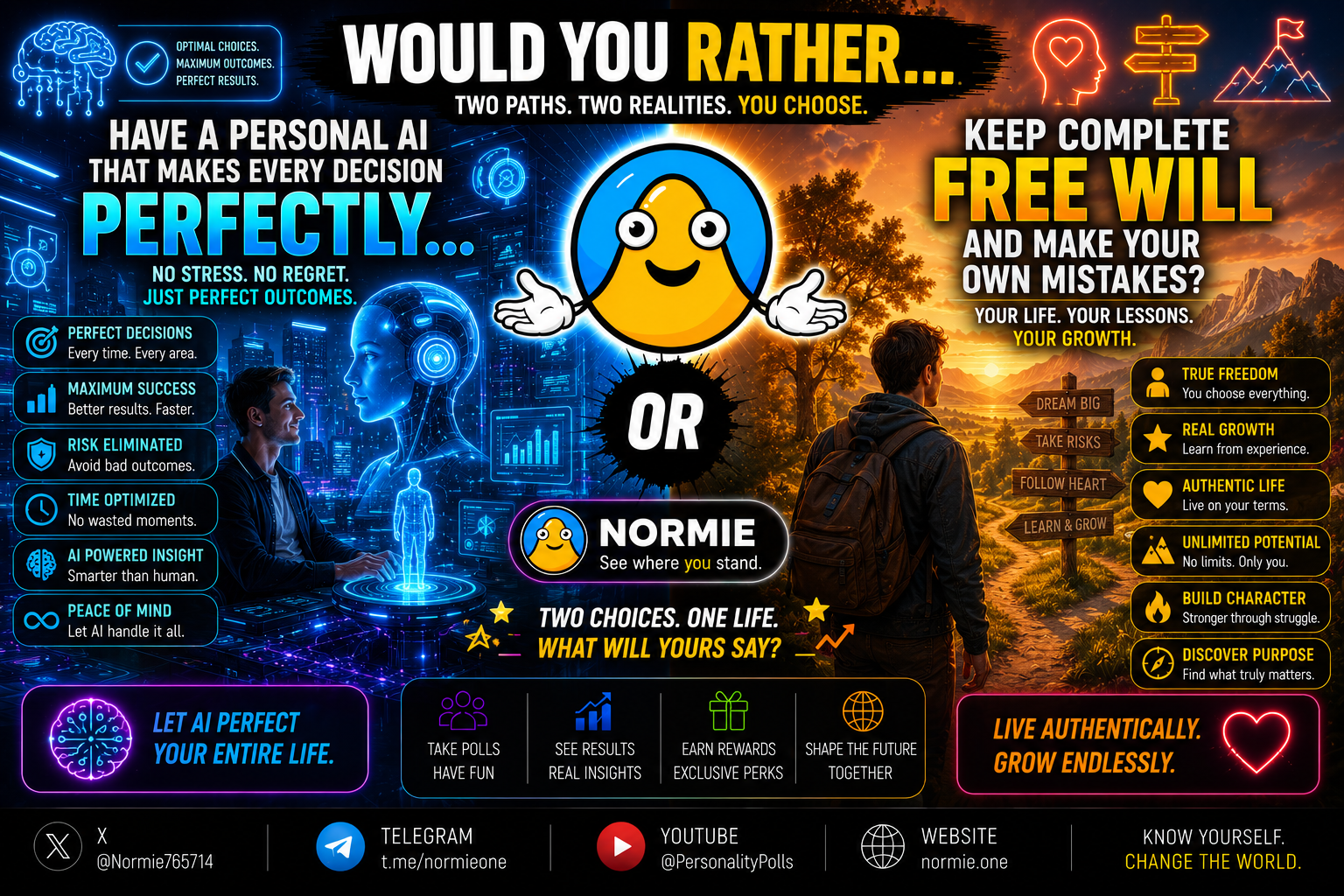
Would You Rather...
Have a Personal AI That Makes Every Decision Perfectly...
OR
Keep Complete Free Will and Make Your Own Mistakes?
The Ultimate Human Dilemma
Imagine waking up tomorrow with access to the most powerful artificial intelligence ever created.
This AI knows everything about you.
It understands your personality better than you do.
It has analyzed your health, finances, relationships, career options, habits, strengths, weaknesses, and future probabilities.
Before every important decision, it tells you exactly what to do.
Not what it thinks is best.
What it knows is best.
The outcome is almost always optimal.
You become wealthier.
Healthier.
More productive.
More successful.
You avoid bad relationships.
You avoid bad investments.
You avoid wasted time.
You avoid failure.
The catch?
You must follow its recommendations.
Every time.
Now imagine the alternative.
No superintelligence.
No perfect predictions.
No guaranteed outcomes.
Only your own judgment.
Your own instincts.
Your own mistakes.
Your own freedom.
Which do you choose?
At first glance, the answer may seem obvious.
But this question reveals something profound about what it means to be human.
The Seduction of Perfect Decisions
Most people spend a large portion of their lives trying to avoid mistakes.
We want certainty.
We want clarity.
We want guarantees.
We want to know:
Which career path to take.
Who to marry.
Where to invest.
Which risks are worth taking.
What decision leads to the best future.
The appeal of a perfect AI advisor is obvious.
Why struggle when a better answer exists?
Why suffer through trial and error?
Why spend years learning lessons the hard way?
In many ways, civilization itself has always been a quest to reduce uncertainty.
Maps reduced the uncertainty of exploration.
Science reduced the uncertainty of nature.
Medicine reduced the uncertainty of disease.
AI may reduce the uncertainty of decision-making.
But there is a deeper question hiding beneath this promise.
What happens when uncertainty disappears?
Why Humans Need Mistakes
Psychologists have long understood that growth often emerges from failure.
The breakup teaches resilience.
The bad investment teaches discipline.
The wrong career teaches self-awareness.
The embarrassing moment teaches humility.
Many of life's most valuable lessons arrive disguised as mistakes.
If an AI prevents every error, it may also prevent many opportunities for growth.
The paradox is that wisdom often comes from decisions that were objectively wrong.
A person who never fails may become efficient.
But do they become wise?
The Psychology of Free Will
Free will is one of the most debated concepts in philosophy and neuroscience.
Many scientists argue that our decisions are heavily influenced by:
Genetics
Environment
Biology
Conditioning
Past experiences
Yet regardless of the scientific debate, humans deeply value the feeling of choice.
People want ownership of their lives.
Even when they make mistakes.
Even when they fail.
Even when the outcome is painful.
Why?
Because autonomy is one of the core psychological needs associated with human well-being.
People do not simply want successful outcomes.
They want agency.
They want authorship.
They want to feel that they are writing their own story.
The Meaning Crisis
Imagine two people.
The first follows perfect AI guidance for 50 years.
Every major decision works out.
Their life is optimized.
The second makes countless mistakes.
Wrong jobs.
Wrong relationships.
Wrong turns.
Unexpected detours.
Yet through these experiences they discover who they truly are.
Which life is more meaningful?
This question reveals a growing challenge of the AI age.
The purpose of life may not be maximizing efficiency.
The purpose of life may be becoming.
Growth often requires uncertainty.
Meaning often emerges through struggle.
Identity often develops through trial and error.
A perfectly optimized life may not necessarily be a fulfilling one.
The Quantum Self Perspective
From the perspective of Quantum Self, human beings are not fixed entities.
They are evolving possibilities.
Every decision creates new pathways.
Every choice opens some doors and closes others.
In many ways, life resembles a field of infinite potential.
The future is not a destination waiting to be discovered.
It is a reality constantly being created.
If an AI chooses perfectly every time, it may lead to a highly optimized future.
But it may also collapse countless alternative possibilities before they have a chance to emerge.
The artist who quit too early.
The entrepreneur who failed three times before succeeding.
The athlete who learned from defeat.
The inventor whose mistake led to a breakthrough.
History is filled with examples where imperfection created innovation.
The Hidden Cost of Perfection
Perfection sounds wonderful.
Until you ask what must be sacrificed to achieve it.
A perfect AI advisor could potentially remove:
Risk
Uncertainty
Failure
Doubt
But it may also reduce:
Exploration
Curiosity
Creativity
Serendipity
Personal discovery
Many of humanity's greatest breakthroughs came from mistakes.
Penicillin was discovered accidentally.
Numerous inventions emerged from unexpected outcomes.
Entire careers and relationships were built from chance encounters.
Life's magic often exists in the unpredictable.
The Rise of AI Co-Pilots
Perhaps the future is not AI versus humanity.
Perhaps it is partnership.
Imagine an AI that does not make decisions for you.
Instead, it helps you think more clearly.
It highlights blind spots.
It analyzes possibilities.
It provides guidance.
But the final choice remains yours.
This model preserves both intelligence and autonomy.
The AI becomes a co-pilot rather than a dictator.
A mentor rather than a master.
A guide rather than a replacement.
What Would You Choose?
Would you trade uncertainty for certainty?
Would you trade mistakes for optimization?
Would you trade freedom for perfection?
Or would you embrace the messy, unpredictable, often painful process of being human?
Perhaps the most important question is not whether AI should make our decisions.
Perhaps it is whether the goal of life is to make perfect decisions at all.
Because sometimes the wrong path leads to the right lesson.
Sometimes the mistake becomes the breakthrough.
Sometimes the detour becomes the destination.
And sometimes what makes life meaningful is not arriving at the perfect answer.
It is discovering who you become while searching for it.
Normie Poll Question
🤔 Would You Rather...
🤖 Have a Personal AI That Makes Every Decision Perfectly...
OR
🧠 Keep Complete Free Will and Make Your Own Mistakes?
There are no right answers.
Only revelations about who you are.
What would you choose?