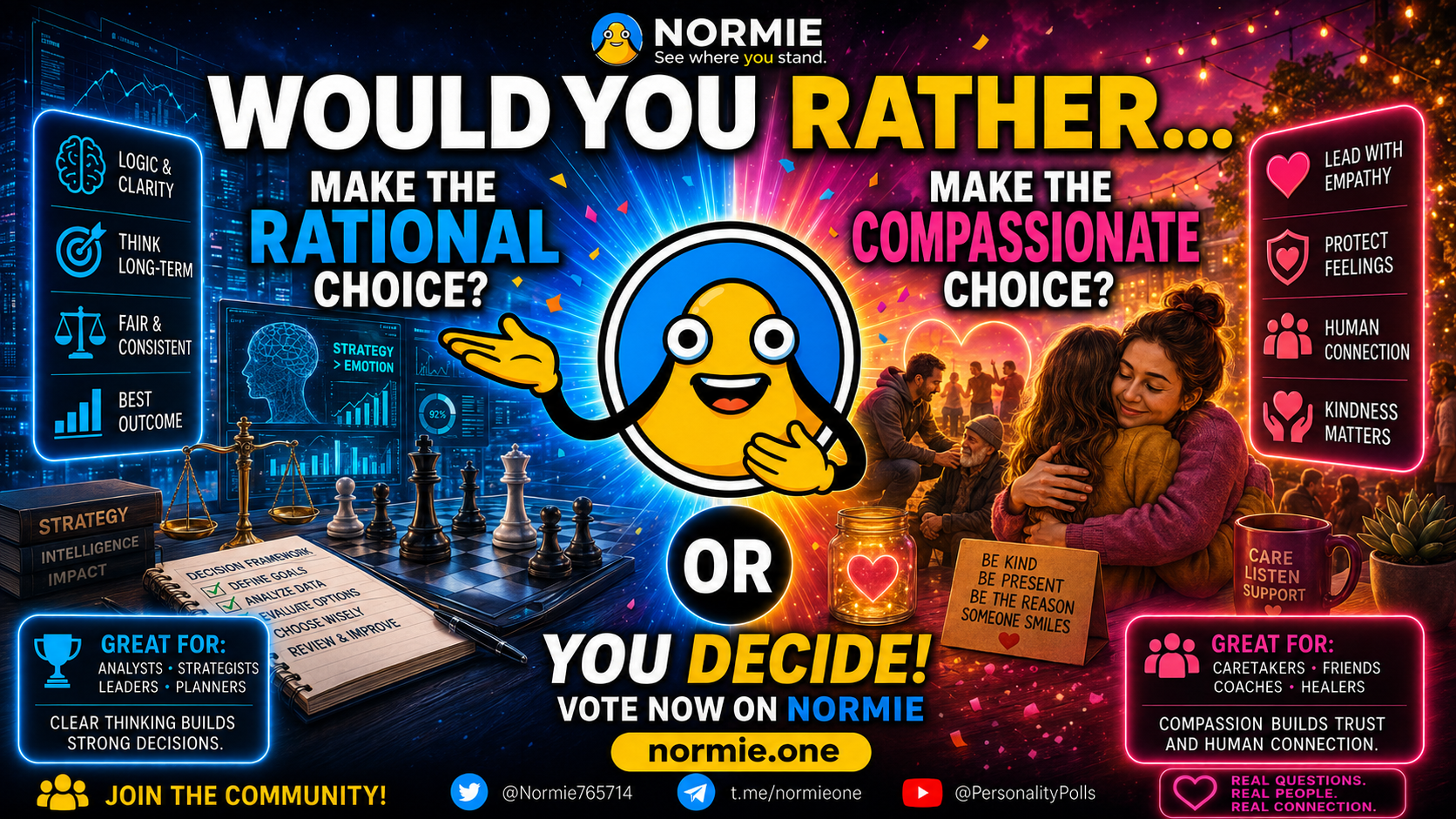
Would You Rather Make the Rational Choice OR Make the Compassionate Choice?
Some questions seem simple until you actually imagine yourself living with the answer.
Would you rather make the rational choice or make the compassionate choice?
At first, the rational choice sounds obvious. Be logical. Use evidence. Stay objective. Make the decision that produces the best outcome.
But then compassion interrupts.
What if the “right” choice hurts someone deeply?
What if the efficient decision damages trust?
What if the logical answer ignores a person’s pain?
What if the kind thing is not the smartest thing?
This is why the question matters. It does not simply ask whether you are smart or caring. It asks what you believe a good decision is supposed to protect.
Results?
People?
Truth?
Harmony?
Fairness?
Feelings?
The future?
Your answer reveals your decision-making style, your moral instincts, and the way you balance head and heart.
The Case for the Rational Choice
People who choose the rational option often value clarity, fairness, consistency, and long-term consequences.
They believe emotions are important, but emotions should not control the decision.
A rational person may ask:
What are the facts?
What outcome helps the most people?
What is sustainable?
What precedent does this set?
What happens if we ignore reality?
The rational choice is powerful because it protects against chaos. It keeps decisions from being driven by guilt, fear, pressure, favoritism, or emotional manipulation.
In leadership, rational thinking matters.
In business, it matters.
In medicine, law, investing, parenting, coaching, and crisis management, it matters.
A purely emotional decision can feel good in the moment but create bigger problems later.
For example, keeping an underperforming employee because you feel bad may hurt the whole team. Lending money to someone repeatedly out of compassion may enable destructive behavior. Avoiding a hard conversation to spare feelings may allow resentment to grow.
Rational people often see this clearly.
They understand that kindness without boundaries can become weakness.
They know that not every painful decision is cruel.
Sometimes the rational choice is the responsible choice.
Sometimes truth is kinder than comfort.
Sometimes the best way to help someone is to stop protecting them from consequences.
The Risk of Being Too Rational
But rationality has a shadow side.
A person can become so focused on logic that they forget they are dealing with human beings.
They may be technically correct but emotionally destructive.
They may solve the problem but damage the relationship.
They may win the argument but lose trust.
This is the danger of cold intelligence.
A rational choice can become a way to avoid vulnerability. It can become a shield against empathy. It can turn people into variables, problems, costs, or inefficiencies.
The rational person may say:
“It is nothing personal.”
But to the person affected, it may feel very personal.
That is the limitation of pure logic.
Human life is not a spreadsheet.
People are not just outcomes.
A decision can be rational and still be incomplete if it ignores dignity, grief, fear, loyalty, love, and emotional reality.
The Case for the Compassionate Choice
People who choose compassion often value care, empathy, forgiveness, emotional intelligence, and human connection.
They believe decisions should not only be correct.
They should be humane.
A compassionate person may ask:
Who gets hurt?
Who needs support?
What pain is hidden here?
How can we protect the relationship?
What would I need if I were in their position?
The compassionate choice is powerful because it sees what logic can miss.
It recognizes that people are not machines. They make mistakes. They carry trauma. They need grace. They need second chances. They need to feel seen.
Compassion can transform a situation.
A struggling employee may become loyal and excellent when supported instead of discarded. A friend who made a mistake may grow when met with honesty and care. A child may learn better through patience than punishment. A team may perform better when people feel safe enough to be human.
Compassion builds trust.
It makes people feel valued beyond performance.
It creates loyalty that rational systems alone cannot produce.
In a world obsessed with efficiency, compassion reminds us that the point of intelligence is not simply to optimize life.
It is to make life more livable.
The Risk of Being Too Compassionate
But compassion also has a shadow side.
Too much compassion without judgment can become enabling.
It can excuse bad behavior.
It can avoid accountability.
It can sacrifice the well-being of many people to protect one person’s feelings.
It can make someone repeatedly choose short-term comfort over long-term truth.
A compassionate person may say:
“I don’t want to hurt them.”
But sometimes avoiding hurt only delays a deeper wound.
If compassion refuses to tell the truth, it becomes sentimentality.
If compassion removes all consequences, it becomes weakness.
If compassion constantly absorbs other people’s chaos, it becomes self-abandonment.
This is why compassion needs structure.
Real compassion is not always soft.
Sometimes the compassionate choice is a boundary.
Sometimes it is a difficult conversation.
Sometimes it is saying no.
Sometimes it is letting someone face reality because reality is the only thing that can help them grow.
The Real Question: What Kind of Person Are You Under Pressure?
This question becomes most revealing when the stakes are high.
It is easy to be rational when nobody is crying.
It is easy to be compassionate when nothing important is at risk.
But what happens when the rational answer hurts someone you love?
What happens when the compassionate answer costs you money, time, status, or opportunity?
What happens when the kind choice creates unfairness?
What happens when the logical choice feels emotionally cruel?
That is where personality shows up.
Some people instinctively detach and analyze.
Others instinctively empathize and protect.
Some people trust systems.
Others trust relationships.
Some people fear being manipulated by emotion.
Others fear becoming cold and uncaring.
Neither side is automatically better.
The deeper issue is whether your default mode makes you wiser or blinds you.
Rationality Without Compassion Becomes Cold
A world ruled only by rational choices would be efficient, but possibly brutal.
People who fall behind might be discarded.
Mistakes might be punished without context.
Relationships might be treated as transactions.
Weakness might be seen as failure.
Grief might be treated as inconvenience.
Everything might work, but few people would feel loved.
That is not wisdom.
That is optimization without humanity.
Compassion Without Rationality Becomes Chaos
A world ruled only by compassion would be warm, but possibly unstable.
Rules might bend constantly.
Accountability might disappear.
Hard truths might be avoided.
Manipulative people might exploit kindness.
Short-term feelings might override long-term consequences.
Everyone might feel understood, but nothing might function.
That is not wisdom either.
That is empathy without structure.
The Best Decisions Usually Need Both
The strongest answer is not always rationality or compassion.
It is integration.
A great decision asks:
What is true?
And who is hurting?
What is fair?
And what is humane?
What solves the problem?
And what preserves dignity?
What are the consequences?
And what does this person need?
The best leaders do this.
The best parents do this.
The best coaches do this.
The best friends do this.
The best partners do this.
They do not abandon logic for emotion.
They do not abandon emotion for logic.
They use rationality to see clearly.
They use compassion to act humanely.
That is the balance.
What Your Answer May Reveal
If you choose the rational choice, you may be someone who values objectivity, responsibility, fairness, and long-term outcomes. You may be good at making hard decisions, staying calm under pressure, and seeing consequences other people avoid.
Your challenge may be remembering that people need more than correct answers. They need care, timing, tone, and emotional respect.
If you choose the compassionate choice, you may be someone who values connection, empathy, mercy, and emotional truth. You may be good at understanding pain, repairing relationships, and making people feel safe.
Your challenge may be remembering that care without boundaries can hurt people too. Sometimes love requires clarity. Sometimes kindness requires courage.
The Normie Perspective
This is exactly the kind of question Normie is built for.
Because it looks simple.
But it reveals something deep.
Two people can answer differently and both be good people. One may be trying to protect truth. The other may be trying to protect the person. One may fear chaos. The other may fear cruelty.
That is what makes the question powerful.
It does not divide people into smart versus kind.
It shows how differently people define wisdom.
Normie turns questions like this into a mirror.
Not to judge people.
But to understand them.
Because everyone is a normie until a question reveals what makes them different.
Final Thought
So, would you rather make the rational choice or the compassionate choice?
The answer depends on what you believe decisions are for.
If decisions are mainly about outcomes, rationality may come first.
If decisions are mainly about people, compassion may come first.
But the most human decisions usually require both.
Rationality asks:
“What is true?”
Compassion asks:
“What does love require?”
Wisdom asks:
“How do we honor both?”