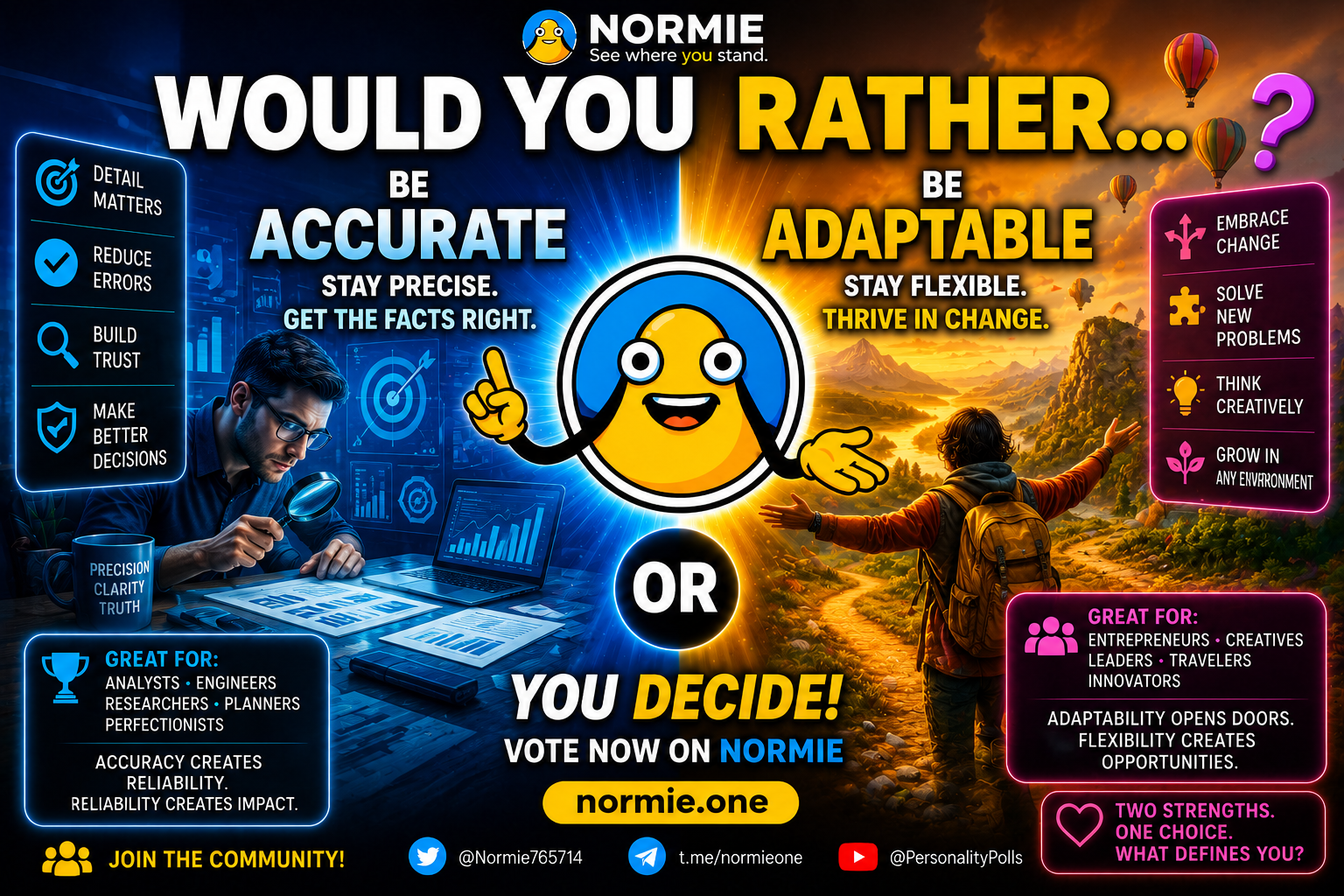
Would You Rather… Be Accurate OR Be Adaptable?
At first glance, this seems like a question about work style.
Would you rather be the person who gets it right…
Or the person who adjusts quickly when everything changes?
But beneath the surface, this question reveals something much deeper about how you approach uncertainty, learning, leadership, and success.
Because in today's world, both accuracy and adaptability have become superpowers.
The challenge is knowing which one to prioritize—and when.
If You Choose: Be Accurate
People who value accuracy often believe that getting the details right is the foundation of excellence.
They tend to value:
Precision
Reliability
Preparation
Consistency
Quality
Expertise
Their mindset is often:
"Do it right the first time."
Accuracy builds trust.
When you're accurate, people depend on your judgment.
They know your work has been checked.
They know your numbers are correct.
They know your advice is thoughtful.
Whether you're an engineer, surgeon, accountant, pilot, scientist, or architect, accuracy isn't optional.
It's essential.
The Power of Precision
History has shown that tiny mistakes can create enormous consequences.
A misplaced decimal.
An overlooked detail.
A coding error.
A misunderstood instruction.
Sometimes success comes down to paying attention when everyone else is rushing.
Accurate people often become the experts others rely on.
They solve problems carefully.
They ask difficult questions.
They verify assumptions.
They build systems that last.
Strengths of Accurate Thinkers
High attention to detail
Strong analytical skills
Reliable execution
Consistent quality
Long-term trust
Potential Blind Spots
Accuracy has a downside.
Perfection can become paralysis.
Highly accurate people sometimes:
Overanalyze decisions.
Delay action waiting for certainty.
Resist change.
Become uncomfortable with ambiguity.
Miss opportunities because they're still preparing.
In a fast-moving world, waiting for perfect information can mean arriving too late.
If You Choose: Be Adaptable
Adaptable people see change differently.
Instead of fearing uncertainty, they embrace it.
They value:
Flexibility
Creativity
Curiosity
Speed
Resilience
Continuous learning
Their mindset is:
"I'll figure it out."
Rather than trying to predict every outcome, they learn by doing.
They pivot.
They iterate.
They improve along the way.
The Power of Adaptability
Today's world changes faster than ever.
Artificial intelligence.
New technologies.
Economic shifts.
Changing careers.
New business models.
Global competition.
The people who thrive aren't always the smartest.
They're often the quickest learners.
Adaptable people understand that being wrong isn't failure.
Refusing to change is.
Strengths of Adaptable Thinkers
Learn quickly
Recover from setbacks
Embrace innovation
Stay calm during uncertainty
Find creative solutions
They don't need every answer before taking the first step.
They trust themselves to learn.
Potential Blind Spots
Adaptability also has risks.
Without discipline, flexibility becomes inconsistency.
Adaptable people may:
Change direction too often.
Chase every new trend.
Lose focus.
Sacrifice quality for speed.
Finish fewer projects.
Being adaptable doesn't matter if nothing ever gets completed.
The AI Era Changes Everything
For decades, expertise meant having the right answers.
Today, AI can generate answers in seconds.
That changes what humans are rewarded for.
Accuracy is increasingly becoming automated.
Adaptability remains deeply human.
The people who succeed won't necessarily know the most.
They'll learn the fastest.
They'll ask better questions.
They'll combine ideas from different fields.
They'll adapt as technology evolves.
The future belongs to continuous learners.
The Investor's Dilemma
Markets provide another example.
Accurate investors spend enormous effort finding the perfect investment.
Adaptable investors know they won't always be right.
Instead, they manage risk.
They change their minds when new evidence appears.
The best investors don't have perfect predictions.
They have flexible thinking.
Leadership Requires Both
Great leaders constantly balance these two traits.
Imagine a CEO during a crisis.
If they're obsessed with accuracy, they may wait too long to act.
If they're only adaptable, they may change direction every week and lose everyone's confidence.
The best leaders combine both.
They gather enough information to make smart decisions.
Then they adapt as reality changes.
Confidence without flexibility becomes arrogance.
Flexibility without accuracy becomes chaos.
What This Question Really Measures
This isn't simply about perfection versus spontaneity.
It's about your relationship with uncertainty.
Accurate people seek certainty before acting.
Adaptable people create certainty by acting.
One minimizes mistakes.
The other maximizes learning.
Neither approach is universally correct.
Every situation demands a different balance.
The Best Performers Develop Both
The highest achievers aren't trapped on one side.
They know when precision matters.
They know when speed matters.
A surgeon needs accuracy.
A startup founder needs adaptability.
A pilot needs precision.
An entrepreneur launching a new product needs experimentation.
Even within the same career, different moments require different strengths.
The secret is knowing which mindset fits the challenge.
What Your Answer May Reveal
Choosing Accuracy Might Suggest:
You value mastery.
You prefer preparation over improvisation.
You build trust through consistency.
You take pride in quality.
You dislike careless mistakes.
Choosing Adaptability Might Suggest:
You embrace uncertainty.
You enjoy learning new things.
You recover quickly from setbacks.
You believe progress beats perfection.
You see change as opportunity.
The Bigger Question
Perhaps the real question isn't:
"Would you rather be accurate or adaptable?"
It's:
"When the world changes, can you remain accurate enough to be trusted… while adaptable enough to survive?"
History suggests that civilizations, businesses, and individuals who refuse to adapt eventually disappear.
But those who adapt without principles often lose their identity.
The future belongs to people who can do both.
Build expertise.
Then stay curious.
Master your craft.
Then keep evolving.
Be precise.
But never become rigid.
Final Thought
Accuracy earns respect.
Adaptability creates resilience.
Accuracy helps you succeed today.
Adaptability helps you succeed tomorrow.
The most successful people don't choose between them.
They know when to rely on precision—and when to embrace change.
That's why this simple "Would You Rather?" question reveals far more than a personality preference.
It reveals how you'll respond when life, technology, markets, and opportunities inevitably change.
Because in a world that never stops evolving, your greatest advantage may not be being right...
It may be your ability to grow.