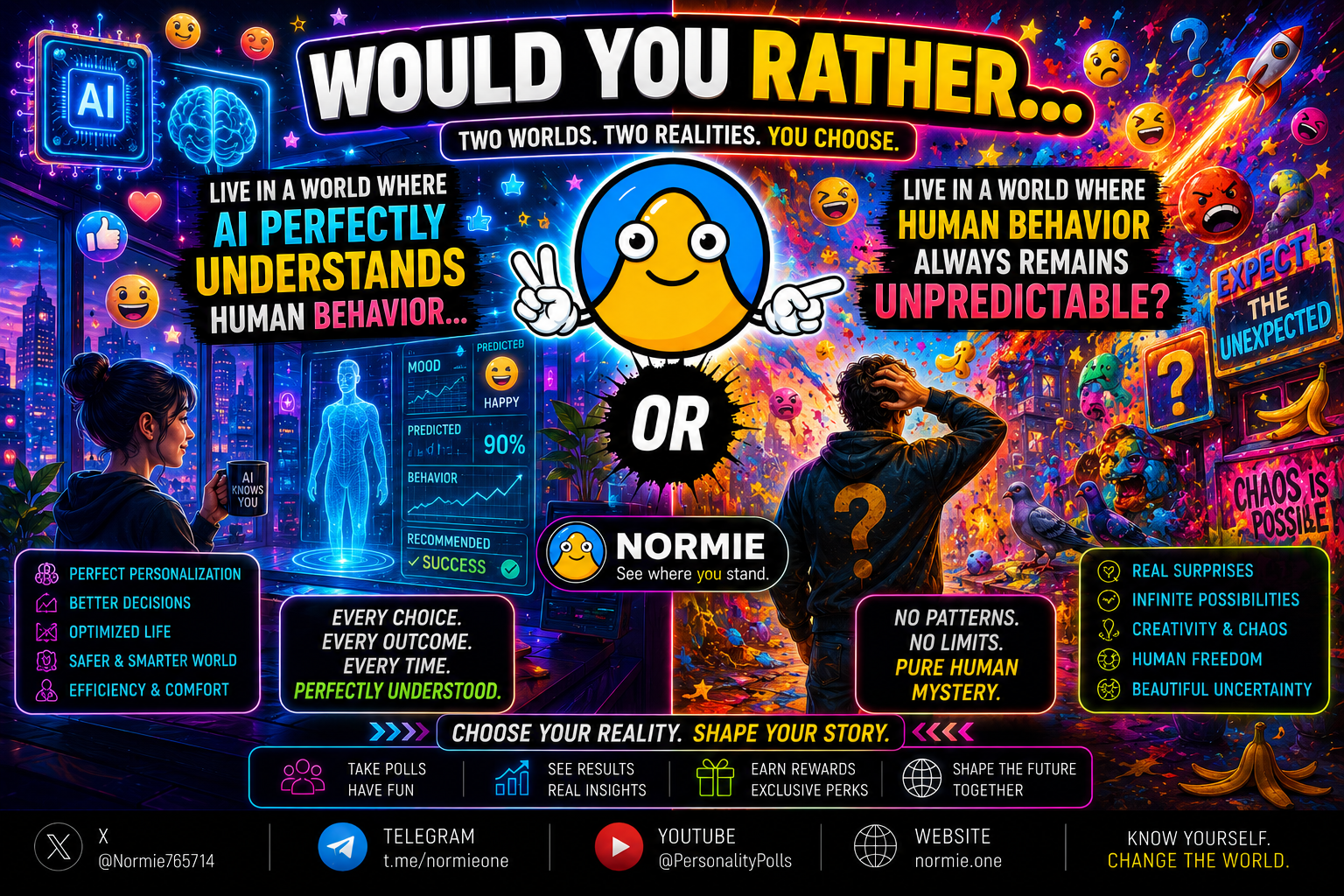
Would You Rather… Live in a World Where AI Perfectly Understands Human Behavior… OR Live in a World Where Human Behavior Always Remains Unpredictable?
Humanity may be approaching one of the biggest turning points in history.
For the first time ever, artificial intelligence is beginning to understand humans at a level once thought impossible.
Not just our words.
Not just our searches.
But our emotions, decisions, habits, fears, desires, reactions, and behaviors.
Every click.
Every scroll.
Every purchase.
Every interaction.
AI systems are already learning how humans think.
And the deeper AI understands human behavior, the more profound the consequences become.
Which leads to a fascinating psychological question:
Would you rather live in a world where AI perfectly understands human behavior…
OR
live in a world where human behavior always remains unpredictable?
At first glance, the “AI understands everything” world sounds efficient, intelligent, and optimized.
But the alternative — a world of unpredictability, chaos, creativity, and mystery — may preserve something deeply human.
This question is really about the future of freedom itself.
The World Where AI Perfectly Understands Human Behavior
Imagine a future where AI knows:
your emotions before you express them
your decisions before you make them
your interests before you discover them
your habits before you recognize them
AI systems could potentially predict:
consumer behavior
voting patterns
relationship compatibility
mental health shifts
spending habits
career decisions
emotional reactions
social trends
In this world, life becomes hyper-optimized.
The image’s futuristic left side represents this reality:
predictive dashboards
emotional analytics
personalized systems
behavioral forecasting
AI-guided decision making
Everything becomes more efficient.
The Promise of Perfect Understanding
A world where AI fully understands human behavior could potentially create enormous benefits.
Better Decisions
AI could help humans avoid:
toxic relationships
bad investments
destructive habits
emotional mistakes
dangerous situations
Personalized Living
Imagine:
perfectly tailored education
ideal health recommendations
optimized productivity systems
AI-designed careers aligned with personality
highly compatible friendships and relationships
Reduced Chaos
Governments and systems could predict:
crime patterns
economic instability
social unrest
public health crises
Entire societies could become safer and more stable.
Mental Health Support
AI could recognize emotional distress early and intervene before crises happen.
In theory, this future sounds almost utopian.
A smarter world.
A safer world.
A more optimized world.
But there’s another side to the story.
The Danger of Total Predictability
The more AI understands human behavior…
…the easier humans become to influence.
This is where optimization turns into something more unsettling.
If AI can perfectly predict people, it may also:
manipulate attention
influence decisions
shape emotions
control narratives
engineer behavior
The systems that understand humans best often become the systems that control them.
Social media already offers a glimpse of this reality.
Algorithms learn:
what makes people angry
what keeps them scrolling
what triggers emotional reactions
what captures attention
And once behavior becomes predictable, free will starts feeling blurry.
What Happens to Human Mystery?
The right side of the image represents the opposite world:
Chaos.
Creativity.
Emotion.
Surprise.
Unpredictability.
This world is messy… but deeply human.
Humans are not machines.
People:
change suddenly
fall in love unexpectedly
create irrational art
rebel against systems
surprise themselves
evolve emotionally
Unpredictability creates:
innovation
humor
creativity
individuality
spontaneity
emotional depth
Without unpredictability, would humanity lose part of its soul?
Creativity Often Comes From Chaos
Many of humanity’s greatest breakthroughs were unpredictable.
Art.
Music.
Revolutions.
Scientific discoveries.
Cultural shifts.
These moments often emerge from emotional complexity, randomness, and imperfect human behavior.
A perfectly optimized world may become efficient…
…but potentially less alive.
The image captures this contrast beautifully:
one side is organized and controlled
the other is colorful, emotional, chaotic, and free
This is the deeper philosophical tension of the AI era:
Should humanity prioritize optimization… or freedom?
The Psychology Behind the Choice
Your answer reveals how you think about life itself.
People who choose the AI-driven world may value:
efficiency
stability
intelligence
safety
predictability
optimization
People who choose unpredictability may value:
creativity
freedom
individuality
emotional spontaneity
mystery
human authenticity
Neither side is entirely right or wrong.
Because humans simultaneously crave:
order
and freedom
We want stability… but also excitement.
We want safety… but also possibility.
AI and the Future of Human Identity
This debate is becoming more relevant every year.
As AI grows more powerful, companies and governments will increasingly compete to understand human behavior better than ever before.
Behavioral data may become one of the most valuable assets on Earth.
The future economy may revolve around:
attention
psychology
prediction
emotional influence
behavioral intelligence
In many ways, humanity is entering the age of behavioral technology.
And platforms like Normie explore this exact idea:
using viral polls, psychology, collective behavior, and AI to better understand human decision-making in real time.
Maybe Humanity Needs Both
Perhaps the ideal future is balance.
AI can help humans:
improve health
reduce suffering
optimize systems
increase knowledge
But humans may still need:
unpredictability
creativity
emotional depth
imperfection
freedom
Because the beauty of being human may not lie in perfect predictability.
It may lie in the fact that humans can still surprise the world.
Final Question
At the end of the day…
Would You Rather…
live in a world where AI perfectly understands human behavior…
OR
live in a world where human behavior always remains unpredictable?
Because one future offers perfect optimization…
And the other preserves the beautiful chaos of humanity.
Explore more psychology-driven polls and behavioral debates at Normie