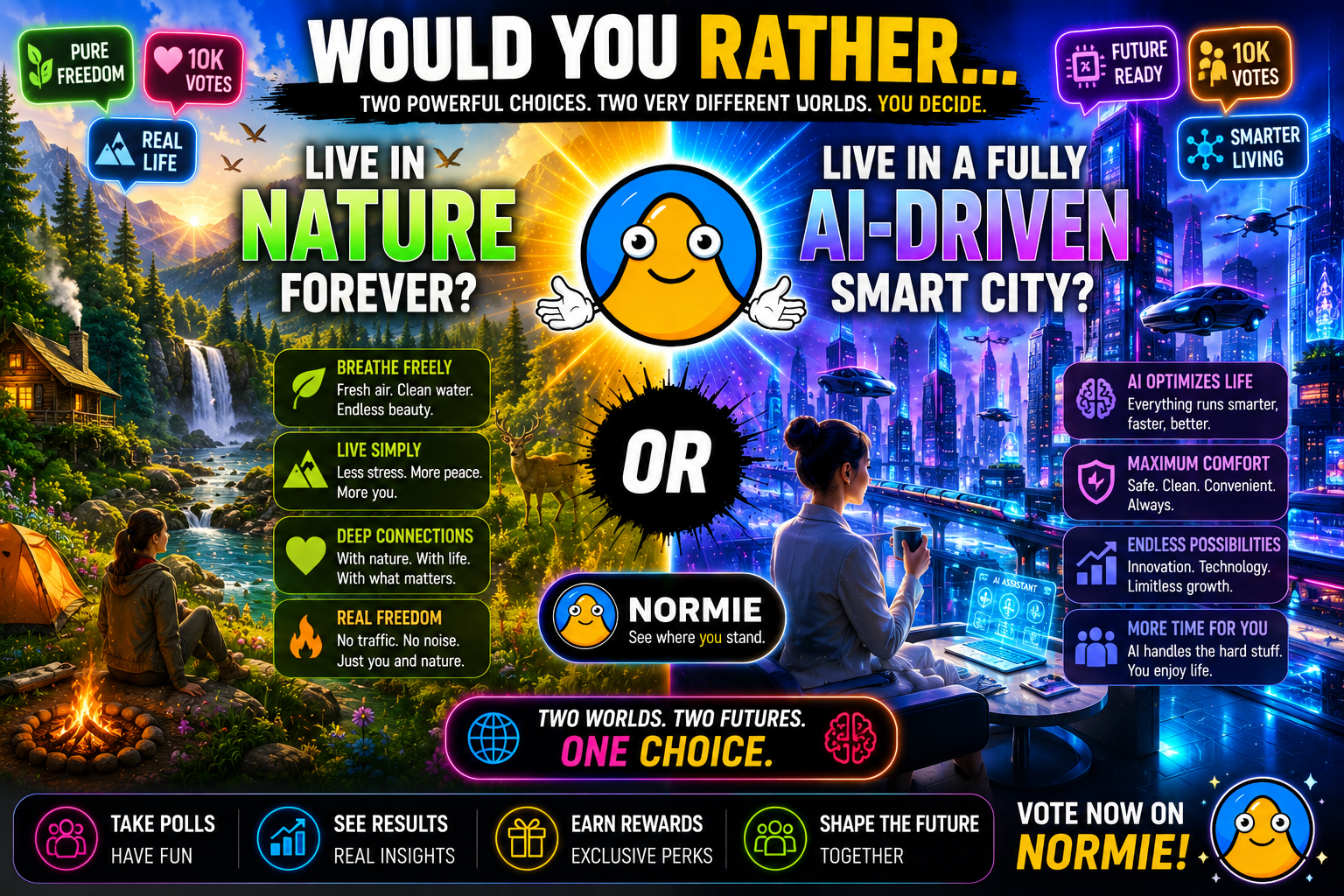
Would You Rather… Live in Nature Forever… OR Live in a Fully AI-Driven Smart City?
Humanity may be heading toward two completely different futures.
One future reconnects us with nature.
The other merges us deeper with technology than ever before.
So the question becomes:
Would You Rather…
Live in Nature Forever…
OR
Live in a Fully AI-Driven Smart City?
At first glance, this feels like a simple lifestyle choice.
Peaceful forests versus futuristic skylines.
Cabins versus smart apartments.
Silence versus hyperconnectivity.
But underneath the surface, this question reveals something much deeper:
What kind of future do humans actually want?
The Dream of Escaping Into Nature
For many people, nature represents freedom.
Freedom from:
noise
stress
traffic
algorithms
notifications
surveillance
endless digital stimulation
Nature slows life down.
It reconnects people with:
sunlight
seasons
stillness
movement
real human presence
simplicity
There’s a reason why so many people fantasize about leaving modern society behind.
The modern world moves fast.
Too fast.
Many people feel overwhelmed by:
social media
endless information
AI automation
digital addiction
burnout culture
hyper-productivity
Nature offers something modern life often cannot:
Mental silence.
Humans Were Never Designed for Constant Stimulation
For most of human history, people lived close to nature.
The human brain evolved around:
rivers
forests
sunlight
animals
weather
natural rhythms
Not constant screens.
Not notifications every five minutes.
Not infinite scrolling.
Modern technology has created extraordinary convenience…
but also extraordinary psychological overload.
Studies increasingly show that time in nature can improve:
anxiety
stress
mood
creativity
focus
emotional regulation
Nature reminds humans they are biological beings…
not just digital identities.
But the AI-Driven Smart City Represents Another Dream
Now look at the opposite future.
The fully AI-driven smart city.
A world optimized by intelligence.
Imagine:
autonomous transportation
AI healthcare systems
instant personalized recommendations
automated homes
intelligent infrastructure
zero traffic
predictive safety systems
hyper-efficiency everywhere
In many ways, smart cities represent humanity’s desire to eliminate friction.
No wasted time.
No inefficiency.
No inconvenience.
AI could optimize:
transportation
energy use
healthcare
communication
education
entertainment
productivity
even relationships
To some people, this future feels exciting.
Not dystopian.
Evolutionary.
Convenience Is Becoming Humanity’s New Addiction
One of the biggest reasons AI-driven lifestyles are attractive is because convenience is psychologically powerful.
Humans naturally move toward systems that reduce effort.
And AI promises to automate almost everything:
scheduling
shopping
driving
communication
decision-making
work itself
The future smart city could become a place where humans spend less time surviving…
and more time creating, relaxing, or exploring.
But there’s also a hidden danger.
The more intelligent systems become…
the more dependent humans may become on them.
The Fear of Losing Humanity
Critics of hyper-technological futures worry about something deeper than convenience.
They worry about disconnection.
What happens when:
AI replaces human interaction?
algorithms shape every decision?
automation removes struggle entirely?
nature becomes secondary to simulation?
Some fear humans could lose:
independence
resilience
emotional depth
attention spans
authentic connection
A perfectly optimized world may become emotionally sterile.
Because humans do not grow only through comfort.
They also grow through uncertainty, challenge, exploration, and imperfection.
Nature vs Technology Is Really About Identity
This question isn’t just asking where you want to live.
It’s asking:
“What does it mean to be human?”
Nature emphasizes:
instinct
emotion
stillness
simplicity
biological connection
AI cities emphasize:
intelligence
progress
innovation
optimization
expansion
One future slows humanity down.
The other accelerates it.
One reconnects humans with Earth.
The other pushes civilization toward a post-biological future.
The Most Likely Future May Be Both
The truth is, humanity may eventually try to combine both worlds.
Future cities may become greener.
Nature may become integrated with technology.
AI could actually help preserve ecosystems rather than destroy them.
Perhaps the ultimate future isn’t choosing between nature and AI.
Perhaps it’s learning balance.
Using technology intelligently…
without losing human consciousness in the process.
Because technology itself is not the problem.
Disconnection is.
And nature itself is not automatically the answer.
Isolation can become its own form of limitation.
The Real Question Behind the Poll
At its core, this “Would You Rather” reveals two powerful human desires:
The desire for peace…
and the desire for progress.
Some people crave escape.
Others crave evolution.
Some want less technology.
Others want humanity to transcend its current limitations entirely.
Neither side is completely right.
Neither side is completely wrong.
But your answer may reveal:
how you view the future
what kind of life you value
how much you trust technology
whether you prioritize peace or innovation
Final Thought
Humanity stands at a crossroads unlike any point in history.
For the first time ever, humans are building systems that may eventually become smarter than humans themselves.
At the same time, more people than ever are longing to reconnect with nature, stillness, and simplicity.
One path says:
“Return to what is real.”
The other says:
“Build what comes next.”
And perhaps the future will depend on whether humanity can evolve technologically…
without losing its soul in the process.
So the question remains:
Would You Rather…
Live in Nature Forever…
OR
Live in a Fully AI-Driven Smart City?
Vote now on Normie — the psychology-powered platform exploring human behavior, personality, technology, and the future of consciousness.