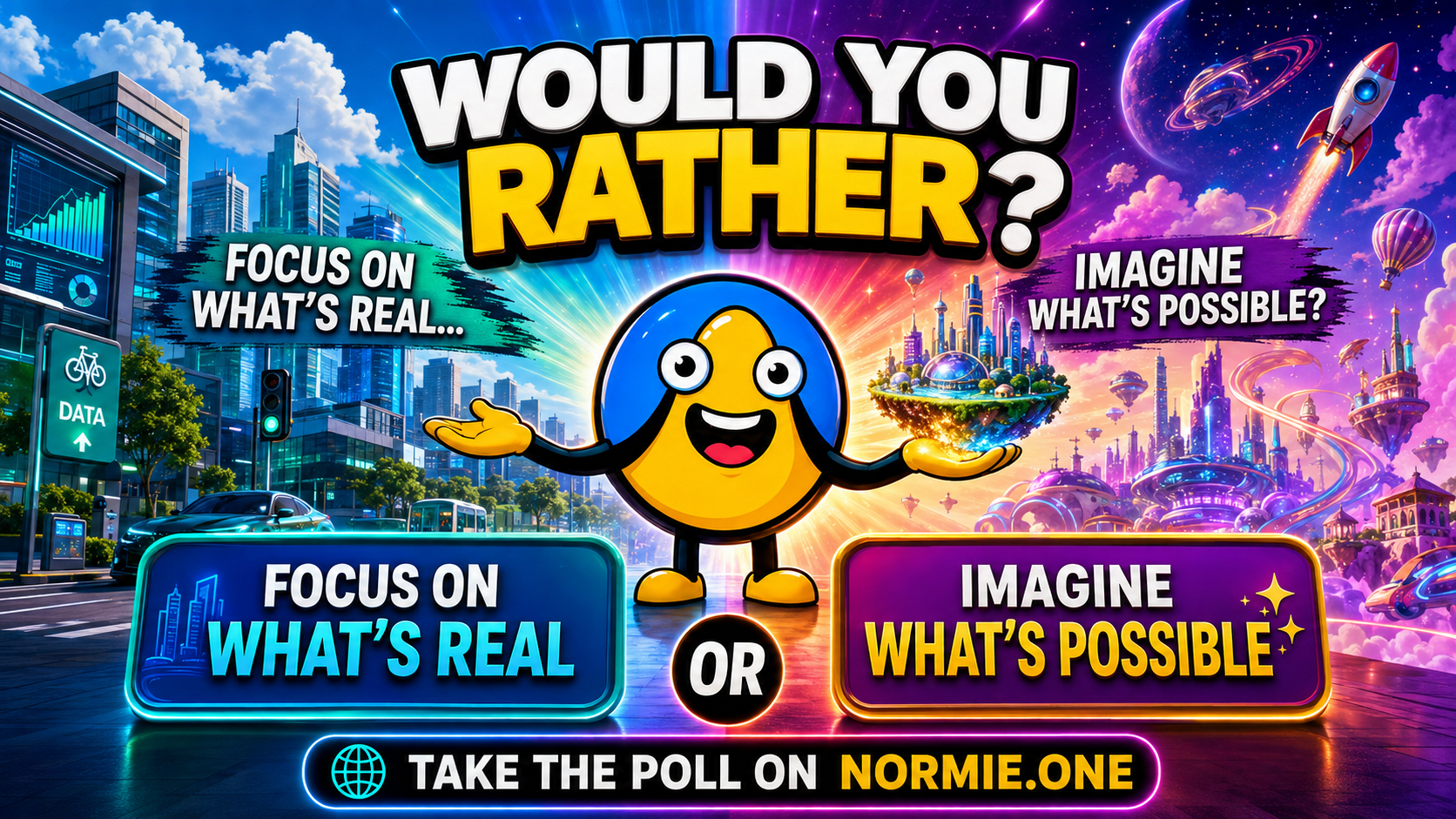
Would You Rather Focus on What’s Real… or Imagine What’s Possible?
“Reality tells us where we stand. Imagination reminds us where we could go.”
Every meaningful decision begins with a tension between two powerful instincts.
One instinct asks: What is true right now? It looks at the available facts, the resources on hand, the lessons of experience, and the practical steps required to move forward. It values evidence over wishful thinking. It wants to understand the terrain before taking the next step.
The other instinct asks: What could be true next? It looks beyond current limits and sees potential where others see obstacles. It notices connections, possibilities, future outcomes, and ideas that may sound unrealistic—until someone makes them real.
Neither instinct is better. In fact, some of humanity’s best outcomes depend on both.
The practical thinker may look at a city and see infrastructure, budgets, traffic, housing, and the systems that need improvement. The visionary may look at that same city and see a cleaner, smarter, more connected place that does not yet exist. One helps us operate in the present; the other helps us redesign the future.
The Strength of Focusing on What’s Real
People who focus on what is real are often the stabilizers in a fast-moving world. They are the ones who ask the questions that prevent a bold idea from becoming an expensive mistake:
What does the evidence say?
Who will actually use this?
What could go wrong?
What will it cost?
What is the first practical step?
This mindset is not pessimistic. It is grounded. It understands that great ideas need execution, discipline, timing, and a clear understanding of the real world.
A person who focuses on reality may be more likely to trust experience, recognize details others overlook, and solve immediate problems before chasing distant possibilities. They may be the builder, operator, analyst, strategist, or reliable friend who turns confusion into a workable plan.
Without this perspective, imagination can become fantasy—exciting, inspiring, and completely disconnected from what it takes to make something happen.
The Power of Imagining What’s Possible
But practical reality alone can also become a limitation.
Many of the most important advances in human history began as a refusal to accept the world exactly as it was. Flying machines, smartphones, space exploration, modern medicine, digital currencies, artificial intelligence, and new forms of art and communication all began with someone seeing beyond the obvious.
People who imagine what is possible often have a natural relationship with change. They are drawn to big questions, unconventional solutions, hidden patterns, and futures that others cannot yet picture. Where some see an established system, they see an opportunity to reinvent it.
This perspective creates movement. It gives people permission to ask better questions:
What if the old way is no longer the best way?
What could this become?
What are we missing because we are too focused on how things have always worked?
What would we build if we started from scratch?
Without imagination, progress can quietly become maintenance. We may become very efficient at preserving a world that no longer serves us.
The Best Ideas Need Both
The real magic happens when practical thinking and imagination work together.
A visionary can imagine a new kind of community, platform, business, or technology. A realist can identify what is needed to make it sustainable. One creates the destination; the other maps the road.
That is true in relationships, careers, investing, creativity, leadership, and personal growth.
If you focus only on what is real, you may protect yourself from disappointment—but you may also overlook the opportunities that require faith, courage, and a willingness to begin before every answer is known.
If you focus only on what is possible, you may generate endless ideas—but struggle to turn them into something lasting.
The balance is not simply to “meet in the middle.” It is to let each perspective strengthen the other. Let imagination expand the horizon. Let reality determine the next responsible step.
What Your Choice May Reveal
Choosing focus on what’s real may suggest that you value reliability, evidence, action, and tangible results. You may be naturally drawn to what can be tested, improved, and implemented today.
Choosing imagine what’s possible may suggest that you value innovation, discovery, future potential, and transformation. You may be energized by ideas that stretch beyond current conditions.
Both answers reveal something important. The world needs people who can see clearly—and people who can see farther.
The better question may not be whether you are a realist or an imaginator. It may be this: Can you stay grounded enough to build—and open enough to dream?
Would You Rather Focus on What’s Real… or Imagine What’s Possible?
Take the poll, share your answer, and see where you fit in the bigger conversation at Normie.
#WouldYouRather #PersonalityPoll #BigIdeas #Normie