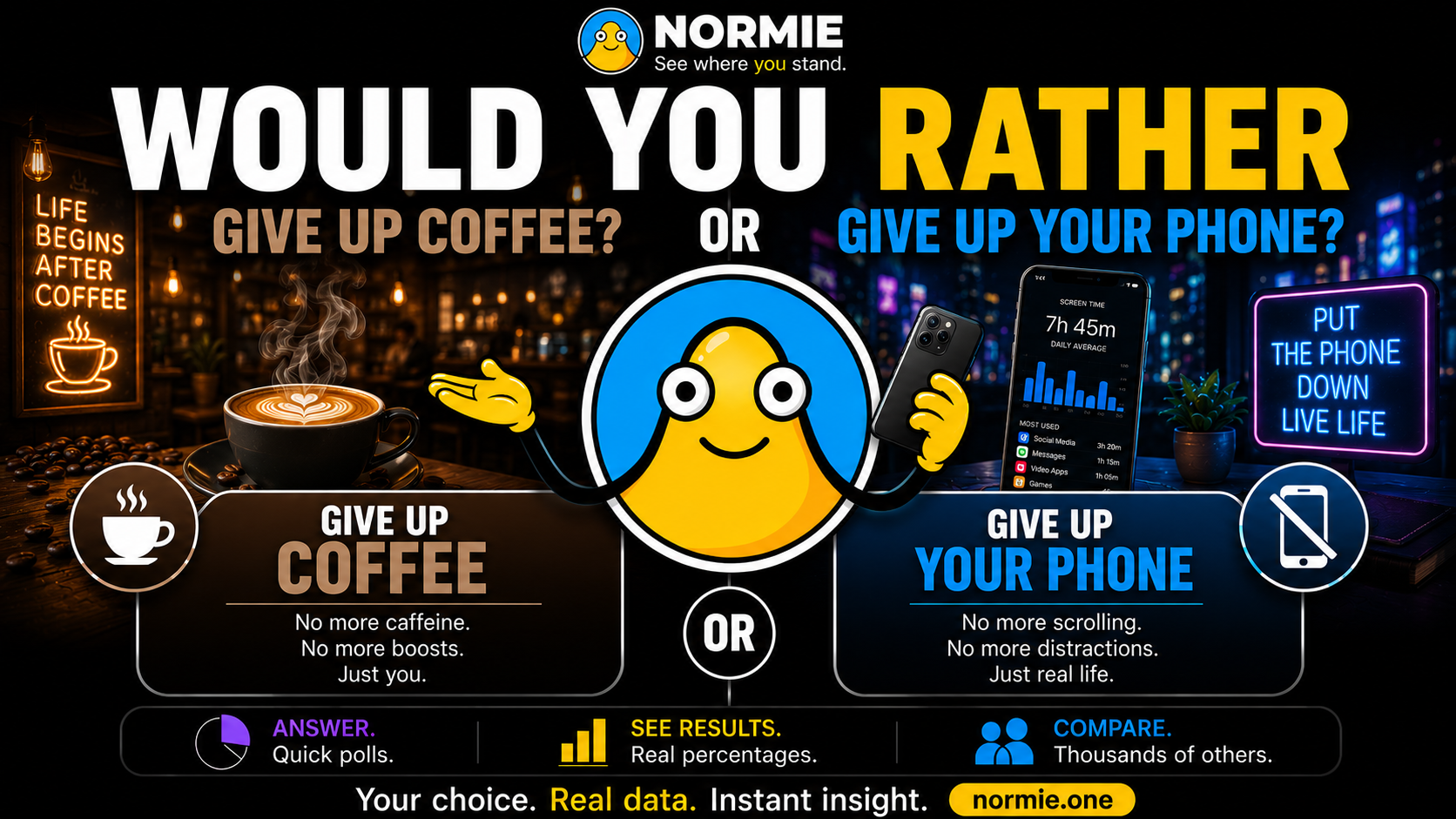
Would You Rather Give Up Coffee… or Your Phone?
At first, this sounds like a funny modern dilemma.
One side threatens your energy.
The other threatens your entire lifestyle.
But beneath the humor lies something surprisingly revealing about modern human behavior, addiction, identity, and dependence.
Would You Rather…
Give Up Coffee…
OR
Give Up Your Phone?
For millions of people, both choices sound impossible.
And that alone says something profound about the world we now live in.

Coffee: Humanity’s Favorite Performance Enhancer
Coffee is more than a drink.
It’s a ritual.
A lifestyle.
A productivity tool.
An emotional comfort system.
A social experience.
A psychological reset button.
For many people, the day does not truly begin until caffeine enters the bloodstream.
Coffee symbolizes:
energy
focus
ambition
routine
momentum
adulthood itself
Entire cultures revolve around it:
coffee shops
work meetings
cafés
creative sessions
study routines
morning rituals
Coffee became one of humanity’s most socially accepted stimulants.
And honestly?
Modern society is partially powered by caffeine.
Why Humans Love Coffee So Much
Caffeine temporarily changes brain chemistry.
It increases:
alertness
dopamine activity
focus
motivation
energy perception
In a fast-moving world demanding constant performance, coffee often feels less like a luxury…
and more like survival fuel.
People use coffee to:
overcome exhaustion
improve productivity
stay competitive
fight burnout
push through stress
The modern economy quietly runs on stimulants and sleep deprivation.
Coffee simply became the most socially normalized version of that reality.
But Phones Changed Humanity More Than Coffee Ever Did
Coffee affects mornings.
Phones affect existence itself.
The smartphone may be the most psychologically transformative device in human history.
Phones are now:
communication systems
entertainment centers
navigation tools
memory storage
identity platforms
social validation systems
workspaces
cameras
news feeds
AI assistants
dopamine machines
Most humans no longer simply “use” phones.
They live through them.
The Psychological Dependency of Phones
What makes phones so powerful is not the hardware.
It’s the behavioral architecture behind them.
Apps are specifically designed to exploit:
attention
novelty seeking
reward anticipation
emotional triggers
social validation
dopamine feedback loops
Every notification carries possibility:
a message
a like
news
attention
opportunity
entertainment
emotional stimulation
Phones became portable psychological ecosystems.
And unlike coffee, they rarely leave your side.
The Average Human Attention Span Is Changing
Modern phones dramatically changed:
focus
memory
patience
boredom tolerance
emotional regulation
social behavior
Humans increasingly struggle with:
silence
stillness
delayed gratification
uninterrupted focus
The phone filled nearly every empty moment:
elevators
waiting rooms
bathrooms
restaurants
conversations
even moments before sleep
Boredom used to create:
imagination
reflection
creativity
Now boredom often gets interrupted instantly.
And humans may not fully understand the long-term psychological consequences yet.
Giving Up Coffee Sounds Hard
Giving up your phone sounds terrifying.
Why?
Because the phone is no longer just a device.
It became:
connection
identity
convenience
stimulation
validation
distraction
work
memory
social existence
Losing coffee affects energy.
Losing your phone affects lifestyle, relationships, communication, work, and even self-perception.
For many people, giving up a phone feels socially isolating.
The Coffee Side Represents Simplicity
Interestingly, coffee represents something more human and grounded.
Coffee rituals often involve:
conversation
cafés
slowing down briefly
mindfulness
comfort
presence
Even though caffeine is stimulating, coffee culture can feel emotionally warm.
The coffee side of the image symbolizes:
routine
physical experience
sensory enjoyment
analog moments
Meanwhile the phone side represents:
speed
distraction
hyper-connectivity
digital dependency
constant stimulation
The contrast says a lot about modern civilization.
The Hidden Tradeoff
This question secretly asks something deeper:
“What controls your life more — chemistry or technology?”
Coffee influences biology.
Phones influence psychology.
And increasingly, technology shapes human behavior at a scale far larger than caffeine ever could.
Phones now influence:
mood
self-esteem
relationships
politics
productivity
loneliness
attention
anxiety
identity
The device is no longer neutral.
It actively shapes human consciousness.
Why Many People Would Choose to Keep Their Phone
Because modern life is structured around it.
Without phones:
navigation becomes harder
work becomes harder
communication slows
entertainment changes
social access weakens
digital identity disappears
The smartphone became the central operating system of modern life.
Coffee is optional.
Phones increasingly feel mandatory.
That psychological difference matters.
Yet Many People Secretly Want Freedom From Their Phones
Here’s the irony:
People rely on phones deeply…
while simultaneously fantasizing about escaping them.
This explains the rise of:
digital detoxes
mindfulness apps
offline retreats
screen-time tracking
minimalist phones
“touch grass” culture
anti-doomscrolling movements
Humans increasingly sense that constant connectivity comes with hidden costs:
anxiety
distraction
comparison
overstimulation
reduced presence
fragmented attention
The phone gives access to the world…
while often pulling people away from the moment directly in front of them.
The Real Question Isn’t Coffee or Phones
The real question is:
“What are humans becoming dependent on to function emotionally?”
Coffee boosts energy.
Phones regulate:
boredom
loneliness
anxiety
stimulation
identity
social connection
In many ways, the smartphone became a modern emotional support device.
And that may be one of the biggest psychological shifts of the digital age.
The Most Interesting Outcome
Ironically, many people who temporarily quit phones report:
increased focus
improved mood
better sleep
stronger presence
deeper conversations
more creativity
reduced anxiety
Meanwhile people who quit coffee often report:
headaches
lower energy temporarily
but eventually more stable energy patterns
One addiction affects the body.
The other increasingly affects the mind.
Final Thought
Coffee helped humans work harder.
Phones changed how humans think, connect, feel, and experience reality itself.
One fuels the nervous system.
The other increasingly shapes consciousness.
And perhaps the most revealing part of this question is not which one people choose…
but how impossible both options suddenly feel.
Because modern humans may no longer simply consume technology.
We may already be psychologically integrated with it.
Would You Rather…
Give Up Coffee…
OR
Give Up Your Phone?
Vote now on Normie — the psychology-powered SocialFi platform exploring human behavior, technology, emotion, and the choices shaping modern life.
Join the community:
X / Twitter @Normie765714
YouTube @PersonalityPolls