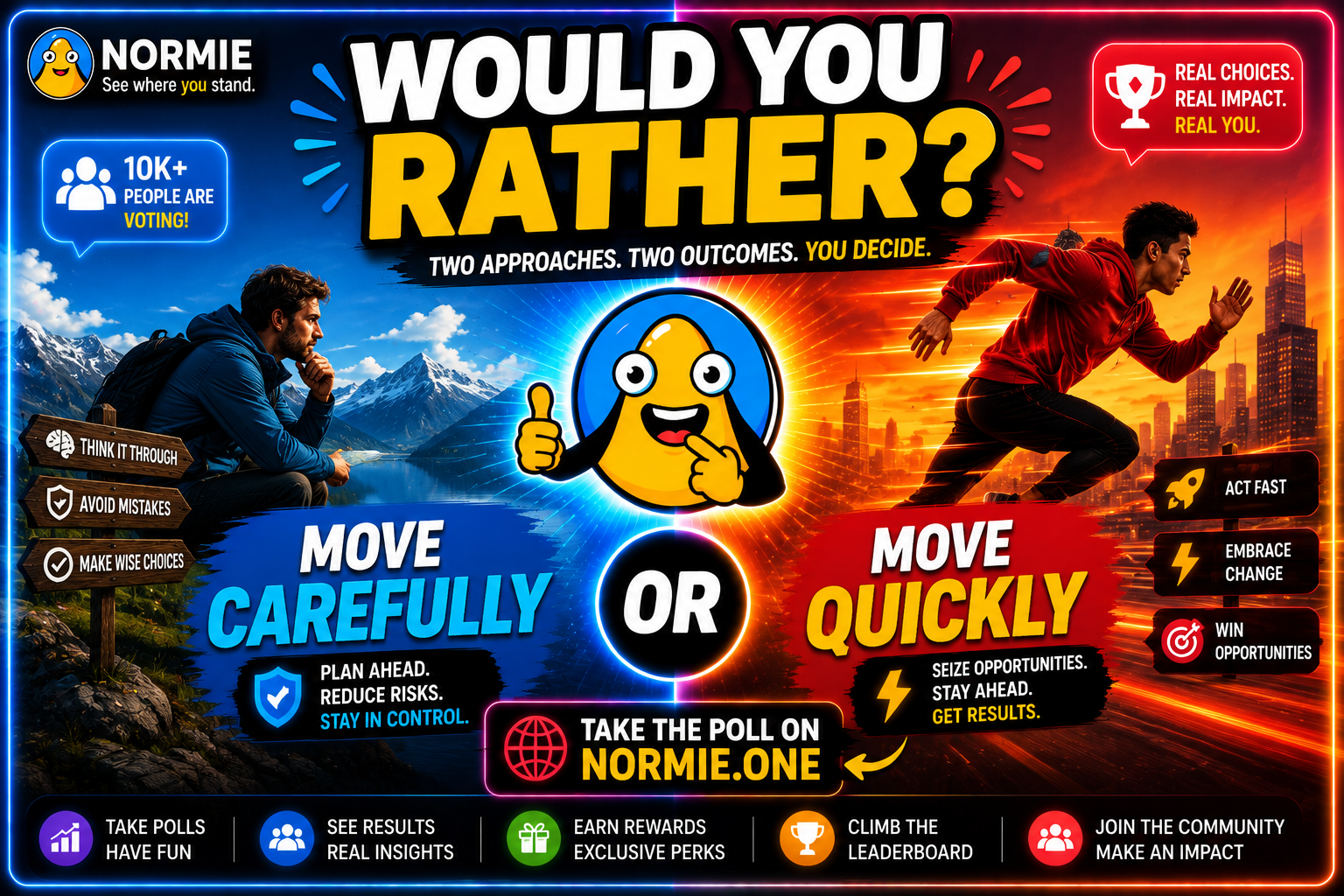
Would You Rather… Move Carefully OR Move Quickly?
Some people see a big decision and immediately ask:
“What could go wrong?”
Others see exactly the same situation and ask:
“What happens if I don't move now?”
That difference can shape careers, relationships, investments, businesses, friendships—and entire lives.
So here's the question:
Would You Rather… Move Carefully OR Move Quickly?
At first, this sounds like a choice between caution and speed. But underneath it lies a much deeper conflict between certainty and opportunity.
Moving carefully gives you more information before committing.
Moving quickly gives you more opportunity before everyone else catches up.
And neither strategy always wins.

The Case for Moving Carefully
There is wisdom in slowing down.
When you move carefully, you have time to investigate assumptions, understand consequences, gather information and consider alternatives.
You aren't necessarily afraid.
You may simply believe:
“A good decision is worth taking the time to get right.”
This mindset can be enormously valuable when decisions are difficult to reverse.
Buying a house.
Choosing a business partner.
Getting married.
Signing a major contract.
Making a large investment.
Hiring a key employee.
Undergoing an important career change.
In situations like these, speed isn't automatically an advantage.
Sometimes the smartest move is simply not making a bad move.
Careful decision-makers often think several steps ahead. Instead of asking only what happens next, they consider what happens after what happens next.
That patience can prevent enormous mistakes.
The Hidden Power of Patience
We live in a culture that increasingly celebrates speed.
Move fast.
Launch now.
Buy before it's gone.
Respond immediately.
Be first.
Don't miss the opportunity.
Social media intensifies this feeling because we constantly see other people apparently moving ahead.
Someone launches a company.
Someone buys an investment before it explodes.
Someone changes careers.
Someone moves across the country.
Someone adopts a new technology.
Suddenly doing nothing feels like falling behind.
But there is an underrated superpower in being able to say:
“I don't know enough yet.”
Patience creates space between impulse and action.
And sometimes that space changes everything.
The Case for Moving Quickly
Now consider the opposite.
You can spend so much time preparing for an opportunity that the opportunity disappears.
The perfect information rarely arrives.
Eventually, action becomes necessary.
Entrepreneurs understand this particularly well.
You could spend two years perfecting a product—or launch something imperfect next month and discover what customers actually want.
The second strategy often produces more useful information.
Why?
Because action creates feedback.
You launch.
You observe.
You adjust.
You try again.
Suddenly speed isn't recklessness.
It becomes a learning strategy.
Sometimes Moving Quickly Is Actually Safer
This sounds counterintuitive.
But imagine two people trying something new.
Person A spends twelve months developing the perfect plan.
Person B tries ten small experiments during those same twelve months.
Who understands the environment better after a year?
Possibly Person B.
Moving quickly doesn't have to mean betting everything.
It can mean:
small action → feedback → adjustment → another action.
That approach is increasingly powerful in a world where technology, markets, culture and opportunities change rapidly.
The person who adapts quickly may outperform the person who predicted perfectly.
The Analysis Paralysis Trap
Careful thinking becomes a problem when thinking replaces action.
You research.
Then research the research.
Then compare five alternatives.
Then watch twelve videos.
Then ask six people.
Then create a spreadsheet.
Then decide you need more information.
Eventually, caution becomes procrastination wearing a suit.
There is always another unknown.
At some point you have to accept an uncomfortable truth:
You cannot eliminate uncertainty before making most important decisions.
Sometimes clarity doesn't come before action.
Clarity comes from action.
The Speed Trap
But moving quickly has an equally dangerous failure mode.
Speed can feel like progress even when you're running in the wrong direction.
Fast decision-makers may confuse confidence with competence.
They can underestimate risk, overlook important details or become addicted to momentum.
They may believe:
“I'll figure it out later.”
Sometimes they do.
Sometimes “later” becomes extremely expensive.
Speed is most dangerous when the consequences are large and the decision is difficult to reverse.
There is a major difference between quickly testing a new marketing campaign and quickly investing your life savings.
The critical variable isn't simply speed.
It's reversibility.
The One Question That Changes the Decision
Before deciding whether to move carefully or quickly, ask:
“Can I easily reverse this?”
If the answer is yes, speed becomes much more attractive.
Try the idea.
Publish the article.
Test the product.
Send the message.
Experiment with the strategy.
Learn from what happens.
But if the answer is no, slowing down becomes much more valuable.
Permanent or expensive decisions deserve greater scrutiny.
This gives us a useful principle:
Move quickly on reversible decisions. Move carefully on irreversible ones.
You don't need one personality for every situation.
You need the ability to recognize which situation you're actually in.
What Your Answer Might Reveal
If you choose MOVE CAREFULLY, you may naturally value preparation, accuracy, security, predictability and control. You may prefer understanding the terrain before taking the first step.
Your strength is foresight.
Your danger is hesitation.
If you choose MOVE QUICKLY, you may naturally value momentum, experimentation, opportunity, adaptability and action.
Your strength is decisiveness.
Your danger is impulsiveness.
And there's another possibility.
Your answer may simply reflect where you are in life.
Someone recovering from a major mistake might choose carefully.
Someone frustrated after years of hesitation might choose quickly.
Context changes personality.
The Best Decision-Makers May Do Both
Perhaps the strongest approach isn't choosing between speed and caution.
It's knowing when each one matters.
Think carefully about the big direction.
Move quickly on small experiments.
Protect yourself from catastrophic downside.
Don't protect yourself from every possible failure.
Gather enough information—not infinite information.
And once the evidence is good enough:
move.
Because life punishes recklessness.
But it can also punish endless hesitation.
Some opportunities disappear.
Some windows close.
Some conversations never happen.
Some ideas never get built.
And sometimes the greatest risk isn't moving too quickly.
It's spending so long deciding that the decision gets made for you.
Would You Rather?
🐢 MOVE CAREFULLY
Think it through. Reduce mistakes. Stay in control.
OR
⚡ MOVE QUICKLY
Act fast. Learn quickly. Capture opportunities.
Neither is automatically right.
The interesting part is discovering which instinct you trust—and when you're willing to override it.
Take the poll, compare yourself with other players, earn points, build your Player Profile and see where you stand on Normie.one.
Normie — Real Questions. Real People. Real Connection.
#decisions, #speed, #caution, #risk, #action, #strategy, #opportunity, #personality