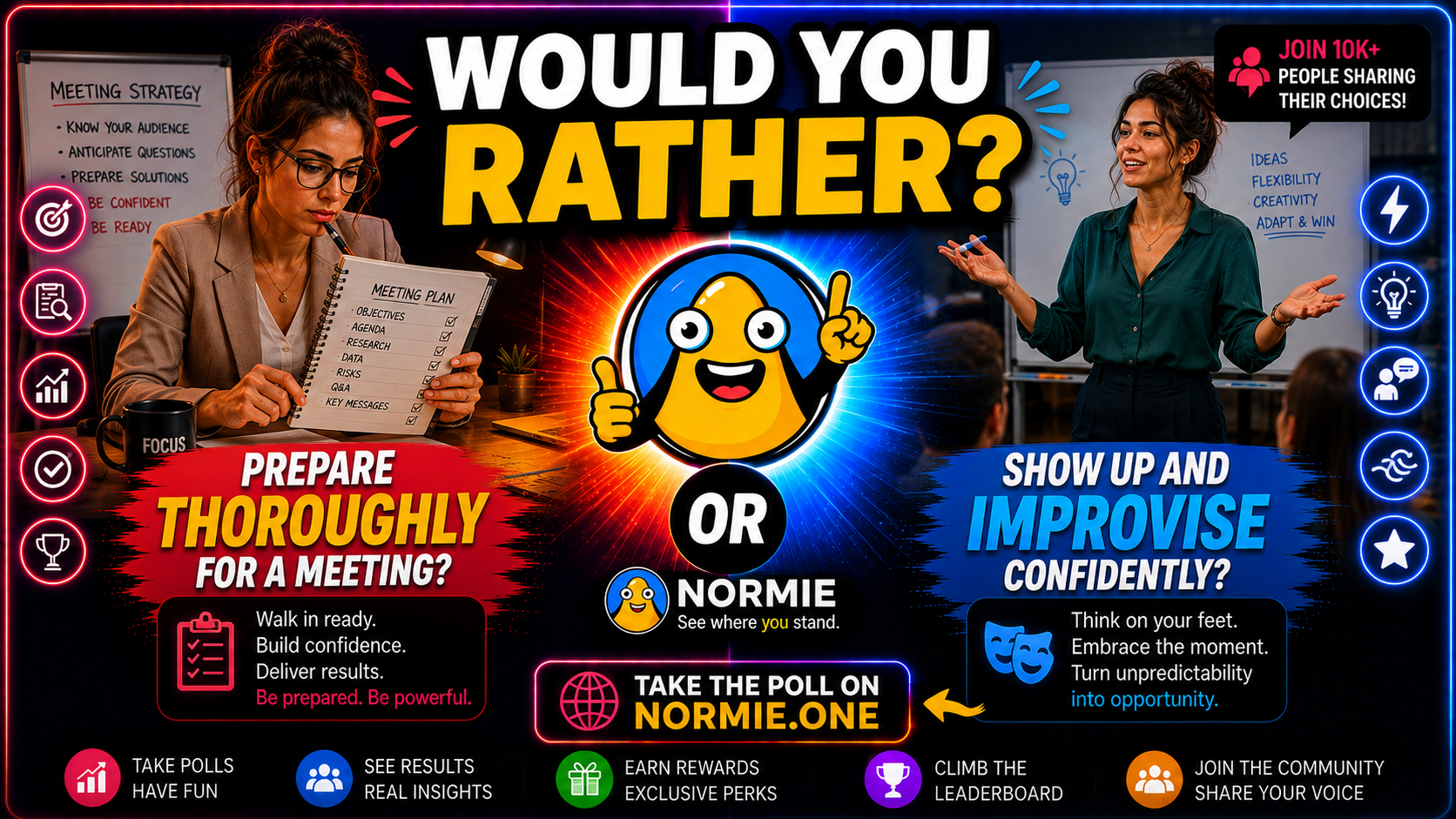
Would You Rather… Prepare Thoroughly for a Meeting OR Show Up and Improvise Confidently?
The meeting starts in ten minutes.
One person has spent hours preparing.
They've reviewed the numbers, anticipated questions, organized their talking points, researched everyone attending, and rehearsed exactly what they want to say.
Another person barely looked at the agenda.
But they're relaxed, confident, experienced, and completely comfortable thinking on their feet.
Who would you rather be?

Would You Rather… Prepare Thoroughly for a Meeting OR Show Up and Improvise Confidently?
It's really a question about two different sources of confidence:
Confidence from preparation.
Or...
Confidence in your ability to adapt.
The Case for Preparing Thoroughly
Preparation gives you an enormous advantage: you've already thought about problems before you're required to solve them in real time.
You understand the subject.
You know your objectives.
You've considered objections.
You have facts available when someone challenges your assumptions.
Instead of using mental energy remembering what you wanted to say, you can focus on the people in the room.
Preparation can also reduce anxiety because uncertainty shrinks.
You may not know exactly what will happen, but you've explored the most likely possibilities.
That's why athletes study opponents, lawyers prepare arguments, salespeople research prospects, and executives review numbers before important meetings.
Preparation doesn't guarantee success.
But it improves your odds.
When Preparation Becomes a Superpower
The best-prepared person in a room often appears naturally confident because much of the difficult thinking happened beforehand.
They don't need to invent every answer.
They've already considered it.
This creates an important distinction:
Preparation doesn't eliminate spontaneity. It gives spontaneity a stronger foundation.
When you know the material deeply, you can depart from your plan without becoming lost.
You have somewhere to return.
The Case for Improvising Confidently
But we've all met people who seem capable of walking into almost any room and figuring things out.
They read people quickly.
They listen carefully.
They communicate naturally.
They aren't disturbed when the conversation moves somewhere unexpected.
Instead of thinking:
“That's not in my presentation.”
they think:
“Interesting. Let's go there.”
Improvisation can make meetings feel more human and responsive.
You're not delivering a script.
You're participating in a conversation.
And sometimes that flexibility is exactly what the situation requires.
The Power of Thinking on Your Feet
Real life rarely follows an agenda perfectly.
Someone asks the question you didn't anticipate.
The client changes priorities.
The technology fails.
The presentation gets shortened from 30 minutes to five.
The conversation suddenly moves in a completely different direction.
At that moment, preparation can only take you so far.
You need adaptability.
The ability to remain composed when the plan disappears is an enormously valuable professional skill.
Confident improvisers often understand something important:
You don't have to control every situation if you trust yourself to respond to it.
The Over-Preparation Trap
Preparation has a downside when it becomes dependence.
You rehearse every sentence.
You build 47 slides.
You anticipate every possible question.
Then someone interrupts three minutes into the presentation.
Suddenly the carefully designed sequence disappears.
Over-preparation can make people rigid.
Instead of listening to what is actually happening, they're mentally trying to drag the conversation back toward what they planned.
Sometimes the person who prepared the most is ironically the least comfortable when the unexpected happens.
The Improvisation Trap
Confidence can also become an excuse for laziness.
There's a difference between:
“I'm experienced enough to think on my feet.”
and
“I couldn't be bothered to prepare.”
Charisma can carry someone surprisingly far.
But eventually somebody asks a detailed question.
Someone knows the numbers.
Someone did the research.
Someone notices that confidence is covering a lack of substance.
Improvisation works best when it rests on a foundation of experience and knowledge.
Otherwise, confidence can become bluffing.
Knowledge vs. Adaptability
This is what makes the choice interesting.
Preparation says:
“I'll reduce uncertainty before I enter the room.”
Improvisation says:
“I'll trust myself to handle uncertainty once I'm there.”
Both are legitimate strategies.
One manages uncertainty in advance.
The other manages it in real time.
What Your Answer Might Reveal
If you choose PREPARE THOROUGHLY, you may value competence, organization, accuracy, predictability, and control.
You want to earn confidence through preparation.
Your strength may be reliability.
Your risk may be becoming uncomfortable when reality doesn't follow the plan.
If you choose IMPROVISE CONFIDENTLY, you may value adaptability, intuition, communication, speed, and spontaneity.
You trust yourself to figure things out.
Your strength may be flexibility.
Your risk may be believing confidence can substitute for preparation when it can't.
“Preparation builds confidence. Improvisation reveals it.”
The Strongest Answer May Be Both
Perhaps the best performers don't actually choose one side.
They prepare deeply enough that they can improvise freely.
Know your objective.
Know your audience.
Know the important facts.
Anticipate the obvious questions.
Then walk into the room and actually listen.
Don't become trapped by your script.
Don't force the conversation toward your plan.
Use preparation as a foundation—not a cage.
That's when confidence becomes something more powerful than performance.
It becomes competence.
So… Would You Rather?
📚 PREPARE THOROUGHLY FOR THE MEETING?
Research. Structure. Knowledge. Readiness.
OR
🎤 SHOW UP AND IMPROVISE CONFIDENTLY?
Adaptability. Intuition. Presence. Confidence.
The most effective person in the room may ultimately be the one who can say:
“I came prepared—but I don't need the plan.”
Take the poll on Normie, compare your answer with the community, and see where you stand.
Categories: Work & Career, Personality, Behavior & Habits
Keywords: preparation, confidence, meetings, improvisation, career, adaptability, leadership, communication, performance
#NORMIE #WouldYouRather #Leadership #Confidence #Mindset