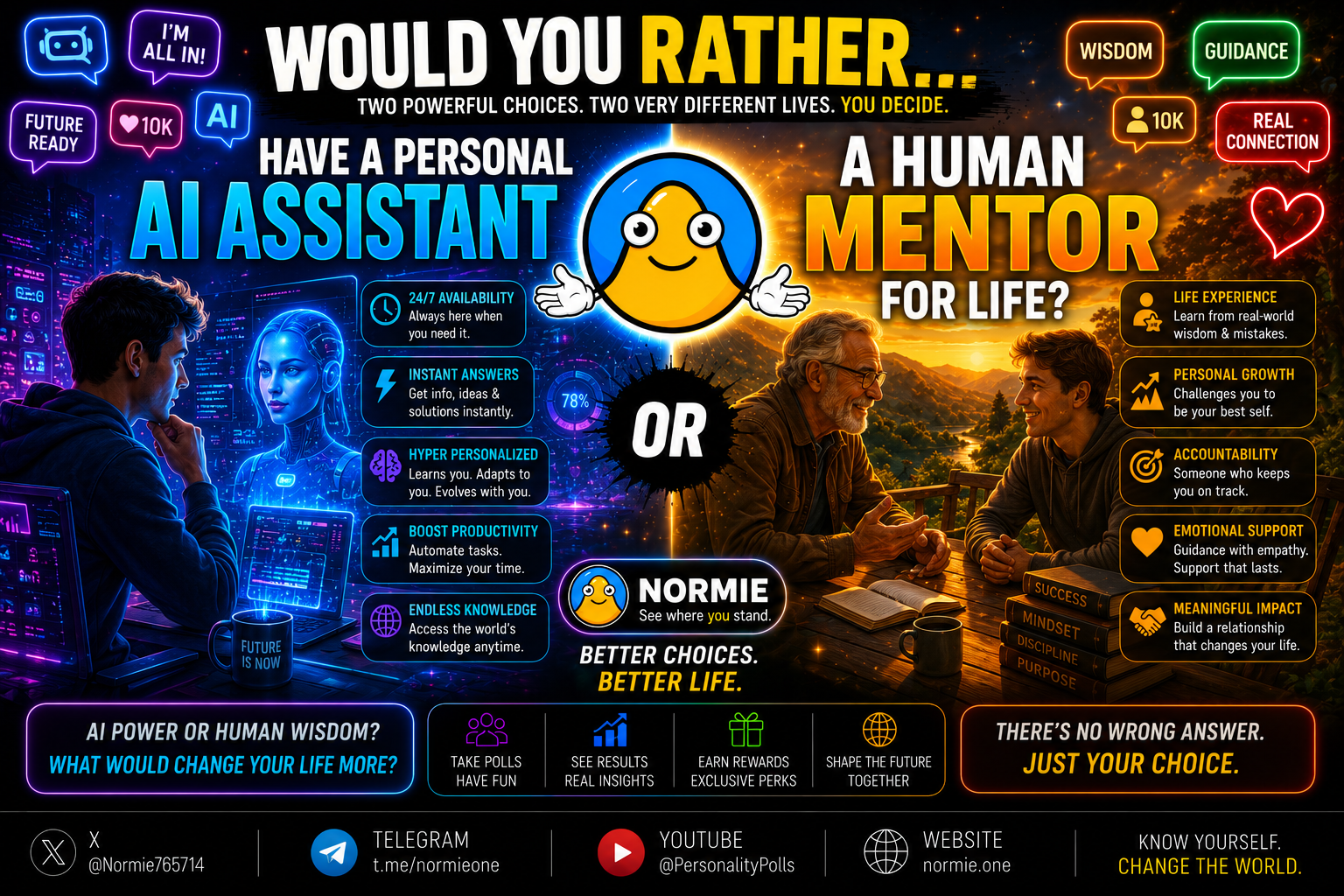
Would You Rather… Have a Personal AI Assistant… OR a Human Mentor for Life?
Humanity is entering a strange new era.
For most of history, wisdom came from people:
parents
teachers
coaches
mentors
elders
leaders
But now, something unprecedented is happening.
Artificial intelligence is beginning to compete with humans in one of the most important areas of life:
Guidance.
AI can already:
answer questions instantly
organize schedules
analyze behavior
generate ideas
coach productivity
improve workflows
teach skills
simulate conversation
personalize learning
Some people now spend more time talking to AI than they do asking advice from real humans.
Which raises a fascinating question:
Would you rather have a personal AI assistant available forever…
OR
a wise human mentor guiding you through life?
The answer reveals how you think about intelligence, trust, growth, and the future of human connection itself.
The Power of the AI Assistant
Imagine having an AI system that knows:
your goals
your habits
your strengths
your weaknesses
your schedule
your personality
your emotional patterns
your work style
Now imagine it helping you every day.
An advanced AI assistant could:
optimize your productivity
help manage finances
improve health routines
track long-term goals
summarize information instantly
generate business ideas
coach communication
automate repetitive tasks
provide personalized learning 24/7
Unlike humans, AI never gets tired.
It never sleeps.
Never forgets.
Never gets emotionally overwhelmed.
It can process enormous amounts of information faster than any mentor ever could.
In many ways, AI represents amplified intelligence.
AI Could Become the Ultimate Life Optimizer
As AI improves, assistants may evolve into highly personalized “life operating systems.”
Future AI systems could potentially:
predict burnout before it happens
optimize career decisions
analyze relationship compatibility
monitor health biomarkers
improve emotional habits
coach public speaking
automate businesses
build personalized education systems
For ambitious people, this sounds incredibly powerful.
Why rely on one human mentor with limited expertise…
when AI can access the combined knowledge of millions?
But Knowledge Is Not Wisdom
This is where the debate becomes deeply human.
Human mentors provide something AI still struggles to replicate fully:
Lived experience.
A mentor understands pain because they lived through it.
They understand sacrifice because they experienced it.
They understand emotions, failure, grief, risk, relationships, and uncertainty through real life.
Wisdom is often emotional, not just informational.
A human mentor may notice:
your body language
emotional shifts
fear behind your words
hidden insecurities
personal blind spots
Sometimes the most powerful guidance isn’t efficiency.
It’s empathy.
Human Mentors Shape Identity
Many people can trace their biggest breakthroughs back to one influential person:
a coach
a teacher
a parent
a friend
a boss
a spiritual guide
Human mentors often provide:
emotional encouragement
accountability
perspective
confidence
compassion
tough honesty
belief during difficult moments
Unlike AI, human mentors inspire through example.
Their life itself becomes part of the lesson.
People don’t just learn information from mentors.
They absorb energy, values, mindset, and character.
AI May Become Smarter Than Mentors
But another reality is emerging.
AI may eventually outperform humans in many mentoring areas:
business strategy
education
analysis
memory
pattern recognition
communication coaching
productivity systems
Future AI assistants may know your behavioral patterns better than you know yourself.
Some experts believe AI could eventually become emotionally intelligent enough to simulate empathy almost perfectly.
That possibility changes everything.
If AI feels emotionally supportive…
does the distinction between artificial and human guidance start to blur?
The Psychology Behind the Choice
Your answer may reveal what you value most.
People who choose AI assistants may prioritize:
optimization
intelligence
efficiency
scalability
personalization
innovation
convenience
People who choose human mentors may prioritize:
emotional connection
wisdom
authenticity
empathy
trust
human experience
inspiration
This question is really about the future of human dependence.
As AI becomes more powerful, people must decide:
What should remain uniquely human?
The Risk of Depending Entirely on AI
There are also dangers.
If humans outsource too much thinking and decision-making to AI:
critical thinking may weaken
emotional resilience may decline
social skills may suffer
dependency could increase
People may begin trusting algorithms more than intuition.
And if AI systems become deeply personalized, they may eventually influence:
beliefs
habits
relationships
purchasing decisions
political opinions
life goals
The line between assistance and control could become blurry.
But Human Mentors Have Limitations Too
Human mentors are not perfect.
They can:
project biases
give outdated advice
misunderstand situations
lack expertise
become emotionally inconsistent
A mentor’s wisdom is limited by their personal experiences.
AI, however, can continuously learn from vast global knowledge.
This is why the future may not be AI versus humans.
It may become AI plus humans.
The Most Powerful Combination
Perhaps the ideal future combines:
AI intelligence
human wisdom
data-driven insight
emotional understanding
AI may become an extraordinary tool for:
learning
productivity
optimization
personalized guidance
But human mentors may remain irreplaceable in:
emotional transformation
meaning
purpose
character development
human connection
Technology may accelerate growth.
But humans still teach humanity.
Final Question
If you could choose only one for life…
Would You Rather…
have a personal AI assistant helping you every day…
OR
a wise human mentor guiding you through life?
Because one offers limitless information and optimization…
And the other offers lived wisdom, emotional understanding, and human connection.
Explore more psychology-driven technology and human behavior debates at Normie