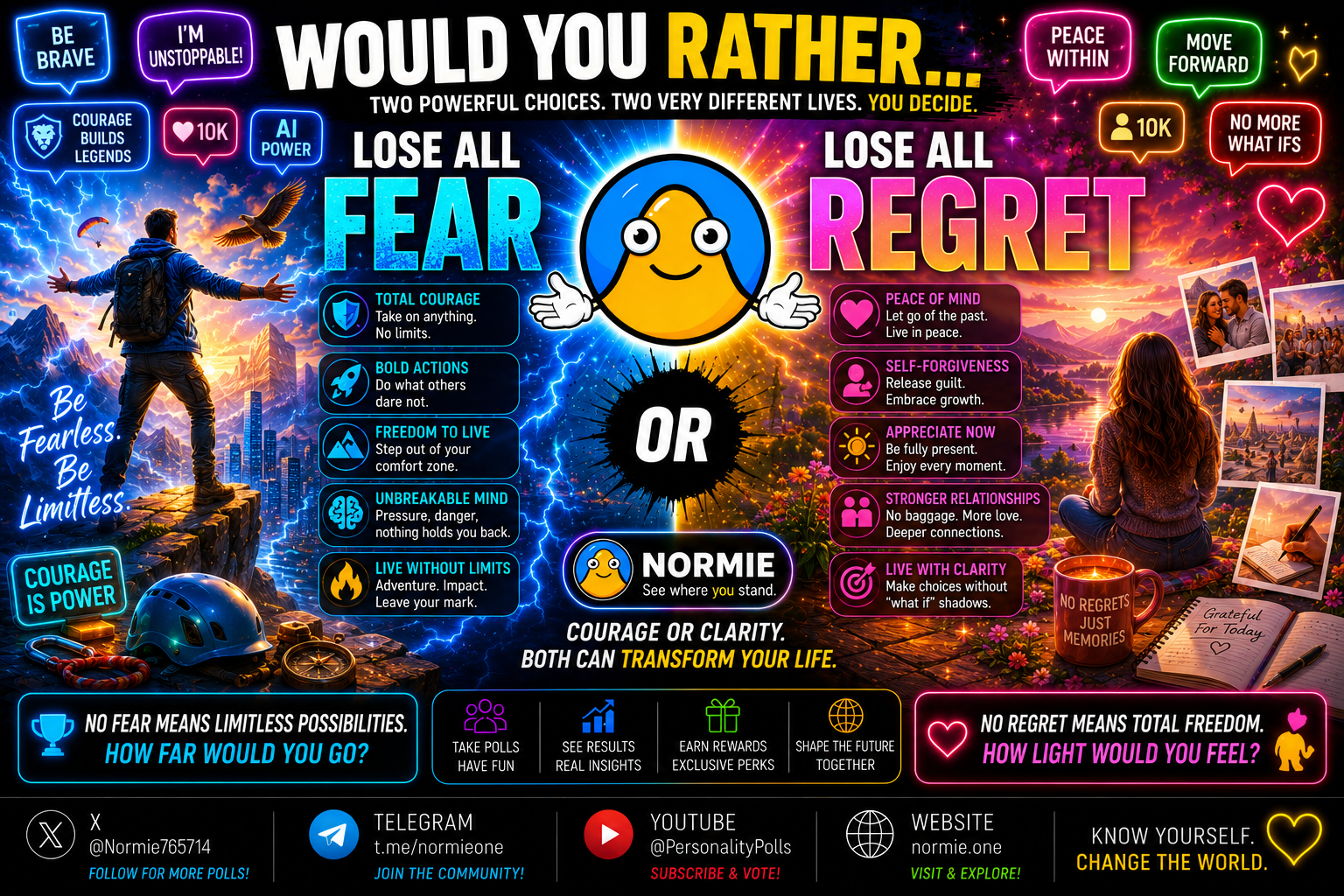
Would You Rather… Lose ALL Fear… OR Lose ALL Regrets?
Every human being is haunted by two invisible forces:
Fear…
and regret.
One controls the choices you never make.
The other lives in the choices you already made.
Fear whispers:
“What if something goes wrong?”
Regret whispers:
“What if things could have been different?”
So the question becomes:
Would you rather lose all fear…
or lose all regrets?
At first, it sounds like a simple psychological thought experiment.
But the deeper you think about it, the more it reveals about human consciousness, growth, trauma, risk, and the way we experience life itself.
Because fear shapes the future.
And regret reshapes the past.
The Case for Losing All Fear
Imagine waking up tomorrow completely free from fear.
No fear of failure.
No fear of rejection.
No fear of embarrassment.
No fear of death.
No fear of judgment.
No anxiety about uncertainty.
How different would your life become?
Most people underestimate how much fear controls them.
Fear quietly influences:
Careers we never pursue
Relationships we never start
Businesses we never launch
Conversations we avoid
Dreams we suppress
Truths we refuse to confront
Fear is often invisible because society normalizes it.
People call it:
“Being realistic”
“Playing it safe”
“Waiting for the right time”
But underneath those phrases is often fear.
Fear creates hesitation.
And hesitation changes destinies.
Fear Has Protected Humanity for Thousands of Years
But here’s the paradox:
Fear is not entirely bad.
Fear evolved to protect us.
Without fear:
Humans would take reckless risks
Survival instincts would disappear
Dangerous behavior would increase
Fear warns us about:
Physical danger
Toxic situations
Manipulation
Poor decisions
A person without fear could become unstoppable…
or self-destructive.
In psychology, researchers study people with impaired fear responses.
Some become extraordinarily courageous.
Others struggle to recognize danger entirely.
Fear creates caution.
Caution creates survival.
So the real question is not whether fear is bad.
It’s whether fear controls too much of modern life.
The Modern World Runs on Fear
Fear has become one of the most powerful forces in society.
Media profits from fear.
Politics uses fear.
Marketing triggers fear.
Social media amplifies fear.
People fear:
Missing out
Being canceled
Falling behind
Looking unsuccessful
Aging
Loneliness
Financial collapse
Irrelevance
Entire industries are built around emotional insecurity.
And because fear is emotional, it often overrides logic.
A talented person may never pursue greatness simply because fear convinced them they weren’t enough.
The Freedom of Fearlessness
A person without fear might:
Speak more honestly
Take bigger opportunities
Love more openly
Travel more freely
Create more boldly
Live more authentically
Many people admire fearless individuals because they represent freedom.
Athletes.
Explorers.
Entrepreneurs.
Artists.
Revolutionaries.
Fearlessness often creates extraordinary lives.
But it can also create chaos.
Without fear:
Would relationships become reckless?
Would people lose empathy for consequences?
Would danger lose meaning?
Fear, when balanced properly, can create wisdom.
The Case for Losing All Regrets
Now imagine something different.
Imagine carrying no regrets.
None.
No painful memories replaying at night.
No “what if” thoughts.
No shame over missed opportunities.
No guilt over past mistakes.
Many people are not trapped by the future.
They are trapped by the past.
Regret can quietly shape an entire life.
A person may regret:
Not saying “I love you”
Choosing the wrong career
Staying in toxic relationships
Missing opportunities
Hurting someone
Wasting years
Not taking risks
Being afraid
Some regrets last decades.
Regret Is Emotional Time Travel
Fear lives ahead of you.
Regret lives behind you.
Regret is the mind constantly revisiting alternate realities:
“What if I tried harder?”
“What if I stayed?”
“What if I left sooner?”
“What if I took the chance?”
This is why regret can feel emotionally exhausting.
The past cannot be changed…
yet the brain keeps trying to rewrite it.
Many psychologists believe regret is tied deeply to identity.
People don’t just regret actions.
They regret versions of themselves.
The person they could have become.
The life they almost lived.
But Regret Also Creates Growth
Here’s the uncomfortable truth:
Regret can teach wisdom.
People often become kinder, smarter, and more self-aware because of painful mistakes.
Regret can create:
Accountability
Empathy
Reflection
Maturity
Humility
Someone without regret may feel emotionally free…
But could they fully learn from the past?
Regret sometimes acts like emotional correction.
It reminds people:
what matters
who they hurt
where they failed
what they truly value
Without regret, some people might repeat destructive behavior endlessly.
Fear and Regret Are Secretly Connected
This is where the question becomes profound.
Fear often creates regret.
People fear taking action…
then later regret not acting.
A person may fear:
rejection
failure
criticism
uncertainty
And years later, the greatest pain isn’t failure.
It’s realizing fear prevented them from truly living.
This is why many older people say:
“I regret the chances I didn’t take more than the mistakes I made.”
Fear protects the present.
Regret judges the past.
Which One Hurts Humanity More?
This may be the core of the question.
Is humanity suffering more from fear…
or from regret?
Fear keeps people trapped.
Regret keeps people haunted.
Fear shrinks life before action happens.
Regret expands pain after action is over.
One limits potential.
The other replays loss.
The Deepest Truth
Maybe the goal isn’t eliminating fear or regret completely.
Maybe the goal is learning how to use them correctly.
Healthy fear creates awareness.
Healthy regret creates growth.
But when either becomes overwhelming, life becomes smaller.
Too much fear leads to paralysis.
Too much regret leads to emotional imprisonment.
The healthiest people often:
feel fear but act anyway
acknowledge regret but keep moving forward
That balance may be the real answer.
Final Question
At the end of your life…
Which would free you more?
Would You Rather…
lose ALL fear…
OR
lose ALL regrets?
Because one changes the future you’re willing to create…
And the other changes the emotional weight you carry from the past.
Explore more psychological debates and human behavior questions at Normie
Join the discussion:
X @Normie765714
Telegram
YouTube @PersonalityPolls