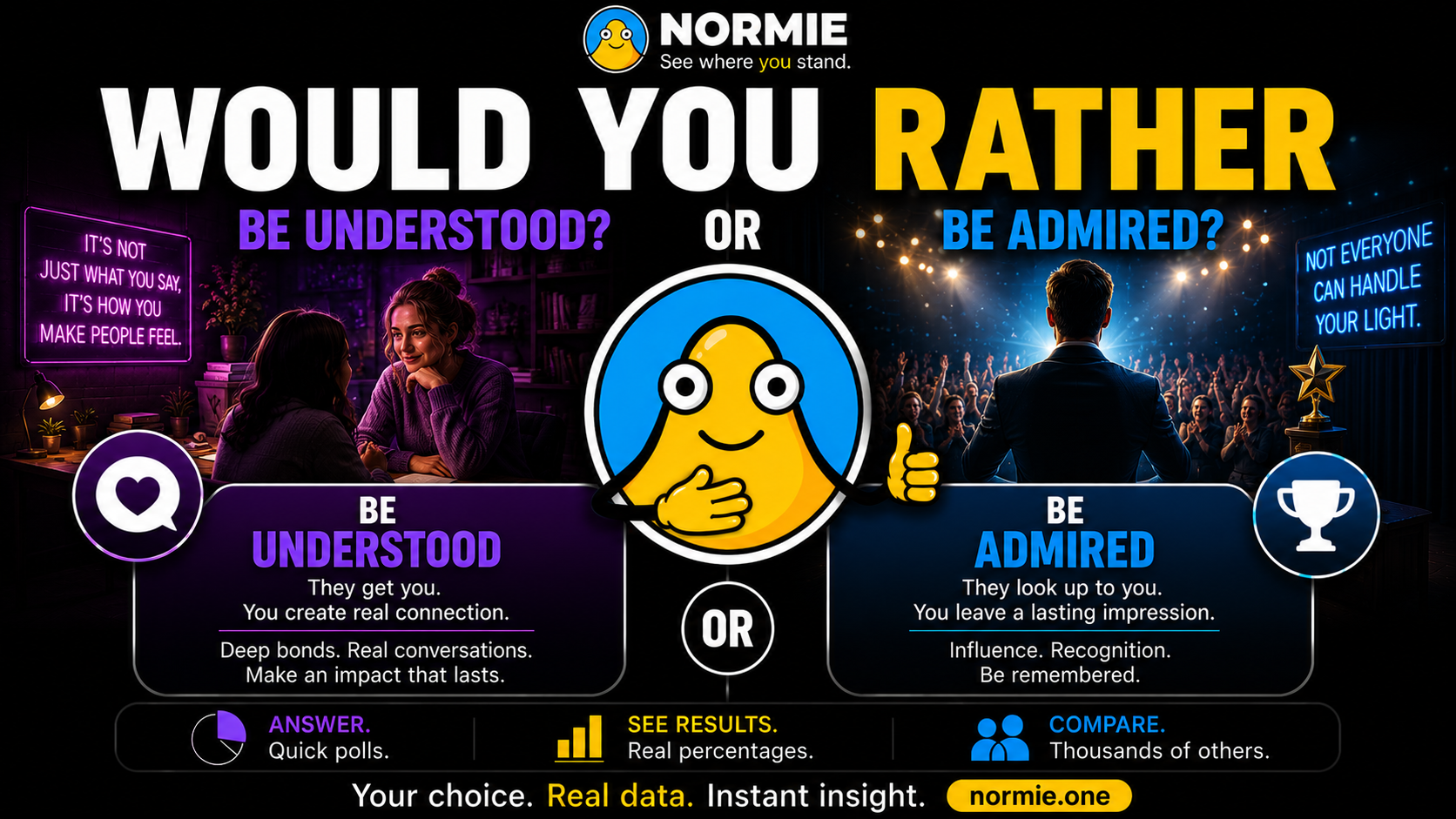
Would You Rather Be Understood… or Admired?
Human beings spend enormous amounts of their lives searching for two things:
connection
and recognition
Some people want to feel deeply understood by another human being — emotionally seen, accepted, and known without pretending.
Others want admiration — influence, respect, status, achievement, recognition, and the feeling of leaving a lasting impression on the world.
And if forced to choose, the question becomes surprisingly difficult:
Would You Rather…
Be Understood…
OR
Be Admired?
At first glance, this seems like a personality question.
But underneath it lies something much deeper:
identity
loneliness
ego
belonging
status
vulnerability
emotional safety
and the human need to matter
Because these two desires shape nearly everything humans do.
The Human Need to Be Understood
To be understood is one of the deepest emotional desires in existence.
It means:
someone truly sees you
someone understands your thoughts
someone accepts your flaws
someone recognizes your emotional reality
Being understood creates emotional safety.
It allows humans to stop performing temporarily.
No masks.
No image management.
No pretending.
Just authenticity.
This is why deep conversations often feel more powerful than superficial admiration.
Humans are emotional creatures.
And emotional connection creates psychological stability.
Why Feeling Understood Is So Rare
Ironically, humans communicate constantly…
yet many people feel deeply misunderstood.
Modern life encourages performance:
social media personas
professional branding
filtered identities
public image management
status signaling
People often become highly visible without becoming emotionally known.
Someone can have:
millions of followers
public success
admiration
influence
and still feel profoundly alone.
Why?
Because admiration is not the same as emotional intimacy.
Many admired people secretly struggle with the feeling:
“People love the version of me I project… but not the real me.”
The Emotional Power of Being Truly Seen
When someone genuinely understands you:
defenses lower
anxiety decreases
trust increases
emotional regulation improves
authenticity grows
Psychologists consistently find that strong emotional connection is one of the biggest predictors of:
happiness
resilience
mental health
life satisfaction
Humans are biologically wired for belonging.
Feeling understood tells the nervous system:
“You are emotionally safe here.”
That feeling is incredibly powerful.
Why Humans Crave Admiration
Yet admiration fulfills a different human need entirely.
Admiration provides:
status
influence
validation
significance
recognition
legacy
To be admired means:
people respect you, look up to you, remember you.
And throughout history, admiration has often been tied to:
survival
leadership
attraction
social hierarchy
power
Humans naturally care about social standing because status historically increased:
resources
opportunities
protection
reproductive success
In many ways, the desire for admiration is deeply evolutionary.
Admiration Feels Like Proof of Value
Many people subconsciously associate admiration with worth.
If people admire you:
you must matter
you must be successful
you must be important
you must have achieved something meaningful
This is why humans pursue:
fame
awards
recognition
followers
applause
achievement
influence
Admiration creates psychological intensity.
It can feel intoxicating.
The brain often experiences admiration as social reward.
Dopamine rises.
Confidence increases.
Identity strengthens temporarily.
But there’s a hidden danger.
Admiration Can Become a Trap
The pursuit of admiration can slowly disconnect people from themselves.
Why?
Because admiration often depends on external perception.
And external perception constantly changes.
The admired person may begin asking:
“How do I maintain my image?”
“What do people expect from me?”
“What if they stop admiring me?”
“Am I enough without recognition?”
This creates a fragile identity structure built on validation.
Eventually, many people discover:
admiration without authentic connection can feel emotionally empty.
The crowd may cheer for you…
while nobody truly knows you.
The Difference Between Being Loved and Being Valued
This question reveals one of the biggest emotional distinctions in human psychology:
Being Understood
Feels like:
emotional intimacy
belonging
acceptance
emotional connection
Being Admired
Feels like:
recognition
importance
influence
social value
One fulfills the heart.
The other often fulfills the ego.
Both matter.
But they affect humans very differently psychologically.
The Social Media Era Changed Everything
Modern platforms intensified the desire for admiration dramatically.
Algorithms reward:
visibility
attention
performance
status signaling
engagement
popularity
As a result, many people now optimize their lives for admiration rather than connection.
People increasingly ask:
“How am I perceived?”
instead of:“Am I emotionally fulfilled?”
The result?
Many individuals become:
highly visible
highly connected digitally
highly admired publicly
yet emotionally isolated privately.
The modern world created unprecedented visibility…
while simultaneously increasing loneliness.
Why Some People Choose “Understood”
People who choose “understood” often value:
emotional depth
intimacy
authenticity
peace
meaningful relationships
emotional security
These individuals often believe:
real connection matters more than status.
They may prefer:
a few deep relationships
overwidespread recognition
For them, emotional honesty feels more meaningful than applause.
Why Some People Choose “Admired”
People who choose “admired” often value:
achievement
influence
legacy
impact
leadership
external success
These individuals may believe:
respect changes reality more than emotional understanding.
Admiration often creates:
opportunity
momentum
authority
social influence
And for some people, building a meaningful legacy matters deeply.
The Hidden Truth
Most humans secretly want both.
They want:
to be deeply understood by a few people
while also being admired by the world
The tension arises because these goals can conflict.
Authenticity sometimes reduces admiration.
And chasing admiration sometimes weakens authenticity.
The more a person performs for approval…
the harder it can become for others to truly know them.
The Most Powerful Combination
The most psychologically fulfilled people often achieve a balance:
respected publicly
understood privately
Because admiration may inspire confidence…
but understanding creates emotional grounding.
One gives visibility.
The other gives belonging.
And humans need both recognition and connection to thrive fully.
Final Thought
At the end of life, humans rarely remember:
follower counts
status symbols
applause
temporary validation
But they deeply remember:
who understood them
who accepted them
who listened
who stayed
who truly saw them
Admiration can make someone feel important.
But being understood can make someone feel human.
And in a world increasingly driven by performance, algorithms, and image…
real understanding may become one of the rarest emotional experiences left.
Would You Rather…
Be Understood…
OR
Be Admired?
Vote now on Normie — the psychology-powered SocialFi platform exploring human behavior, identity, emotion, and the choices that define modern life.
Join the community:
X / Twitter @Normie765714
YouTube @PersonalityPolls