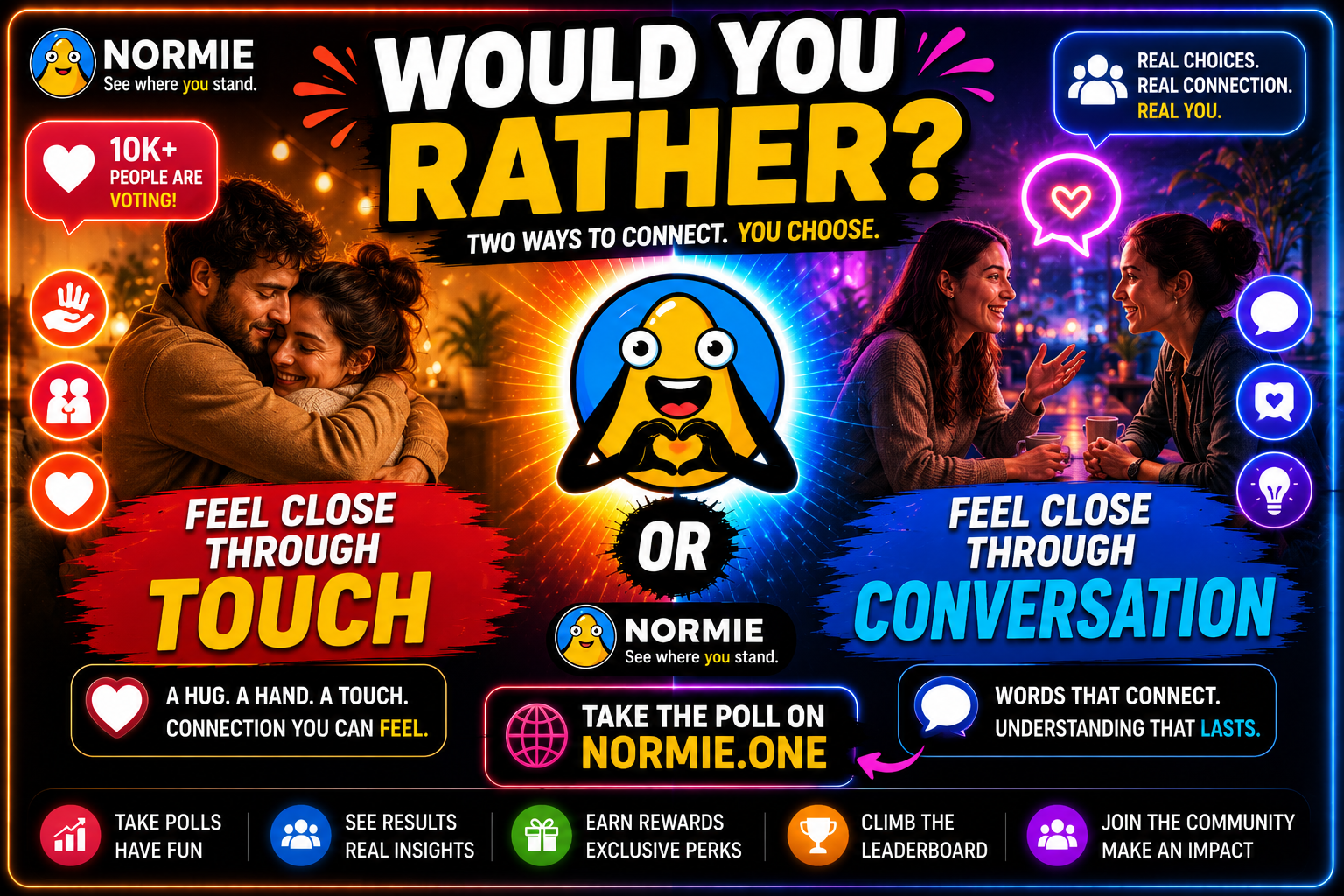
Would You Rather… Feel Close Through Touch OR Feel Close Through Conversation?
How do you know when you're truly close to someone?
Is it the feeling of their hand in yours?
A hug that lasts a little longer than expected?
Sitting together on a couch without needing to say anything?
Or is closeness created through words—the late-night conversations, private thoughts, ridiculous stories, difficult admissions, and moments when someone finally says:
“I understand what you mean.”
That brings us to a surprisingly revealing question:
Would You Rather… Feel Close Through Touch OR Feel Close Through Conversation?
This isn't simply about romance.
It can reveal something deeper about how we experience trust, affection, friendship, intimacy, reassurance, and human connection.
Some people feel closest when someone is physically present.
Others feel closest when someone truly understands what is happening inside their mind.
Neither is better.
But the difference can have an enormous effect on our relationships.
The Case for Touch
Sometimes words aren't enough.
Someone you love is hurting, and there is no brilliant sentence that will make everything better.
So you hug them.
You put your arm around them.
You hold their hand.
You sit beside them.
Nothing has been solved—and yet something has changed.
Physical affection can communicate something remarkably complicated without requiring a single word:
I'm here.
For people who naturally connect through touch, physical presence can create a powerful feeling of safety and belonging.
A partner can say “I love you” ten times, but a spontaneous hug might communicate it more deeply.
A friend can offer advice for an hour, but sometimes a hand on the shoulder says more.
Touch can make affection tangible.
The Language Without Words
Human beings communicated through physical presence long before we had smartphones, text messages, social networks, or video calls.
Think about how many emotions can be expressed physically.
A hug.
A kiss.
A handshake.
Holding hands.
Leaning against someone.
A reassuring pat on the back.
A child reaching for a parent's hand.
Friends embracing after years apart.
Two people sitting close together during a difficult moment.
These actions contain almost no information in the traditional sense.
And yet they can communicate enormous amounts of emotion.
Touch is almost like a language beneath language.
You don't necessarily analyze it.
You experience it.
The Case for Conversation
But imagine being physically close to someone who never really understands you.
You're together.
You hug.
You hold hands.
You share the same room.
But you can't tell them what you're actually thinking.
Would you still feel deeply connected?
For many people, the answer is no.
They need conversation.
Not necessarily constant talking.
They need the feeling that another person understands their internal world.
Their hopes.
Their fears.
Their strange ideas.
Their memories.
Their insecurities.
Their ambitions.
Their humor.
Their contradictions.
For these people, intimacy happens when the conversation moves beyond:
“How was your day?”
and reaches:
“Tell me what you're really thinking.”
When Conversation Becomes Intimacy
There are conversations we have with almost everyone.
What do you do?
Where are you from?
What did you think of the movie?
How was work?
Then there are conversations we have with very few people.
What are you afraid of?
What do you wish you had done differently?
When are you happiest?
Do you think you're becoming the person you wanted to become?
What do you want your life to mean?
These conversations create a different kind of closeness.
You aren't simply learning facts about another person.
You're being allowed into their internal world.
And when someone trusts you with something they don't normally reveal, the relationship changes.
Conversation can create intimacy through mutual vulnerability.
The Modern Paradox: Constant Communication, Less Connection
We have arguably never communicated more.
Texts.
Group chats.
DMs.
Comments.
Voice notes.
Video calls.
Emails.
Social feeds.
Notifications.
Yet communicating frequently isn't necessarily the same as feeling connected.
You can exchange 100 messages with someone without saying anything meaningful.
Likewise, you can spend hours physically beside another person while both stare at separate screens.
Modern technology has given us extraordinary tools for maintaining relationships across distance.
But it has also created a strange possibility:
We can be constantly connected without actually feeling close.
That distinction matters.
What Happens When Two People Connect Differently?
This is where the question becomes especially interesting.
Imagine one partner experiences affection primarily through physical closeness.
The other experiences it through conversation.
Person A thinks:
“I'm always hugging you. Of course you know I love you.”
Person B thinks:
“But you never talk to me about anything meaningful.”
Meanwhile Person B wants to spend an hour discussing their feelings.
Person A thinks:
“Why do we have to analyze everything? Just come sit with me.”
Neither person necessarily loves the other less.
They're simply sending and receiving connection differently.
And this pattern doesn't exist only in romantic relationships.
It happens between parents and children.
Friends.
Siblings.
Even generations.
Understanding how another person experiences closeness can sometimes matter almost as much as understanding what they say.
Touch Can Exist Without Emotional Intimacy
There is also an important distinction.
Physical closeness does not automatically create emotional closeness.
Two people can be physically affectionate while avoiding difficult conversations, emotional vulnerability or deeper understanding.
Touch can become comforting while still leaving important things unsaid.
That means someone who strongly prefers physical connection may occasionally need to ask:
“Am I using closeness to communicate—or to avoid communicating?”
That's a very different question.
Conversation Can Exist Without Emotional Intimacy Too
Talking isn't automatically connecting either.
Some people can talk endlessly without revealing anything vulnerable.
They discuss politics, work, sports, entertainment, other people, ideas and current events.
Hours pass.
But the conversation never reaches:
“Here's what I'm actually feeling.”
Intellectual conversation can create powerful bonds, but emotional intimacy requires something more.
It requires allowing another person to see parts of you that aren't perfectly polished.
So the question isn't simply whether you talk.
It's what you're willing to reveal when you do.
What Your Answer Might Reveal
If you choose TOUCH, you may experience connection as something physical, immediate and reassuring.
You might value presence over explanation.
Being together matters.
Affection matters.
Small physical gestures matter.
Sometimes you don't need someone to solve your problems.
You just want them beside you.
If you choose CONVERSATION, you may experience connection through understanding, curiosity and emotional openness.
You want to know people beneath the surface.
And you want them to know you.
For you, one extraordinary conversation may create more intimacy than weeks of simply spending time together.
But there's another possibility:
Your answer may depend entirely on the person.
You might crave conversation with friends but touch with a romantic partner.
You might have wanted more physical affection when you were younger and deeper conversation as you've grown older.
Our preferred forms of connection aren't necessarily permanent.
The Question Beneath the Question
Ultimately, this poll may really be asking:
Would you rather feel someone beside you—or feel someone understands you?
That's much harder.
Because most of us probably want both.
We want someone who can talk with us until 2:00 in the morning...
…and someone we can sit beside at 2:00 in the morning without saying anything.
Someone who asks:
“What's going on?”
But also recognizes the moments when the better response is simply:
“Come here.”
Maybe the Deepest Connection Requires Both
The strongest relationships may not choose between physical and conversational intimacy.
They learn to move between them.
Words create understanding.
Touch creates presence.
Conversation says:
“I want to know you.”
Touch can say:
“I'm here with you.”
And when those two forms of connection reinforce each other, something powerful happens.
You don't simply feel loved.
You feel known, accepted and accompanied.
In an increasingly digital world, that combination may become more valuable—not less.
Because technology can reproduce many parts of communication.
It can generate words.
Recommend responses.
Maintain conversations.
Translate languages.
Even simulate companionship.
But human relationships are much bigger than information exchange.
They are built from shared experiences, vulnerability, presence, memories, laughter, silence, trust—and sometimes the simple reassurance of another human being sitting beside you.
Would You Rather?
🤝 FEEL CLOSE THROUGH TOUCH
Presence. Affection. Warmth. Physical reassurance.
OR
💬 FEEL CLOSE THROUGH CONVERSATION
Understanding. Vulnerability. Ideas. Emotional connection.
Your answer might reveal more than how you communicate.
It might reveal what makes you feel truly seen by another person.
Take the poll, compare your answer with the community, build your Player Profile, earn points and discover how your choices compare with others on Normie.one.
Normie — See where you stand.
Real Questions. Real People. Real Connection.
#connection, #touch, #conversation, #relationships, #intimacy, #communication