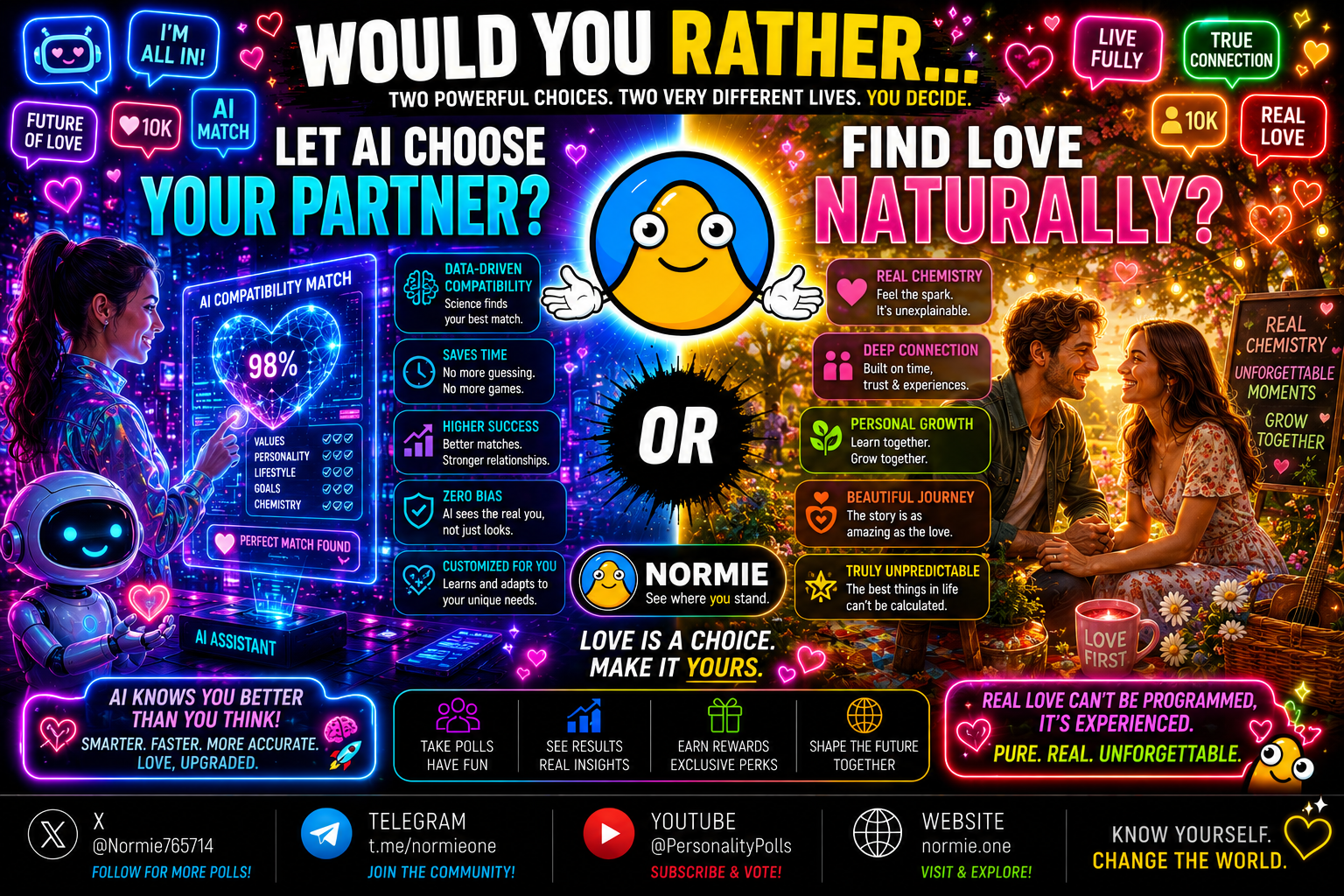
Would You Rather… Let AI Choose Your Partner… OR Find Love Naturally?
Love may be humanity’s oldest mystery.
For thousands of years, people searched for connection through chance encounters, shared experiences, chemistry, intuition, and emotion.
But now, something new is happening.
Artificial intelligence is slowly entering the most personal part of human life:
Relationships.
Dating apps already use algorithms to influence attraction.
Social media predicts compatibility through behavior patterns.
AI systems can analyze personality traits, interests, communication styles, emotional tendencies, and even facial expressions.
So the question no longer sounds like science fiction.
It sounds inevitable.
Would you rather let AI choose your perfect partner…
or find love naturally?
The answer may reveal how much you trust technology… and how much you believe love should remain human.
The Rise of Algorithmic Love
Modern dating is already heavily controlled by algorithms.
Apps track:
Who you swipe on
How long you look at profiles
Your texting behavior
Your interests
Your location
Your emotional preferences
AI systems are becoming surprisingly good at predicting compatibility.
Some researchers believe future AI could analyze:
Personality psychology
Attachment styles
Emotional regulation
Communication patterns
Life goals
Behavioral habits
Conflict tendencies
Long-term compatibility probabilities
In theory, AI may eventually know who you are compatible with better than you do.
That idea is both fascinating… and terrifying.
The Argument for Letting AI Choose
Many people struggle in relationships because attraction and compatibility are not always the same thing.
Humans are emotional.
People often choose partners based on:
Physical attraction
Excitement
Trauma patterns
Familiarity
Validation
Impulse
Fantasy
This can lead to repeated unhealthy relationship cycles.
AI, however, wouldn’t operate emotionally.
An advanced system might recognize:
toxic compatibility patterns
emotional mismatches
unhealthy attachment dynamics
communication incompatibilities
long-term value differences
It may calculate relationship success with extraordinary accuracy.
Imagine an AI system telling you:
“This person statistically gives you the highest probability of long-term happiness.”
Would you trust it?
AI Could Reduce Loneliness
Loneliness is becoming one of the biggest emotional issues in modern society.
Despite infinite digital connection, many people feel emotionally disconnected.
Some experts believe AI-assisted matchmaking could:
create stronger compatibility
reduce divorce rates
improve emotional communication
help introverts connect
reduce toxic dating patterns
In a world filled with endless dating options and swipe fatigue, some people may eventually prefer precision over randomness.
Especially if AI becomes highly accurate.
But Love Isn’t Just Math
This is where the debate becomes emotional.
Love has always contained mystery.
Unexpected timing.
Chemistry.
Imperfection.
Chance encounters.
Growth through struggle.
Many people believe the beauty of love comes from its unpredictability.
Could an algorithm truly understand:
butterflies in your stomach?
emotional timing?
spiritual connection?
intuition?
passion?
sacrifice?
soul-level chemistry?
Some things may be impossible to quantify.
A relationship may look “perfect” on paper…
yet feel emotionally empty.
Meanwhile, two completely incompatible people may build extraordinary love through growth and shared experience.
Humans are not spreadsheets.
The Danger of Optimized Relationships
There’s another deeper concern.
If AI perfectly optimized relationships, would love become less human?
Part of what makes relationships meaningful is vulnerability.
The uncertainty matters.
The risk matters.
The process of discovering another person matters.
If AI removed all uncertainty:
Would romance feel artificial?
Would people stop trusting intuition?
Would emotional spontaneity disappear?
Would people become overly dependent on algorithms?
Some fear that hyper-optimized relationships could eventually feel emotionally engineered rather than naturally discovered.
The Psychology Behind the Question
Your answer says a lot about your worldview.
People who choose AI-assisted love may value:
logic
efficiency
compatibility
stability
psychological insight
long-term optimization
People who choose natural love may value:
intuition
spontaneity
chemistry
emotional mystery
fate
human imperfection
This question also reflects a larger societal shift:
How much decision-making are humans willing to give to AI?
Today it’s music recommendations.
Tomorrow it may be careers, friendships, and romantic partners.
The Future May Combine Both
The most likely future may not be fully artificial or fully natural.
Instead, humans may use AI as a guide rather than a replacement.
AI could help identify compatibility patterns…
while humans still choose based on emotion, intuition, and connection.
In many ways, that’s already happening.
Technology increasingly influences:
who we meet
who we talk to
who we spend time with
who we fall in love with
The line between “natural” and “algorithmic” love is already blurry.
Love in the AI Era
As artificial intelligence becomes more powerful, relationships may become one of the biggest philosophical battlegrounds of the future.
Because love is not just about compatibility.
It’s about meaning.
And humans are still trying to understand what makes connection truly real.
Perhaps AI will help people avoid heartbreak.
Or perhaps the heartbreak, uncertainty, and vulnerability are part of what makes love human in the first place.
Final Question
At the end of the day…
Would you rather trust advanced AI to find your ideal partner…
OR
take your chances finding love naturally?
Because one path trusts data and probability…
And the other trusts chemistry, timing, and the mystery of human connection.
Explore more psychology-driven relationship debates and behavioral polls at Normie