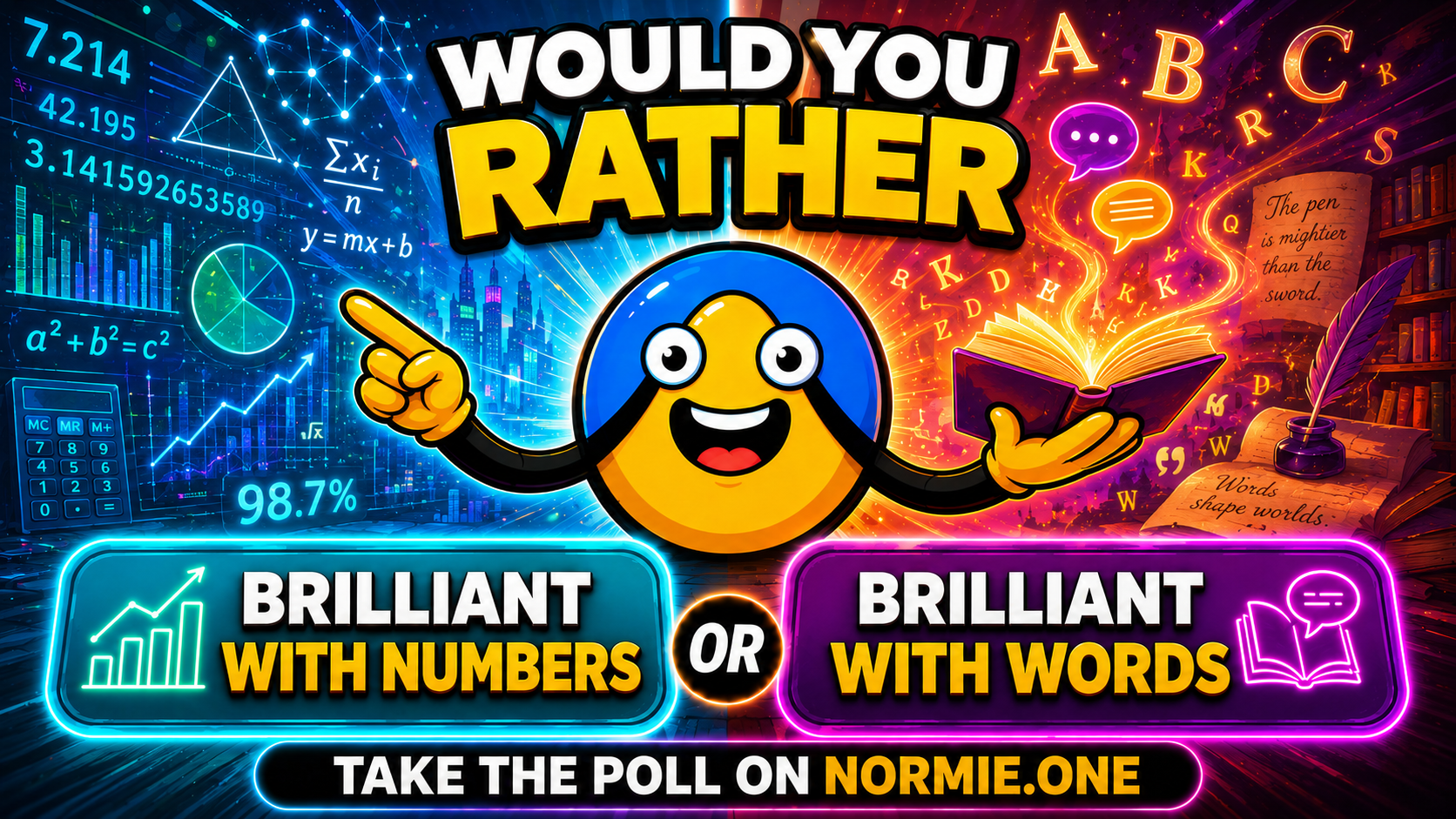
Would You Rather Be Brilliant With Numbers… or Brilliant With Words?
“Numbers reveal the pattern. Words reveal the meaning.”
Human progress has always depended on two kinds of brilliance.
One sees the world through numbers: patterns, probabilities, systems, measurements, models, and equations. It helps us calculate risk, design technology, understand markets, build bridges, model disease, and transform enormous amounts of information into decisions.
The other sees the world through words: language, stories, persuasion, metaphor, explanation, and dialogue. It helps us share knowledge, lead movements, build relationships, resolve conflict, teach difficult ideas, and turn private thoughts into something another person can understand.
Both forms of intelligence are powerful. But they do different things.
Numbers help us understand how the world works. Words help us decide what that understanding means—and what we should do with it.
The Intelligence of Numbers
Numerical brilliance is not just about being fast at math.
It is the ability to recognize structure beneath complexity. It can mean seeing a pattern in financial markets, identifying an error in a system, understanding probability, modeling a future scenario, or knowing how small changes in one part of a process affect everything else.
This kind of thinking is increasingly valuable in a world shaped by data, artificial intelligence, automation, engineering, finance, and science. The people who can make sense of numbers often help organizations see what is happening before everyone else does.
They may ask:
What does the data actually show?
What pattern is emerging?
What are the odds?
Where is the risk hiding?
What can be measured, tested, and improved?
Numerical intelligence can offer clarity when emotion, opinion, and noise are competing for attention. It can challenge assumptions and expose gaps between what people believe and what the evidence suggests.
But numbers alone do not automatically tell us what matters.
A data point can reveal that something is growing, declining, profitable, dangerous, or efficient. It cannot, by itself, tell us whether the outcome is good, fair, meaningful, or worth pursuing. That requires values, context, and communication.
The Intelligence of Words
Verbal brilliance is also more than having a large vocabulary.
It is the ability to organize thought, explain complexity, understand nuance, and communicate in a way that reaches people. It is knowing when one sentence can clarify an idea that a thousand facts cannot. It is using language to create trust, move an audience, settle disagreement, or make someone feel understood.
Words can turn information into action.
A scientist may make a discovery, but someone must explain why it matters. An entrepreneur may see an opportunity, but someone must articulate the vision. A leader may have a strategy, but people need language that makes them want to believe in it.
Those gifted with words may ask:
What is the real story here?
What does this mean for people?
How can this idea be made clear?
What needs to be said that has not been said yet?
How can we create understanding instead of just winning an argument?
Words can inspire, heal, persuade, divide, comfort, teach, and challenge. They can become the bridge between a complex idea and the people who need to act on it.
But words without substance can also create an illusion of understanding. A powerful message is not necessarily a true one. The strongest communicators pair language with honesty, evidence, and responsibility.
Precision and Persuasion
The most influential people and organizations often learn to combine both strengths.
Data can identify the problem. Words can make people care about solving it.
Numbers can help an investor evaluate risk. Words can help a founder inspire a team. Numbers can show whether a medical treatment works. Words can help patients understand the decision in front of them. Numbers can model the future. Words can help people imagine themselves in it.
In the era of AI, this combination may become even more important.
Machines are becoming exceptionally capable of processing information, calculating outcomes, and generating language. But humans still need to ask the right questions, interpret the consequences, and decide what should be optimized in the first place.
The future will not belong only to people who can calculate or communicate. It will favor those who can connect evidence with meaning.
What Your Choice May Reveal
Choosing brilliant with numbers may suggest that you are drawn to logic, systems, precision, analysis, and the satisfaction of finding the hidden pattern.
Choosing brilliant with words may suggest that you are drawn to expression, storytelling, persuasion, connection, and the ability to turn ideas into shared understanding.
Neither answer is a limitation. Many people have some of both, and each ability can be developed with practice. The question simply reveals which kind of power feels more compelling to you.
Would you rather see the structure beneath the world—or possess the language to shape how the world understands itself?
Would You Rather Be Brilliant With Numbers… or Brilliant With Words?
Take the poll on Normie, choose your intellectual superpower, and see whether the community prefers precision or persuasion.
#WouldYouRather #Intelligence #Numbers #Words #Normie