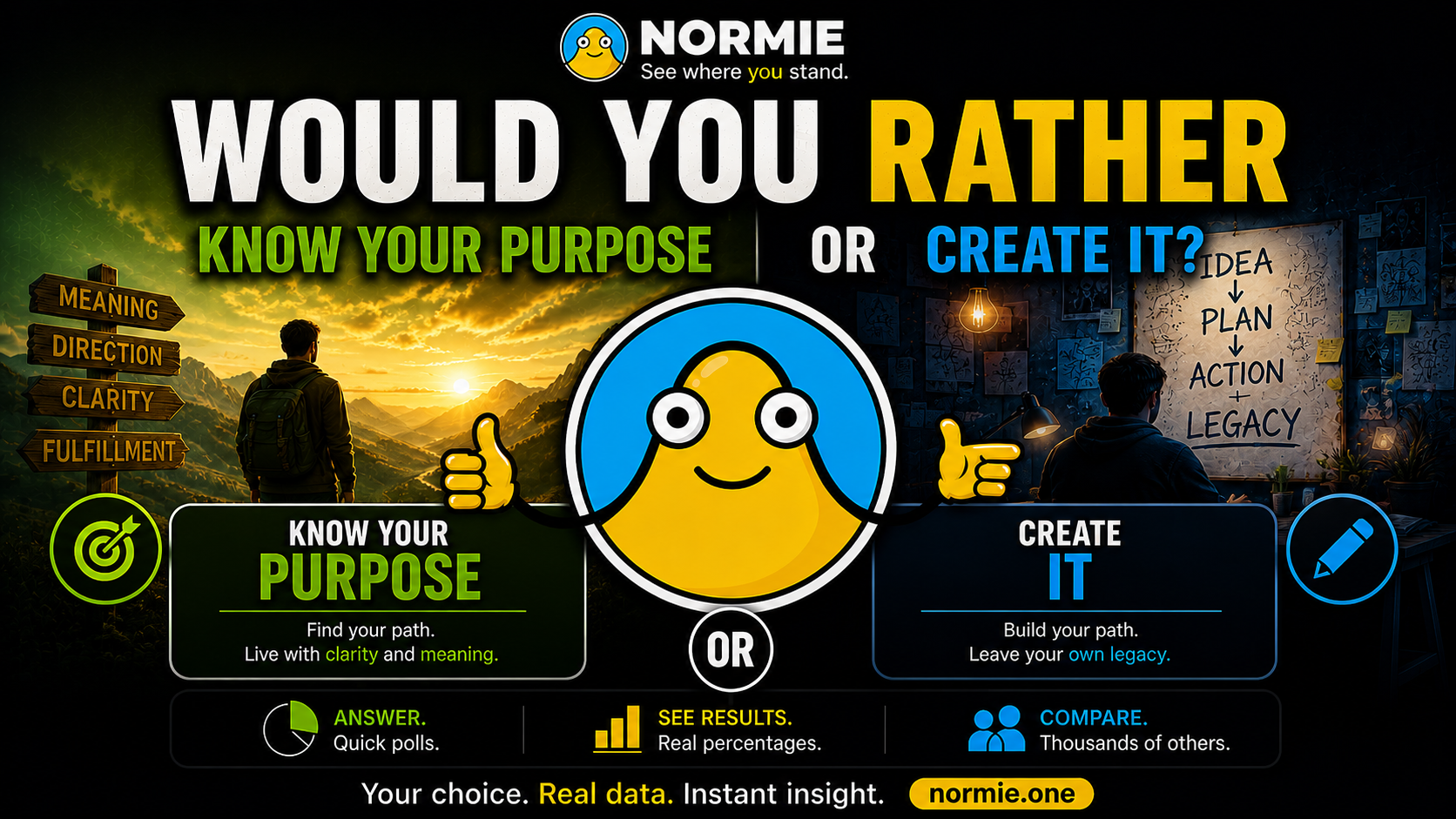
Would You Rather Know Your Purpose… or Create It?
Human beings have always searched for meaning.
Across history, philosophy, religion, psychology, and modern self-help, one question keeps returning in different forms:
“Why am I here?”
Some people believe purpose already exists — hidden somewhere deep inside us, waiting to be discovered like buried treasure.
Others believe purpose is not found at all.
It is built.
Created.
Invented through choices, struggle, experiences, and action.
And that leads to one of the most fascinating psychological questions imaginable:
Would you rather KNOW your purpose…
or CREATE it?
At first, the question seems simple.
But underneath it lies a massive divide in how humans view identity, destiny, freedom, and the meaning of life itself.
<div class="blog-embed"><iframe src="https://www.youtube-nocookie.com/embed/5uyzitJ5qE8" title="youtube embed" loading="lazy" allowfullscreen></iframe></div>The Desire to KNOW Your Purpose
Most people secretly want certainty.
We want reassurance that:
our life matters
our struggles have meaning
our talents exist for a reason
we are moving toward something important
The idea of “knowing your purpose” is emotionally powerful because it removes ambiguity.
It gives direction.
It creates clarity in a chaotic world.
Imagine waking up tomorrow with absolute certainty about:
what you’re meant to do
who you’re meant to help
why you exist
where your path leads
No confusion.
No second-guessing.
No endless searching.
For many people, that sounds like freedom.
As author Mark Twain famously said:
“The two most important days in your life are the day you are born and the day you find out why.”
That quote resonates deeply because humans crave meaning almost as much as survival itself.
The Psychological Comfort of Destiny
Believing you have a predefined purpose can reduce anxiety.
It creates structure in a world filled with uncertainty.
Psychologists have long observed that humans naturally seek narratives that make life feel coherent.
Purpose acts as psychological gravity.
Without it, people often feel:
lost
disconnected
anxious
directionless
emotionally adrift
This may explain why so many people obsess over:
astrology
personality tests
spirituality
career alignment
“calling” culture
life coaches
motivational content
People desperately want signs that they are “on the right path.”
Because uncertainty can feel terrifying.
But What If Purpose Isn’t Found?
Now comes the other side of the question.
What if purpose isn’t hidden somewhere waiting to be discovered?
What if purpose is something humans create through action?
This idea is central to existential philosophy.
Thinkers like Jean-Paul Sartre argued that life does not come preloaded with meaning.
Instead:
“Man first exists, encounters himself, and defines himself afterward.”
In other words:
You are not born with a finished identity.
You become who you are through choices.
This is both liberating…
and frightening.
Because if purpose must be created, then responsibility shifts entirely onto us.
No destiny.
No script.
No guaranteed path.
Only decisions.
The Freedom of Creating Purpose
There is incredible power in creating your own purpose.
Why?
Because it means your past does not permanently define you.
You can reinvent yourself.
Again and again.
A person born into hardship can create meaning through resilience.
An artist can create purpose through expression.
A parent can create purpose through love.
An entrepreneur can create purpose through building something impactful.
Purpose becomes dynamic instead of fixed.
And this perspective may actually be more empowering than waiting for some mystical “true calling” to appear.
As Viktor Frankl — Holocaust survivor and author of Man’s Search for Meaning — wrote:
“Life is never made unbearable by circumstances, but only by lack of meaning and purpose.”
Frankl did not argue that meaning magically arrives.
He believed humans actively create meaning through:
suffering
responsibility
love
courage
action
The Hidden Danger of “Finding Your Purpose”
Modern culture often romanticizes purpose.
Social media constantly pushes messages like:
“Find your passion.”
“Discover your calling.”
“Unlock your destiny.”
But this creates an unexpected problem.
Many people become paralyzed searching for the “perfect purpose.”
They delay action because they fear choosing the wrong path.
They wait for certainty instead of building momentum.
Ironically, purpose is often discovered through movement — not overthinking.
Many successful people did not begin with perfect clarity.
Their purpose evolved over time.
Steve Jobs once said:
“You can’t connect the dots looking forward; you can only connect them looking backward.”
That idea changes everything.
Purpose may not always appear as a lightning bolt moment.
Sometimes it emerges gradually through:
experimentation
failure
relationships
curiosity
hardship
growth
Humans Want Meaning — But Also Freedom
This is where the question becomes psychologically fascinating.
Knowing your purpose offers certainty.
Creating your purpose offers freedom.
But humans want both.
We want:
direction without limitation
meaning without sacrifice
identity without uncertainty
Yet life rarely works that way.
Too much certainty can become rigid.
Too much freedom can become overwhelming.
That tension exists at the core of modern human psychology.
The Modern Crisis of Purpose
Today, millions of people struggle with purpose more than ever before.
Why?
Because modern life offers endless options.
Previous generations often inherited identity through:
family roles
religion
geography
tradition
career expectations
Today, people face infinite possibilities.
While freedom sounds empowering, it can also create decision paralysis.
Psychologist Barry Schwartz called this:
“The Paradox of Choice.”
The more options humans have, the harder meaning becomes to define.
And social media amplifies this problem.
Every day people compare themselves to:
entrepreneurs
influencers
athletes
creators
millionaires
spiritual gurus
AI-generated success stories
This creates the illusion that everyone else has already found their purpose.
When in reality…
most people are still figuring themselves out.
Maybe Purpose Is Not One Thing
Another hidden assumption is that humans have only one purpose.
But what if purpose evolves throughout life?
At 20, your purpose may involve exploration.
At 40, it may involve contribution.
At 60, it may involve wisdom or legacy.
Purpose may not be a single destination.
It may be an ongoing process of becoming.
As Carl Jung once wrote:
“The privilege of a lifetime is to become who you truly are.”
That process never fully ends.
AI, Technology, and the Future of Purpose
The rise of AI makes this conversation even more important.
As automation changes work and identity, millions may begin questioning:
What makes humans valuable?
What gives life meaning?
What role do humans play in an AI-driven world?
For decades, people tied purpose to productivity.
But if AI performs more jobs, humans may increasingly search for meaning beyond work.
This could trigger:
spiritual exploration
creative reinvention
identity shifts
psychological transformation
deeper questions about consciousness and fulfillment
The future may force humanity to redefine purpose entirely.
So… Which Would You Choose?
Would you rather KNOW your purpose…
or CREATE it?
One offers certainty.
The other offers freedom.
One feels comforting.
The other feels empowering.
But perhaps the deepest truth is this:
Purpose may not be something humans simply discover.
And it may not be something humans completely invent either.
Maybe purpose emerges from the interaction between:
who we are
what we experience
what we love
what we survive
and what we choose to become
Final Thoughts
Humans spend much of life searching for answers about identity and meaning.
But perhaps the goal is not to find one perfect purpose forever.
Perhaps the goal is to live deeply enough that meaning naturally grows from the way we engage with life itself.
Because in the end…
purpose may not be a destination.
It may be a relationship between your choices, your awareness, and the impact you leave behind.
What Would YOU Choose?
KNOW Your Purpose
OR
CREATE It?
Vote now and compare your answer with thousands of others on:
Join the community:
X / Twitter @Normie765714
YouTube @PersonalityPolls