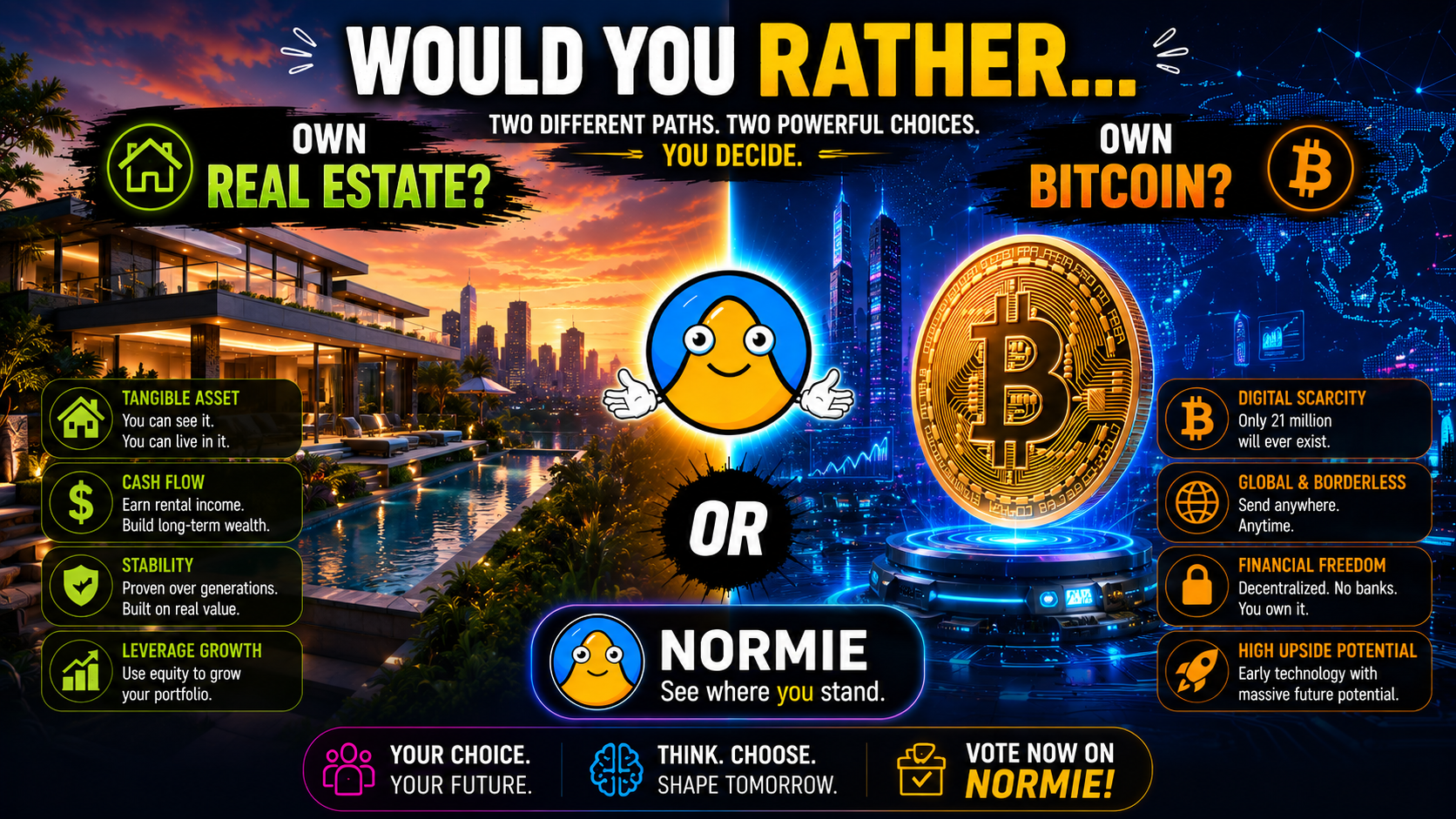
Would You Rather… Own Real Estate… OR Bitcoin?
For decades, real estate was considered one of the safest paths to wealth.
Buy property.
Hold it long term.
Build equity.
Generate cash flow.
Pass it down to future generations.
Then Bitcoin arrived and challenged everything.
Suddenly, a completely digital asset with no physical form began outperforming many traditional investments on Earth.
And now millions of people are asking a question that would have sounded absurd twenty years ago:
Would You Rather…
Own Real Estate…
OR
Bitcoin?
At first glance, this seems like a financial question.
But underneath the surface, it’s really a debate about:
old systems vs new systems
physical assets vs digital assets
stability vs volatility
tradition vs innovation
security vs freedom
And perhaps most importantly…
What kind of future do you believe humanity is moving toward?

Why People Trust Real Estate
Real estate feels real.
You can touch it.
Live in it.
Rent it.
Improve it.
Pass it to your children.
For generations, property ownership represented stability and success.
Real estate offers:
physical utility
cash flow potential
leverage opportunities
inflation protection
long-term appreciation
psychological security
There’s comfort in owning something tangible.
Even during economic uncertainty, people will always need places to live, work, and gather.
That creates a sense of permanence.
Real estate also became deeply connected to the “American Dream.”
Owning property symbolized:
independence
family stability
wealth creation
social status
For many people, it still does.
But Real Estate Has Limitations
The problem is that real estate is not as flexible as the modern world.
Property is:
expensive to maintain
difficult to move
heavily taxed
highly regulated
geographically fixed
slow to transact
And in many cities, younger generations feel increasingly locked out of ownership entirely.
Housing prices have exploded.
Interest rates fluctuate.
Debt burdens increase.
Meanwhile, technology is reshaping how people think about ownership itself.
The digital generation values:
mobility
speed
decentralization
accessibility
borderless assets
And that’s exactly where Bitcoin enters the conversation.
Why Bitcoin Feels Revolutionary
Bitcoin is unlike anything humanity has ever seen before.
It’s:
digital
decentralized
borderless
scarce
programmable
independent of governments
Only 21 million Bitcoin will ever exist.
To Bitcoin believers, this makes it “digital property.”
A new form of ownership native to the internet age.
Unlike real estate, Bitcoin can be:
transferred globally within minutes
self-custodied
divided infinitely
accessed anywhere on Earth
No banks.
No middlemen.
No physical limitations.
To many younger investors, Bitcoin feels less like speculation…
and more like the future of money itself.
The Psychology Behind Both Choices
What makes this debate fascinating is that both assets satisfy completely different emotional needs.
Real estate represents:
security
grounding
stability
tradition
permanence
Bitcoin represents:
freedom
independence
innovation
disruption
future potential
Real estate appeals to people who value structure.
Bitcoin appeals to people who distrust systems.
And in today’s world, trust itself is changing.
Bitcoin Is More Than an Investment
For many people, Bitcoin has become philosophical.
It represents resistance against:
inflation
centralized banking
excessive money printing
government control
financial surveillance
Some view Bitcoin almost as a digital revolution.
A financial system built for the internet era.
Its supporters believe future generations may eventually trust code more than institutions.
And if that happens, Bitcoin could become one of the most important assets of the digital age.
But critics argue Bitcoin remains:
highly volatile
speculative
emotionally driven
vulnerable to regulation
dependent on adoption
Unlike real estate, Bitcoin produces no shelter and no direct utility beyond its network.
Its value comes largely from collective belief.
Then again…
so does money itself.
Real Estate vs Bitcoin Is Really About Time Horizons
Real estate often rewards patience slowly.
Bitcoin rewards conviction through chaos.
Real estate investors tend to think in decades.
Bitcoin investors often think in cycles and exponential adoption curves.
One asset evolved from the industrial world.
The other emerged from the digital world.
And humanity now lives between both.
The Generational Divide
Older generations often trust real estate because they experienced decades where property created wealth consistently.
Younger generations grew up online.
They understand:
digital networks
virtual ownership
online economies
decentralized communities
internet-native value systems
To them, digital scarcity feels normal.
This generational divide may shape investing trends for decades.
Because the future economy may increasingly blur the line between physical and digital assets.
The Most Powerful Investors May Own Both
The truth is, many wealthy investors no longer see this as an either/or question.
Real estate provides:
stability
cash flow
leverage
tangible value
Bitcoin provides:
upside potential
mobility
scarcity
asymmetric opportunity
One anchors wealth.
The other potentially accelerates it.
And perhaps the smartest strategy isn’t choosing sides emotionally…
but understanding what role each asset plays.
The Real Question Behind the Question
This “Would You Rather” isn’t only asking:
“What would you invest in?”
It’s asking:
“What future do you believe in?”
A future built on physical ownership and traditional systems?
Or a future driven by digital networks, decentralized assets, and internet-native economies?
Your answer may reveal:
your risk tolerance
your trust in institutions
your view of technology
your beliefs about money itself
Final Thought
Human civilization is entering a period where digital and physical worlds are colliding faster than ever before.
Homes are becoming smarter.
Money is becoming digital.
Ownership itself is evolving.
Real estate represents the foundation of the old world.
Bitcoin represents the emergence of a new one.
And somewhere between those two systems…
the future economy is being built right now.
So the question remains:
Would You Rather…
Own Real Estate…
OR
Bitcoin?
Vote now on Normie — the psychology-powered platform exploring finance, technology, human behavior, and the future of digital culture.