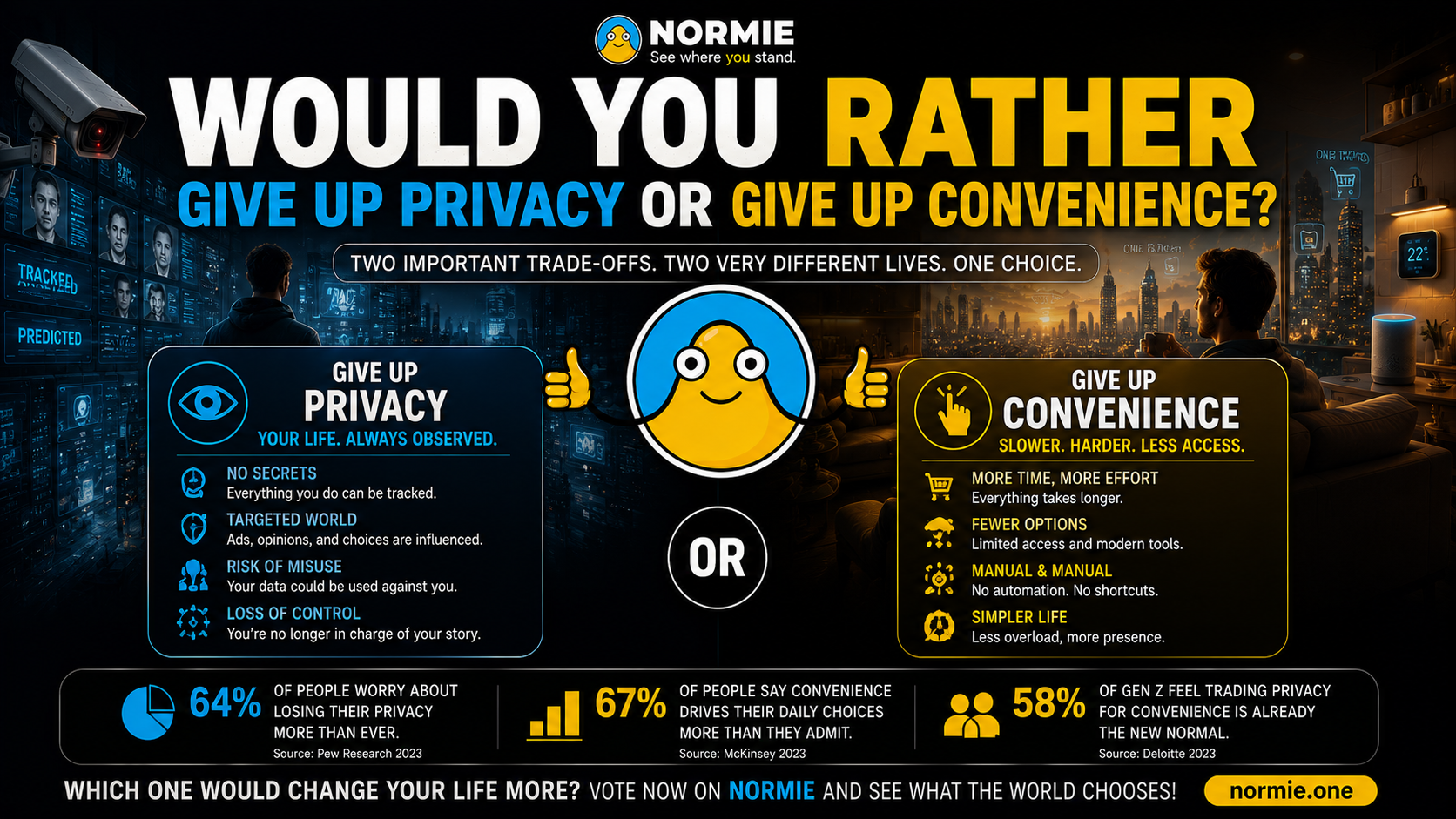
Would You Rather Give Up Privacy… or Convenience?
Modern life runs on invisible tradeoffs.
Every time you:
unlock your phone with your face
ask an AI assistant a question
use GPS navigation
shop online
scroll social media
wear a smartwatch
accept cookies
use a free app
you are participating in one of the biggest psychological and technological exchanges in human history:
privacy for convenience.
And whether people realize it or not, society is slowly being forced to answer a question that may define the future of civilization itself:
Would You Rather…
Give Up Privacy…
OR
Give Up Convenience?
At first, most people instinctively say:
“Obviously privacy matters.”
But then reality arrives.
Because convenience is addictive.
The Age of Frictionless Living
Technology companies figured out something incredibly important about human behavior:
People will trade enormous amounts of personal information for tiny reductions in friction.
Humans love:
speed
ease
personalization
automation
instant gratification
comfort
And the easier technology becomes, the harder it is to resist.
Think about how quickly society adapted to:
one-click ordering
facial recognition
voice assistants
predictive search
AI recommendations
smart homes
location tracking
biometric authentication
Most people no longer ask:
“Should this technology exist?”
Instead they ask:
“Does it make my life easier?”
That subtle shift changed everything.
Privacy Used to Mean Something Different
For most of human history, privacy was natural.
You could:
disappear into a crowd
move anonymously
have private conversations
make mistakes without permanent records
reinvent yourself
But the digital age created permanent memory.
Now:
your searches are stored
your movements are tracked
your preferences are analyzed
your attention is monetized
your behavior is predicted
In many ways, data has become more valuable than oil.
And humans themselves became the product.
The Attention Economy Knows You Better Than You Think
Modern algorithms are not just observing behavior.
They are learning:
your emotional triggers
your habits
your fears
your desires
your routines
your vulnerabilities
Every click teaches the machine something.
Over time:
recommendation engines become psychological mirrors
AI becomes predictive
platforms learn how to influence attention
digital systems shape decision-making itself
This is why many experts believe the future battle is not just about information…
but about human autonomy.
Why Most People Choose Convenience
The truth is uncomfortable:
Most people already chose convenience.
Not because they are weak.
Because convenience feels invisible.
The tradeoff happens slowly:
“Allow location access?”
“Accept all cookies?”
“Enable microphone?”
“Sync contacts?”
“Use face ID?”
“Personalized recommendations?”
One tap.
One permission.
One shortcut at a time.
And eventually convenience becomes dependency.
Imagine suddenly losing:
GPS
autofill passwords
AI assistants
streaming recommendations
cloud storage
smart devices
online banking
instant search
Modern life would feel dramatically harder overnight.
Convenience doesn’t just help people anymore.
It structures reality itself.
The Psychological Comfort of Convenience
Convenience reduces cognitive load.
Humans are biologically wired to conserve energy.
This is why people naturally prefer:
easier decisions
faster systems
automation
reduced uncertainty
Technology increasingly acts like an external brain.
Phones now remember:
birthdays
directions
phone numbers
appointments
shopping lists
entertainment preferences
conversations
even health data
The result?
Humans outsource more thinking every year.
And AI may accelerate this trend dramatically.
The Fear Behind Losing Privacy
Yet privacy matters for reasons deeper than secrecy.
Privacy protects:
individuality
freedom of thought
experimentation
dissent
personal growth
psychological safety
Without privacy:
people behave differently.
This is one of the most studied effects in psychology.
When humans know they are being watched:
they self-censor
conformity increases
creativity often decreases
risk-taking changes
authenticity weakens
A world without privacy can slowly become a world without psychological freedom.
The AI Era Changes the Stakes
Artificial intelligence raises this debate to an entirely new level.
AI systems thrive on data.
The more data AI receives:
the smarter it becomes
the more personalized it gets
the more predictive it becomes
Future AI assistants may know:
your schedule
your finances
your relationships
your emotional states
your health patterns
your goals
your weaknesses
And honestly?
Many people will love this.
Imagine an AI that:
handles your calendar
negotiates your bills
optimizes your health
plans your meals
filters information
automates your work
predicts problems before they happen
It sounds incredible.
But it also requires extraordinary access to personal data.
The future may force humanity into a difficult realization:
The most intelligent systems often require the deepest surveillance.
The Real Question Isn’t Privacy vs Convenience
The real question is:
“How much control are humans willing to surrender in exchange for comfort?”
Because convenience gradually changes behavior.
Navigation weakened memory skills.
Social media changed attention spans.
Streaming altered patience.
AI may change thinking itself.
Technology doesn’t just serve humans.
It reshapes them.
The Generational Divide
Older generations often remember life before constant surveillance.
Younger generations were born into digital visibility.
For many younger people:
sharing feels normal
tracking feels expected
online identity feels inseparable from real identity
This creates a cultural shift where privacy increasingly feels abstract while convenience feels immediate.
And humans almost always prioritize immediate rewards over distant risks.
The Future Could Split Into Two Worlds
Some experts believe society may eventually divide into two groups:
The Convenience Class
People who fully integrate with AI systems, smart devices, biometric ecosystems, automation, and predictive technology.
Maximum comfort.
Minimal friction.
Minimal privacy.
The Privacy Class
People who intentionally disconnect:
encrypted systems
offline living
minimal digital footprints
decentralized technology
privacy-first tools
More effort.
More control.
More independence.
The future may not be one system.
It may become a spectrum of tradeoffs.
The Strange Irony
Here’s the paradox:
Humans say they value privacy deeply.
But behavior consistently shows:
people value convenience more.
This gap between belief and behavior is one of the defining contradictions of modern civilization.
People fear surveillance while carrying tracking devices voluntarily.
People criticize algorithms while relying on them daily.
People distrust AI while increasingly delegating decisions to it.
Convenience slowly normalizes surrender.
Final Thought
Privacy and convenience are not just technological issues.
They are philosophical questions about:
freedom
identity
autonomy
comfort
control
what it means to remain human in an AI-driven world
Because every technological advancement asks humanity the same hidden question:
“What are you willing to trade for ease?”
And history shows:
humans rarely notice the true cost until the trade is already complete.
Would You Rather…
Give Up Privacy…
OR
Give Up Convenience?
Vote now on Normie — the psychology-powered SocialFi platform exploring human behavior, technology, emotion, and the choices shaping the future of humanity.
Join the community:
X / Twitter @Normie765714
YouTube @PersonalityPolls