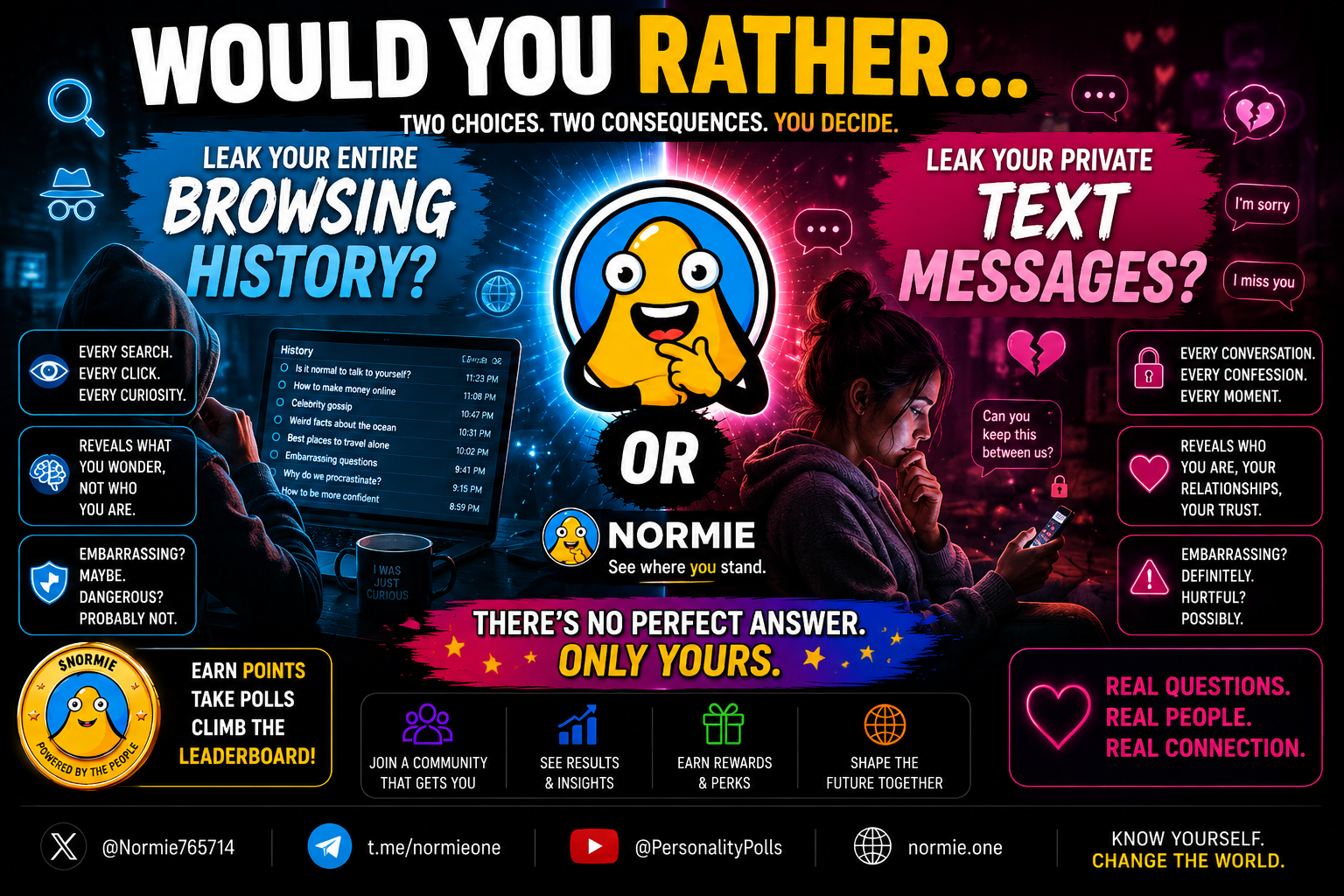
Would You Rather: Leak Your Browsing History or Your Private Texts?
It sounds like a party game. It isn't. It's a surprisingly precise instrument for figuring out what you actually value — privacy from whom, and privacy from what kind of judgment.
Ask a room this question and you'll watch people sort themselves into two camps almost instantly, with almost no deliberation. That instinct is worth examining, because it reveals something most of us haven't thought carefully about: not all privacy is the same shape.

Two Different Kinds of Exposure
Your browsing history is a record of you alone. It's the unedited transcript of your curiosity, boredom, anxiety, and appetite — searches at 2 a.m., health symptoms you Googled before telling anyone, political rabbit holes, shopping you're embarrassed by, things you clicked and immediately regretted. Nobody co-authored it. It's you talking to a machine that you assumed wasn't really listening.
Your texts are a record of you with other people. They're relational — half of every exchange belongs to someone else, who never consented to being exposed. A leaked message thread doesn't just reveal what you think; it reveals what you said about your sister to your best friend, what your friend said back, the joke that would read badly out of context, the fight you had with your partner in real time.
So the question isn't really "which is more private." It's: would you rather be embarrassed alone, or embarrassed in front of — and alongside — the people who trust you?
The Case for Leaking Browsing History
Most people who choose this option are making a bet on deniability. A search history has no addressee. It can be reframed: "I was curious," "I was researching for a friend," "that's not what it looks like." There's an interpretive gap between clicking something and endorsing it that doesn't exist in the same way with a text you actively composed and sent.
There's also the fact that browsing history, however revealing, is generally a monologue. It implicates only you. Nobody else's privacy is collateral damage. If you're the kind of person who compartmentalizes — who can live with being seen as strange or contradictory, as long as it doesn't cost you a relationship — this is the "safer" leak.
The Case for Leaking Texts
People who'd rather expose their texts are usually making a different bet: they trust their character more than their curiosity. A text thread, even an unflattering one, is still you behaving like a person in relationship — arguing, apologizing, gossiping, flirting, being petty and then being kind two messages later. It's messy, but it's recognizably human and social, which people are quick to forgive because they recognize it in themselves.
Browsing history, by contrast, often has no narrative logic. It's fragments without context — and fragments are exactly what algorithms of judgment (and actual algorithms) are worst at handling fairly. A single search taken out of sequence can imply something entirely false about who you are. At least a text has a scene: a sender, a recipient, a moment.
The Part Everyone Underestimates
Here's the twist most people miss when they answer instinctively: texts implicate other people, and that changes the ethics of the choice, not just the stakes. Choosing to leak your texts isn't really "your" choice to make alone — you're volunteering your friends, family, and partners into the leak with you. Their private words, their bad days, their vulnerable disclosures to you, all exposed without their consent, filtered through your decision.
That's the real asymmetry. Browsing history is a privacy question about you. Texts are a privacy question about your entire social graph. Answering quickly, without registering that difference, is itself revealing — it suggests we tend to think of privacy as something that belongs to individuals, when a lot of the time it's held jointly, and we're only one signature on the lease.
What the Question Is Actually Testing
Underneath the hypothetical are three real questions people are answering without realizing it:
Do I fear being misunderstood more than being known? (Browsing history risks the former; texts risk the latter.)
Whose trust matters more to me — strangers' or intimates'? A leaked search history mostly damages your reputation with people who don't know you. Leaked texts damage your standing with the people who do.
How much of my selfhood is performed versus private? Texts are already semi-performed — you chose your words for an audience of one or a few. Browsing history is the closest thing most of us have to an unperformed self. Some people find that self more frightening to reveal precisely because no one edited it.
There's No Right Answer — But There's a Better Question
The instinctive answer people give says less about which leak is "worse" and more about what kind of shame they're least equipped to survive: the shame of being misjudged by strangers, or the shame of being fully seen — flaws, contradictions, and all — by the people whose opinion actually shapes their life.
Maybe the more useful version of the question isn't "which would you rather leak," but: which one, if leaked, would you be less able to explain your way out of — and does that tell you something about how honestly you're already living?
That's a much less fun party game. But it's the one actually hiding inside this one.