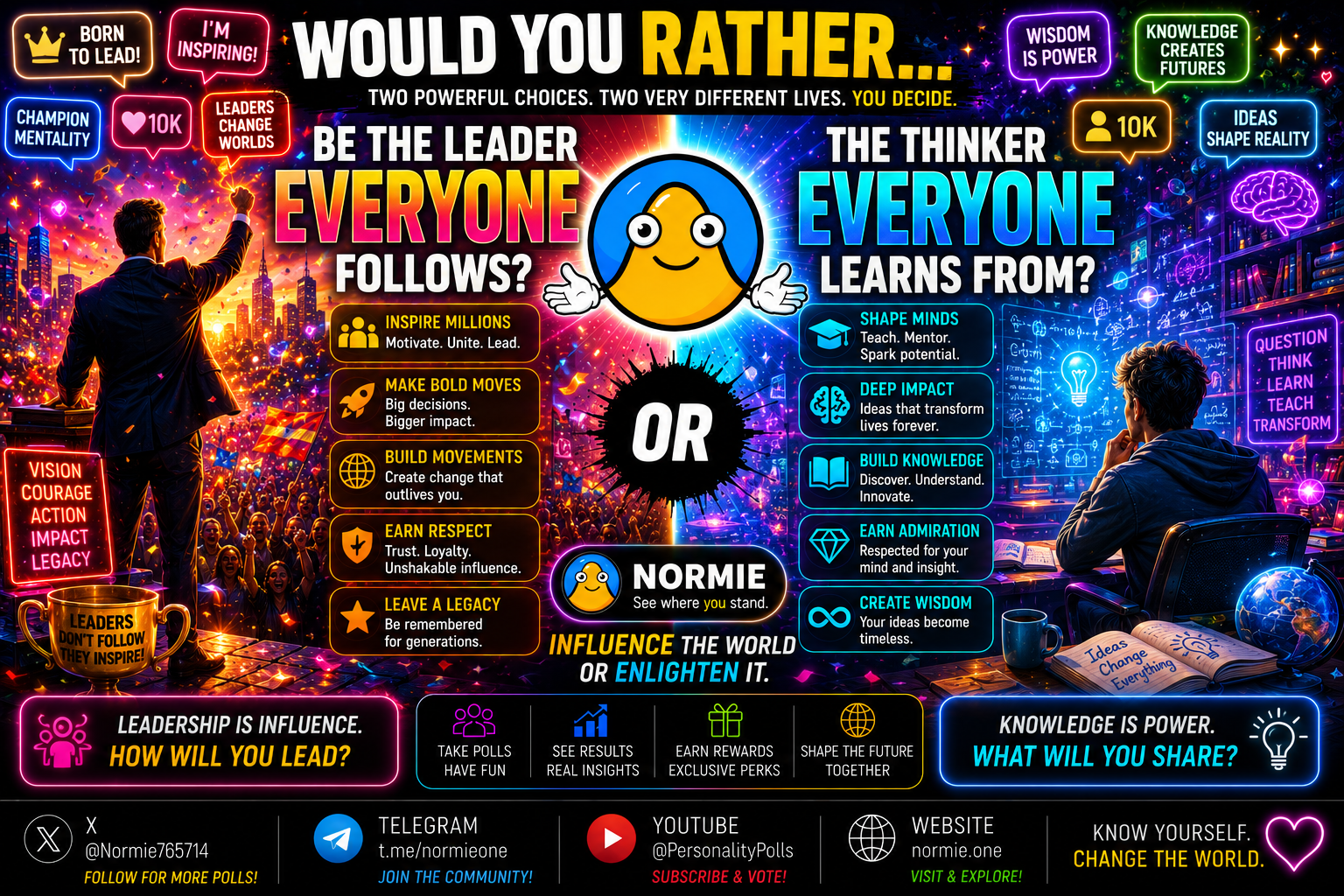
Would You Rather… Be the Leader Everyone Follows… OR the Thinker Everyone Learns From?
Some people command rooms.
Others change minds.
One leads movements through action, confidence, and influence.
The other shapes the future through ideas, wisdom, and understanding.
So the real question is:
Would you rather be the leader everyone follows…
or the thinker everyone learns from?
At first glance, the answer seems simple.
But this question reveals one of the deepest tensions in human history:
Is it more powerful to guide people… or to change the way they think?
The Power of the Leader
Leaders move people into action.
They inspire crowds.
Build companies.
Lead nations.
Organize revolutions.
Create momentum when others hesitate.
A great leader has presence.
When they speak, people listen.
When they act, others follow.
History remembers leaders because they shape visible events:
Kings and presidents
CEOs and founders
Generals and revolutionaries
Coaches and influencers
Leadership is often associated with:
Confidence
Charisma
Decisiveness
Influence
Communication
Courage under pressure
The world tends to reward visible leadership.
Leaders often gain:
Recognition
Power
Status
Wealth
Authority
Public admiration
In today’s social media era, leadership has become even more amplified.
Influencers build tribes.
Entrepreneurs build movements.
Creators build audiences that follow their every word.
But leadership comes with pressure.
Leaders carry responsibility for others.
Every decision affects people.
Every mistake becomes public.
And sometimes, leaders are simply repeating ideas created by someone else.
The Power of the Thinker
Thinkers shape the invisible foundations of society.
They ask difficult questions.
Challenge assumptions.
Create philosophies.
Invent technologies.
Discover truths others overlook.
Thinkers may not always lead crowds… but they often influence the leaders themselves.
People like:
Socrates
Einstein
Carl Jung
Nikola Tesla
Alan Turing
Leonardo da Vinci
These people changed civilization not through command… but through ideas.
The thinker values:
Understanding
Wisdom
Creativity
Curiosity
Observation
Depth
Thinkers often work quietly.
Sometimes society ignores them at first.
Sometimes their ideas seem strange or threatening.
But over time, their thinking reshapes the world.
Many of humanity’s greatest transformations began as ideas before they became movements.
A thinker may never stand on a stage…
yet their ideas can echo for centuries.
Leaders Control the Present. Thinkers Shape the Future.
This may be the core difference.
Leaders often dominate the current moment.
Thinkers often influence generations.
A leader can inspire millions temporarily.
A thinker can permanently alter how humanity understands reality.
The internet has blurred these roles.
Today, some people become both:
Elon Musk mixes engineering ideas with leadership.
Steve Jobs combined vision with execution.
Martin Luther King Jr. blended philosophy with public leadership.
Marcus Aurelius ruled an empire while reflecting like a philosopher.
The most influential humans often combine deep thinking with powerful communication.
The Psychology Behind the Choice
Your answer may reveal how you view power.
People who choose “leader” may value:
Influence
Visibility
Action
Achievement
Control
Social impact
People who choose “thinker” may value:
Knowledge
Truth
Wisdom
Creativity
Intellectual legacy
Depth
Extroverts may naturally gravitate toward leadership.
Introverts may resonate more with the thinker archetype.
But it’s not always that simple.
Some leaders are quiet.
Some thinkers become icons.
The Modern World Rewards Visibility
Today’s world heavily rewards leadership aesthetics.
Social media favors:
Confidence
Attention
Personal branding
Fast opinions
Public influence
Meanwhile, deep thinking often happens quietly and slowly.
This creates an interesting problem:
Many people want to appear intelligent…
but fewer people want to spend years deeply thinking.
Likewise, many want influence…
but not the responsibility leadership requires.
In many ways, modern culture creates performative leaders but fewer true thinkers.
Why Society Needs Both
Civilizations collapse without thinkers.
But ideas go nowhere without leaders.
Thinkers create the map.
Leaders move people across it.
One creates vision.
The other creates momentum.
Science needs philosophers.
Movements need organizers.
Technology needs inventors.
Communities need guidance.
Human progress has always depended on the relationship between ideas and action.
The most powerful societies are built when thinkers and leaders respect each other.
The Deeper Question
Maybe this question is really asking:
Would you rather influence people emotionally…
or intellectually?
Would you rather inspire action…
or inspire understanding?
Would you rather be remembered for what you built…
or for how you changed human thought?
There’s no universal answer.
Some people are born to lead.
Others are born to observe, analyze, and teach.
And sometimes the rarest individuals do both.
Final Thought
At the end of life, influence takes many forms.
Some people leave behind empires.
Others leave behind ideas.
Both can outlive generations.
So what would you choose?
Would You Rather…
be the leader everyone follows…
OR
the thinker everyone learns from?
Explore more psychology-driven questions and behavioral debates at Normie
Join the community:
X @Normie765714
Telegram
YouTube @PersonalityPolls