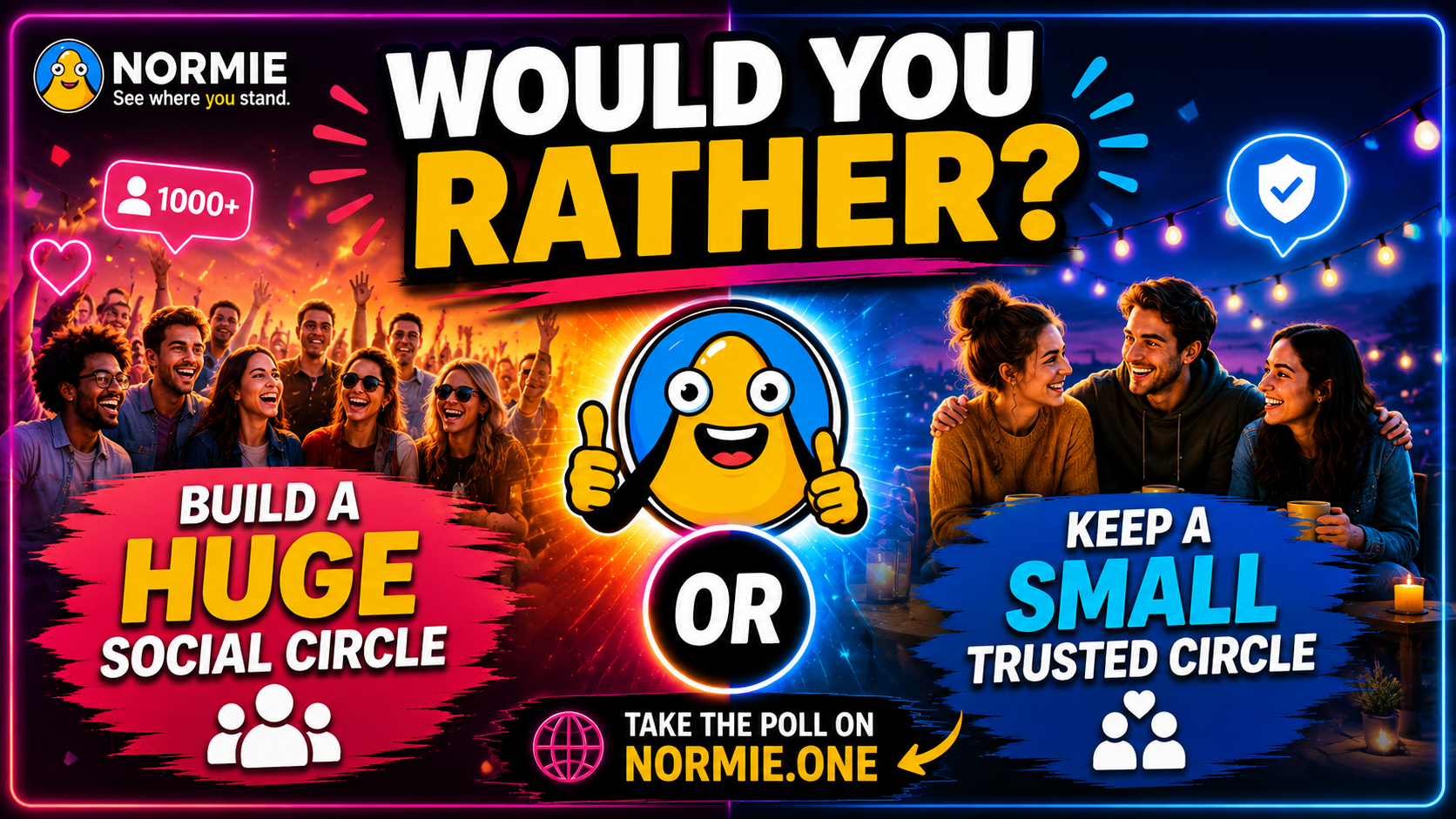
Would You Rather: A Huge Social Circle or a Small Trusted One?
This one gets asked at parties and answered like a personality test — because it basically is one. But underneath the casual phrasing is a real tradeoff that shapes how people build careers, survive crises, and experience loneliness. It's not a question about extroversion versus introversion. It's a question about what you want your relationships to do for you.

Two Different Resources
A huge social circle is a network. Its value is in breadth, reach, and optionality — the friend of a friend who gets you the job interview, the acquaintance who happens to know a great divorce lawyer, the group chat with forty people where someone always has an answer. Sociologists call these "weak ties," and despite the name, they're enormously powerful. Mark Granovetter's classic research found that people are more likely to hear about job opportunities through casual acquaintances than close friends — precisely because your close friends already know what you know, while acquaintances move in different circles and bring in new information.
A small trusted circle is infrastructure. Its value isn't reach, it's depth — the two or three people who will drop everything at 2 a.m., who know your worst year and didn't leave, who will tell you the truth about your relationship even when it costs them the comfort of the conversation. This is what psychologists sometimes call your "attachment network" — the people whose support actually buffers stress, rather than just witnessing it.
Both are real forms of wealth. They just compound differently.
The Case for the Huge Circle
People who choose breadth are usually optimizing for possibility. A large network means more exposure to new ideas, more paths to opportunity, more redundancy — if one connection goes quiet, twenty others remain. There's real evidence behind this instinct: diverse, loosely-connected social networks are associated with better access to information, career mobility, and even resilience at the community level, because information and resources flow along many different channels instead of a single fragile one.
There's also an emotional case, not just a strategic one. A wide circle offers variety — different people to be different versions of yourself with, less pressure on any single relationship to meet every need. Nobody has to be your best friend, therapist, business partner, and workout buddy simultaneously, because the load is distributed.
The risk, of course, is thinness. Breadth without depth can leave you surrounded and still lonely — a phenomenon researchers have connected to weak-tie-heavy social lives that lack a strong inner core. You can have five hundred contacts and nobody to call when things actually fall apart.
The Case for the Small Circle
People who choose depth are usually optimizing for reliability. A small trusted circle is built for the moments a big network quietly fails you: illness, grief, public failure, the kind of vulnerability that requires someone to already know your history in order to understand what's happening. Robin Dunbar's research on social bonding suggests humans can only maintain a small number of truly close, high-trust relationships at once — often cited around five — no matter how socially capable or well-connected we are. Depth has a hard ceiling. You cannot have fifty best friends; the intimacy itself requires scarcity.
There's also a quieter argument here about energy. Every relationship requires maintenance, and trust particularly requires repeated, costly maintenance — showing up, remembering, being vulnerable back. A small circle lets you invest that finite energy where it compounds most, rather than spreading it so thin that no relationship ever gets deep enough to bear real weight.
The risk is fragility. If your entire support system is three people, you're one falling-out, one move, one death away from a genuine crisis. Depth without breadth can also calcify into an echo chamber — the same few perspectives, reinforced endlessly, with no new information getting in.
The Overlooked Third Variable: What You're Actually Afraid Of
Like most "would you rather" questions, the instinctive answer says less about logistics and more about fear.
People who choose the big circle are often, underneath it, afraid of dependence — of needing someone so much that losing them would be catastrophic. Spreading yourself across many relationships is a hedge against that particular kind of loss.
People who choose the small circle are often afraid of superficiality — of a life full of people who technically know you but don't actually know you, of mattering to no one in particular even while being liked by many.
Neither fear is irrational. They're just pointed in opposite directions.
The Actual Research Verdict
If forced to pick a winner, most social science lands closer to depth — but not exclusively. Longitudinal studies on wellbeing, including the famous Harvard Study of Adult Development, consistently find that the quality of close relationships is one of the strongest predictors of long-term happiness and health, more than wealth, fame, or social reach. A handful of high-trust relationships tends to outperform a large low-trust network on almost every measure of life satisfaction.
But breadth isn't worthless — it's just optimized for different outcomes. Career mobility, exposure to opportunity, resilience against any single relationship's collapse: these favor a wider net. The healthiest answer, unsurprisingly, isn't really "one or the other." It's a small trusted core surrounded by a wide, loosely maintained periphery — depth where it counts, breadth for everything else. Most people who seem to have both aren't defying the tradeoff; they're just running two different systems for two different jobs.
The Better Question
So if you're asked this one, the interesting answer isn't which side you pick. It's noticing why — whether you're chasing possibility or protecting against isolation, and whether the circle you actually have matches the one you say you want.
Because most people don't choose their circle size deliberately. They just end up with whatever came from a decade of accidents, moves, and who happened to stay. The real version of this "would you rather" isn't hypothetical at all — it's a question about whether the social life you're currently living was ever actually chosen.
#friendship, #socialcircle, #trust, #relationships, #community, #loyalty, #networking, #personality