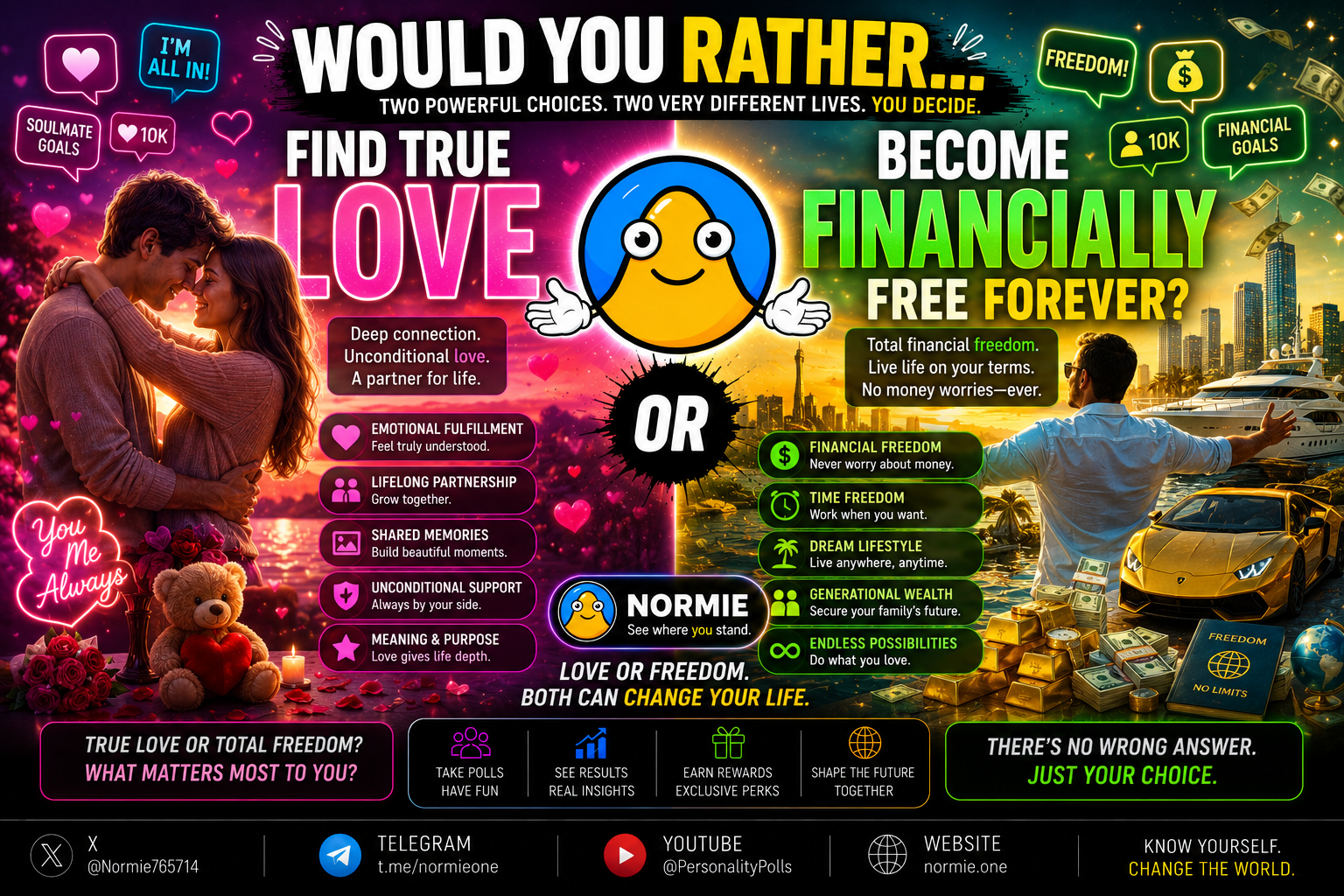
Would You Rather… Find True Love… OR Be Financially Free Forever?
Human beings spend most of their lives chasing two things:
Love…
and freedom.
One promises emotional fulfillment.
The other promises security, independence, and control over your future.
For some people, true love is the meaning of life itself.
For others, financial freedom represents ultimate peace.
And deep down, almost everyone wonders the same thing:
If you could only choose one…
Would you rather find true love…
OR
be financially free forever?
It’s a simple question that exposes some of the deepest truths about human psychology, happiness, relationships, fear, ambition, and modern society.
Because this debate is really asking:
What matters more — emotional connection or total freedom from financial stress?

The Dream of True Love
For centuries, stories, movies, songs, and entire cultures have revolved around love.
Humans are deeply social creatures.
We crave:
intimacy
connection
belonging
affection
understanding
emotional safety
True love represents more than romance.
It represents being fully seen by another person.
The idea that someone understands your flaws, accepts your imperfections, and chooses you anyway is one of the most powerful emotional experiences humans can have.
Many people believe love gives life meaning.
A loving relationship can provide:
emotional support
companionship
purpose
shared memories
family
emotional healing
motivation during difficult times
Even people who achieve enormous success often say relationships matter more than money in the long run.
Why Humans Prioritize Love
Psychology strongly supports the importance of connection.
Studies on happiness consistently show that meaningful relationships are one of the biggest predictors of long-term well-being.
People can survive without luxury.
But prolonged loneliness often damages:
mental health
physical health
emotional stability
self-worth
Humans evolved in tribes, families, and communities.
Connection isn’t just emotional.
It’s biological.
Love affects:
dopamine
oxytocin
serotonin
stress hormones
nervous system regulation
In many ways, love literally changes the human brain and body.
But Love Can Also Bring Pain
Here’s the difficult truth:
Love is unpredictable.
Relationships can bring:
heartbreak
betrayal
emotional dependency
jealousy
divorce
loss
disappointment
True love is not guaranteed to last forever.
People change.
Life changes.
Circumstances change.
Some people sacrifice careers, dreams, and financial security for relationships that eventually collapse.
Others spend years searching for love and never fully find it.
This uncertainty is what makes love beautiful… but also terrifying.
The Power of Financial Freedom
Now imagine something different.
No debt.
No financial stress.
No anxiety about bills.
No fear of losing your home.
No pressure to stay in toxic jobs.
Financial freedom represents control.
It means:
owning your time
reducing stress
increasing options
creating independence
escaping survival mode
For many people, money is not about luxury.
It’s about peace.
Financial freedom allows people to:
travel freely
pursue passions
help family
start businesses
retire early
focus on health
reduce anxiety
In modern society, money affects nearly every aspect of life.
This is why financial stress is one of the leading causes of:
anxiety
depression
relationship conflict
burnout
A financially free person may feel emotionally lighter simply because survival pressure disappears.
Money Changes Human Behavior
Financial freedom also changes psychology.
People with financial security often gain:
confidence
autonomy
flexibility
reduced stress
increased opportunity
Money creates access.
Access to healthcare.
Education.
Experiences.
Freedom of movement.
Freedom of choice.
In many ways, financial freedom gives people the ability to design their lives more intentionally.
That’s incredibly powerful.
But Money Cannot Fully Replace Connection
Here’s where the question becomes deeply human.
Money can solve many problems.
But it cannot automatically provide:
intimacy
trust
affection
emotional safety
genuine companionship
A person can live in a mansion and still feel profoundly lonely.
Some of the wealthiest individuals in the world still struggle with:
depression
isolation
broken relationships
emptiness
Because humans are emotional beings, not just economic ones.
Success without connection can eventually feel hollow.
The Modern World Complicates Everything
Today’s culture constantly sends mixed messages.
Social media glorifies:
luxury lifestyles
wealth
entrepreneurship
status
financial independence
At the same time, people still deeply desire love and emotional connection.
This creates tension.
Many people delay relationships chasing financial success.
Others sacrifice financial growth prioritizing relationships.
The challenge is that both money and love affect quality of life in massive ways.
The Psychology Behind the Choice
Your answer may reveal what you fear most.
People who choose true love may fear:
loneliness
emotional emptiness
isolation
lack of meaning
People who choose financial freedom may fear:
instability
dependence
survival stress
lack of control
This question also reflects personal history.
Someone who grew up emotionally neglected may prioritize love.
Someone who grew up financially insecure may prioritize money.
The answer often comes from what people felt deprived of most.
Can Love and Money Coexist?
The healthiest lives usually involve both emotional connection and financial stability.
The problem is that life often forces trade-offs.
Building wealth can consume time and energy.
Relationships require attention, vulnerability, and sacrifice.
Some people become financially successful but emotionally disconnected.
Others build beautiful relationships while constantly struggling financially.
Balance is difficult.
But perhaps the real goal is not choosing one over the other.
Perhaps the goal is creating a life where:
love feels secure
and freedom feels possible
The Deeper Question
Maybe this debate is really asking something even bigger:
What creates fulfillment?
Is fulfillment emotional?
Financial?
Relational?
Psychological?
Humans are complex.
Some people would gladly give up wealth for one extraordinary relationship.
Others would sacrifice romance for permanent freedom and peace of mind.
Neither answer is universally correct.
Because happiness itself is deeply personal.
Final Thought
At the end of life, most people remember:
the people they loved
the moments they shared
the experiences they lived
But financial stress can also quietly destroy years of peace, opportunity, and mental health.
That’s what makes this question so difficult.
Would You Rather…
find true love…
OR
be financially free forever?
Because one may fill your heart…
And the other may free your entire life.
Explore more psychology-driven questions and behavioral debates at Normie